
X the Unknown
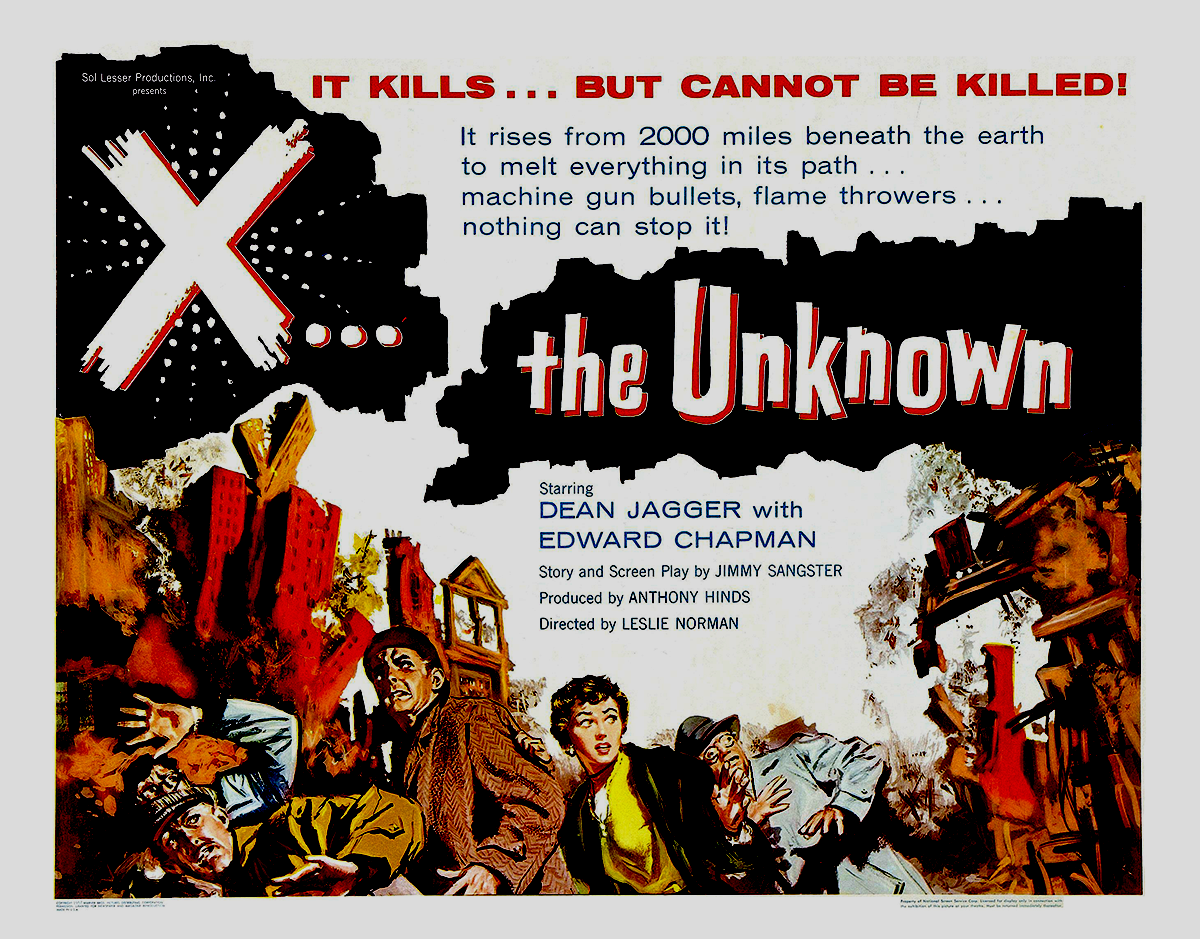
Energy-absorbing creatures from beneath the Earth create fissures to reach the surface and destroy humankind. 1 HR 20 MINS 1956 Warner Bros.
HORROR/SCIENCE FICTION
written by Gary Svehla
2/24/202610 min read
Story
A soldier passes his Geiger counter over a mud hole in desolate terrain. After walking the area, his Geiger counter registers activity. He digs up a canister near the most radioactive spot. Joining the other troops, Lieutenant Bannerman (Peter Hammond) explains that this is a test of the Geiger counter and that it may one day save your life.
A Jeep pulls up, and Major Cartwright (John Harvey) asks Bannerman why he hasn’t moved his men out yet. Bannerman explains that they have just found high levels of radioactivity in this area. Bannerman asks a soldier to mark the area with an axe stick. Almost immediately, water bubbles up from the ground. The earth seems to pull apart as a hole forms. Then, unexpectedly, a thunder-like sound fills the air, though no storm materializes. Fissures form in the earth, grow, and finally belch fire, exploding and knocking people over.
Dr. Adam Royston (Dean Jagger) sequesters himself in his workshop. A messenger arrives to announce that the director, John Elliott (Edward Chapman), wants to see him immediately. Elliott chastises Royston for working on private projects instead of the ones he should be working on. Then he says the military has detected radiation and wants Adam to take a look.
Royston arrives at the scene of the earth fissures. He checks the area with a Geiger counter and finds no radioactivity. He asks whether the men had made a mistake. Then he sees Bannerman helping transport a soldier with radiation burns. The soldier soon dies. Another soldier, farther from the explosion, shows burns on his back. Royston wants Bannerman to send some equipment from his laboratory here.
Two boys hide in the night, scared but resigned to finding out whether Old Tom (Norman MacOwan) sleeps in the woods. They swore to uncover the truth. One boy says he’ll wait while Willie Harding (Michael Brook) goes ahead to explore the woods. Willie’s eyes bulge as he sees something terrifying amid a radioactive buzz. As the buzzing grows louder, Willie tries to flee. The boy runs silently past the first boy. The other boy, Ian Osgood (Frazer Hines), starts running, trying to keep up.
Ian reluctantly tells Adam where they were in the marshes. He finds a cabin in the woods with a homemade still for making illegal alcohol. An old man, Tom, weakly rises from his bed, coughing. Smiling, he drinks a bit of the concoction. Royston finds a canister from his workshop on the man’s shelf. Royston says the canister that registered deadly radiation yesterday is completely benign today. Royston tells Elliott that something sucked the energy right out of the canister.
Later, Inspector McGill of the United Kingdom Atomic Energy Commission’s Security Division is ordered to begin an investigation. Back at the hospital, Willie dies, and his parents grieve. The boy’s father confronts Royston, calling him a scientist and a murderer, not a doctor who heals the sick. The boy’s parents solemnly leave the hospital.
A doctor leaves the hospital’s radiation room to call a nurse for a romantic tryst. She arrives, and they begin to kiss as the sound of radioactivity intensifies in the next room. While investigating, the radiation mutates the doctor, melting him. The nurse screams at what she witnesses. The hospital’s radium has apparently been stolen from the site of the blown-out safe where it was stored. Royston concludes that something apparently passed through a metal grill. The same “force” entered Royston’s lab by crawling under the door. “Obviously, this thing can take any shape it needs to,” Adam says.
Two men at the scene of the earth fissures see a strange glow alongside the disturbed earth. One of the men reluctantly takes a look. Haggis (Ian McNaughton) cries out to Spider (Anthony Newley), but Haggis starts screaming. Spider calls out to Haggis but receives no answer. Spider finds Haggis’ rifle covered in a strange residue. Radioactivity sounds as Spider starts shooting in fear as something approaches, and the soldier screams.
Back in his workshop, Royston explains his theory of what’s happening: “Hundreds of millions of years ago, the Earth was like the sun, with no form or solidity. It was just a blazing mass of energy, and then the Earth started cooling. As it cooled, an outer crust formed. The energy was still there, but it was being compressed beneath this crust. As time went by, the crust grew deeper, and the compression became greater as this vast energy was squeezed into an ever-decreasing space … Their world is being compressed out of existence.” So Royston has sensed that these energy creatures have returned to the surface to survive. And, needing sustenance, these creatures, being almost pure energy, live on energy, radiation.
Peter Elliott (William Lucas) volunteers to be lowered down the crevice. He is slowly lowered by a crank device. Peter scans the area with a light as he descends. Suddenly, the men operating the crank lose control, lowering Peter rapidly, though unharmed. While waiting, a splatter of mud lands on his hand. He shines his flashlight on the spot and sees a melted soldier. Peter orders the men to keep lowering when the radiation sounds. His face registers absolute terror as he orders the men to get him out fast. Cartwright appears and says his orders are to kill that thing down there and cement the crevice.
The soldiers use flamethrowers that night to burn the fissure. Roaring fires erupt from the crevice. Explosives detonate from below. The fissure is then sealed. In his workshop, Royston shows McGill some radiated mud … how do you kill mud? Royston explains that Cartwright failed to eradicate these energy creatures. But Adam is experimenting with a device that will neutralize them by disintegrating their radiation. Back at the crevice, the cement cracks, and a radioactive mud/blob creature emerges.
Peter Elliott receives a phone call from McGill reporting that the creature has escaped, killing four people in a car. The creature seems to detect radiation, heads toward it, then returns to the fissure. Royston concludes the creature is headed here. “It’s on its way for the biggest meal of its life,” Royston tells Elliott. He orders all the cobalt removed from the facility immediately. The guard at the entrance hears his phone ring, but before answering, he hears the loud buzz of radiation. Investigating, he becomes another victim, soon melting away. Peter climbs a ladder and sees a blob moving through the facility. Then the blob oozes over the roof of a storage building.
When a minister huddles his flock inside the church, a child is left outside. She wanders toward a wall where the blob breaks through. The minister and the girl’s mother exit the church, and the minister grabs her. As the blob grows, it must be stopped at the fissure, or it will reach Inverness. Royston tries the neutralizing machine in his workshop, but though he’s getting closer to a solution, he hasn’t perfected the gizmo. No time remains, and the government men say he has to use it.
Back at the crevice, Major Cartwright and his soldiers await Royston's arrival. Royston asks about his Jeep, the vehicle meant to lure the creature with radiation, but Adam warns the driver not to approach within 15 feet. The neutralizing machines pull up toward the fissure. A cobalt canister is carefully placed in the Jeep's rear. The two neutralizers sync as Royston orders the Jeep to proceed toward the crevice. Peter takes over for the ill driver and backs the Jeep toward the hole. The creature does not appear, so he backs up closer, dangerously close. Then Peter hears a sizzling sound, and the pit begins to glow. The radioactive canister also starts glowing. As Peter tries to drive forward, his wheels get stuck in the mud. As the creature emerges from the crevice, Peter remains trapped. Peter finally frees the Jeep and drives out of danger.
With the blob partially emerged, the two neutralizing machines turn on, and the blob begins to glow. After glowing, the creature explodes into a heap of fire and smoke. The creature vanishes completely as Royston says the machine worked. As the men slowly approach the fissure, an explosion erupts from beneath the earth. As the higher-ups congratulate Adam, he glumly mutters that the last explosion should never have happened, then walks toward the crevice to investigate.
Critique
Hammer Film Productions made science fiction films before their Gothic color films. Their two biggest successes, which garnered distribution in the States, were the two Quatermass films, The Quatermass Xperiment and Quatermass II. After the very successful first Quatermass movie in 1955, they were excited to film a sequel while the iron was still hot. So they hired Jimmy Sangster to write X the Unknown using the character of Professor Quatermass, created by Nigel Kneale. Kneale immediately poo-pooed the idea because the Quatermass character was not written by him for the movie. Thus, Hammer changed the professor's name from Bernard Quatermass to Adam Royston to avoid any potential conflicts. [IMDb]
Joseph Losey was brought in as director after being blacklisted in Hollywood and was creatively exiled to Europe. Before shooting began, star Dean Jagger refused to work with the director because he felt Losey was a Communist sympathizer. So Hammer, to appease their American star, let Losey go, and Lesley Norman was hired for the film. Apparently, he proved difficult on the set and really wasn’t interested in doing the movie, so Hammer never used him again. It makes one wonder whether the wrong man was fired, since Losey soon became a director of renown and would have made X the Unknown something special instead of boilerplate. [IMDb]
Eventually, Hammer made up with Nigel Kneale and hired him to write a true sequel, Quatermass II. So X the Unknown was the bastard child of the highly praised Quatermass series. Without the input of Kneale, Royston lacked the aloofness and quirkiness of Quatermass and was simply too cuddly. Also, without the participation of director Val Guest (who directed the two Quatermass films), a disinterested Lesley Norman could not compete with Guest's highly creative, seemingly inspired work in the two Quatermass films.
But despite this controversy, X the Unknown is a creepy “B” movie. While not quite up to Nigel Kneale’s standards, it does manage to scare the yell out of you and entertain. All three movies are highly rated in my estimation.
X the Unknown benefits from two components: it is dreary, as though the entire movie were filmed at night, and suspense is effectively generated by the way the monster is not shown. Whenever I think of this movie, I always remember its darkly shot night scenes, which offer so much dread, such as the blob lurking around the government facility, the descent into the fissure, the boys in the wooded area, the Geiger counter training exercise at the beginning (not filmed at night but incredibly eerie), the four people killed in the car, seeing the blob rolling around and threatening people in the Scottish village, the doctor and nurse having a fling in the radiation room of the hospital, and the burning and bombing of the crevice area. As I mentioned, even daylight sequences appear dreary or dark.
And the reason most 1950s monsters are not shown until near the end is budget limitations. But here, suspense and horror are delicately crafted. We have the opening of the fissure amid thunder in the very first sequence, we have Royston examining the fissure and not finding radiation, we have the youthful Willie confront the monster in the woods, we have the attempted sexual encounter between the doctor and nurse resulting in the doctor melting away, we witness the screaming deaths of Haggis and Spider, we have Peter Elliott’s descent down the crevice, and finally the creature emerges after the crevice is cemented over. We see the fear registered on victim’s faces, see their deaths, but never witness the horror before them. When the blob is first seen, we have already been nicely building up to its revelation.
The special effects are very crude by today's standards, but they were quite decent in their time. In the first Quatermass, the monster was only seen in the final minutes, and in Quatermass II, the giant blobs were seen at the end of the film, but for a longer stretch, perhaps 10 minutes or so. But here in X the Unknown, the blob monster is seen in several sequences during the final half hour. X the Unknown may not be the best film out of the three, but it has the most monster action. And for juvenile fans of the 1950s, that is essential.
Dean Jagger was an odd choice for Adam Royston, since two years earlier he had been a major supporting actor in the mega-hit White Christmas, playing the retired general whose regimen would “follow the old man wherever he would go.” And he was such a sad figure who tore your heart out. But here he is, searching for and destroying monsters. People were too aware of his sympathetic character in that earlier movie, which probably made it difficult for them to see him as a quirky scientist.
And the movie ends on an odd note. When Royston is being congratulated for saving the day, another explosion occurs, one that is unplanned and unexplained. Instead of ending on a triumphant note, we end on a note of concern that something unexpected is happening and that the horror might not be ending. Perhaps the film is awkwardly planning a sequel that never was made. But it destroys the satisfying ending for its current audience. It feels as though it were ending before the conflict is totally resolved.
But, as presented, X the Unknown is a terrific programmer that paved the way for better things at Hammer. It might be aborted, Quatermass lite, but it features a dark mood, effective special effects (blobs would be the in-thing for horror movies in the second half of the 1950s), and makeup (the various melting men are effectively gruesome because they are shown in small snatches, making them seem much more ghastly). Hammer, even in its primitive days, was superior to the competition. While American “B” horror was mostly delivered either over-the-top or tongue-in-cheek, British cinema did more with less, delivered quite solemnly. And X the Unknown was one of the better ones of the era.
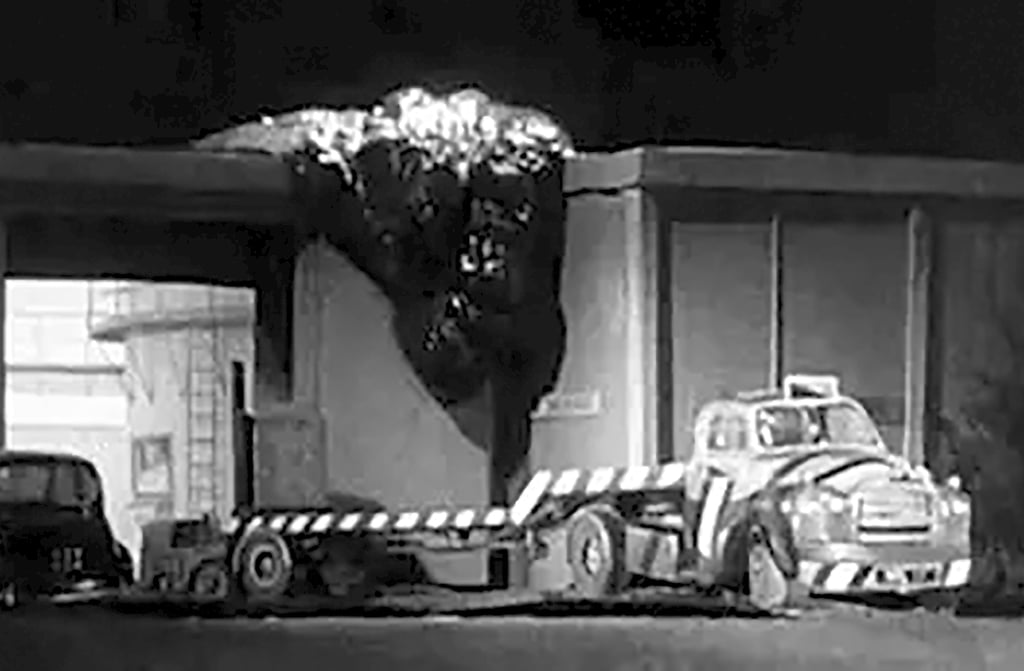
THE BLOB ENERGY FORCE SLITHERS OVER A STORAGE BUILDING.
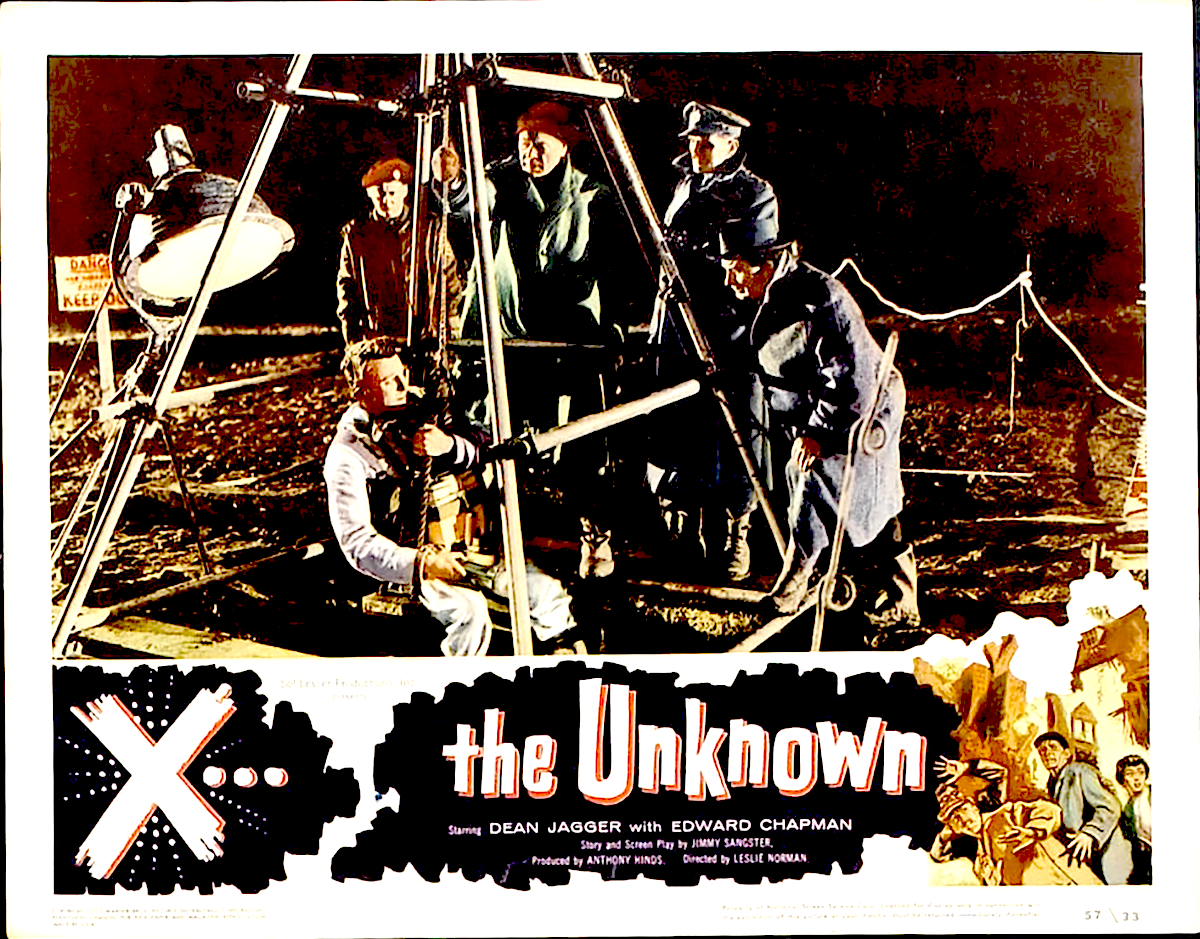
PETER ELLIOTT (WILLIAM LUCAS) PREPARES TO DESCEND THE MYSTERIOUS CREVICE TO LEARN ITS SECRETS.
garysvehla509@gmail.com