
The Woman in the Window
A college professor tries to outsmart the police when he commits murder, but he is outsmarted by clues he left behind. Blackmail complicates the situation.. 1 HR 40 MINS 1944 RKO
FILM NOIR/DARK CINEMA
written by Gary Svehla
2/17/202610 min read
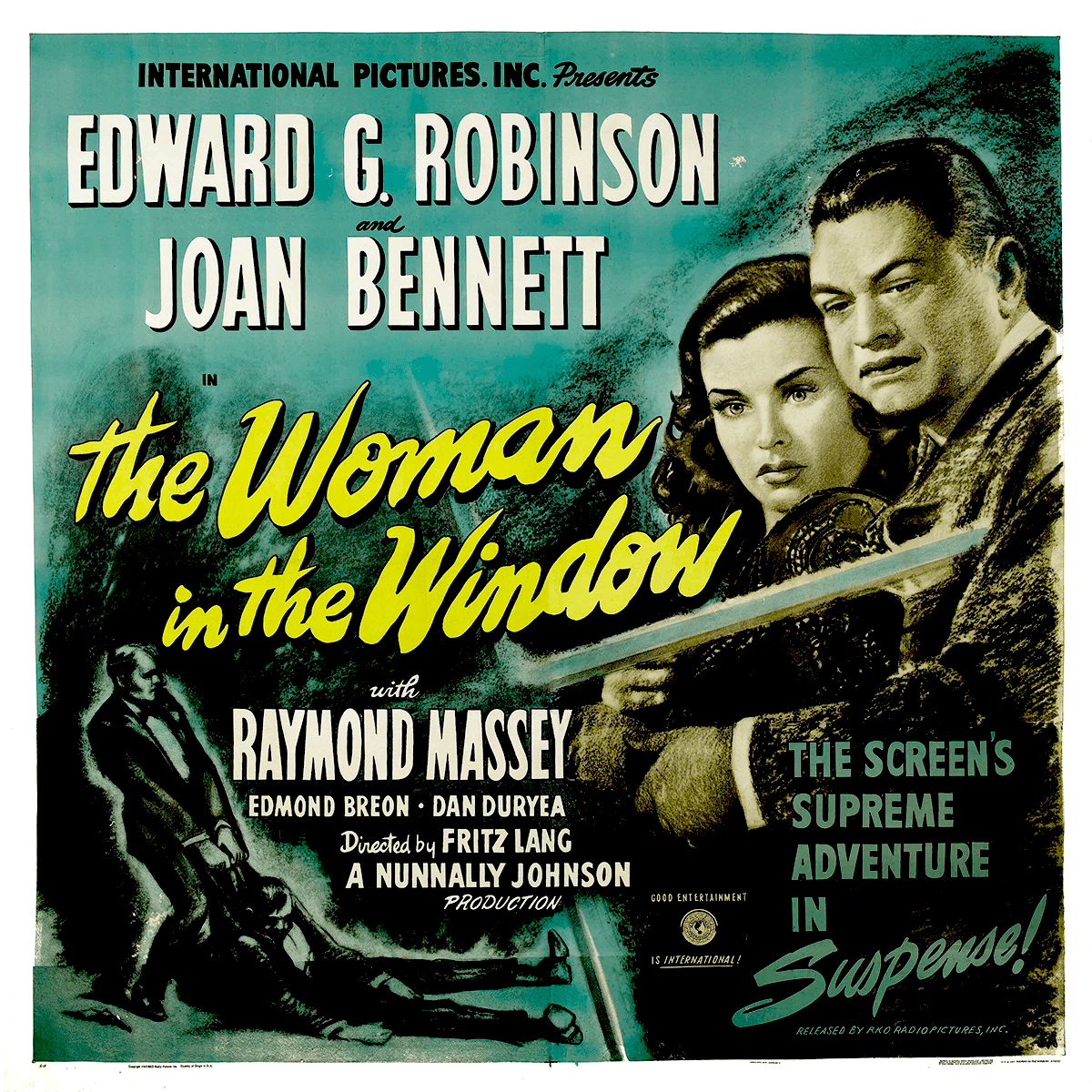
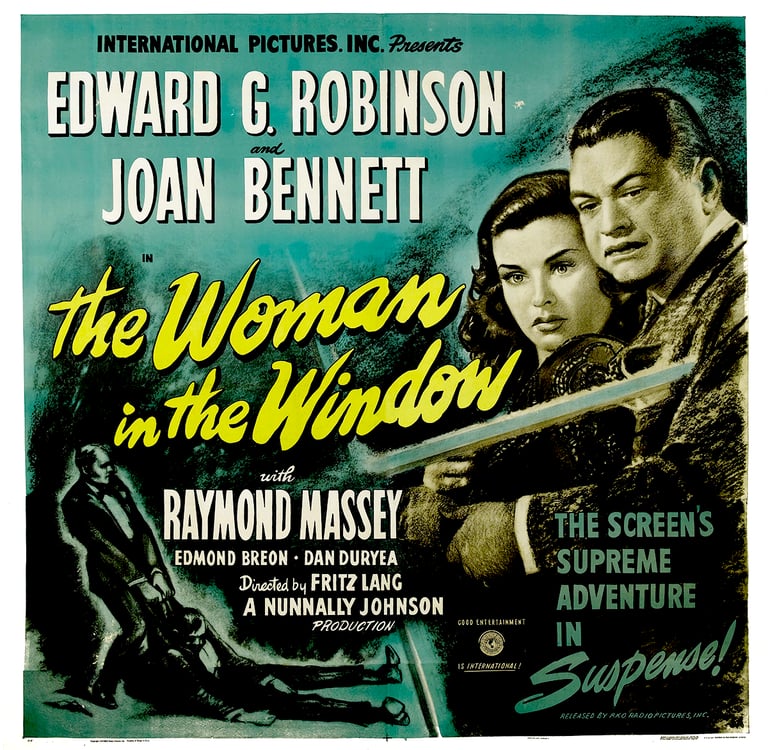
Story
Gotham College, 10 a.m. Richard Wanley (Edward G. Robinson), Assistant Professor, is lecturing on “Some Psychological Aspects of Homicide.” After the lecture, his wife (Dorothy Peterson) makes sure he has activities planned as she and the kids are leaving on a trip. He’s having dinner and drinks with two male friends that night.
Richard stops to look at a painting in a gallery while walking the streets of New York City. His dinner friends see Wanley observing a painting of a woman, as if he were a teenager with a crush. Wanley greets them: Frank Lalor (Raymond Massey), a district attorney, and Dr. Michael Barkstane (Edmund Breon), a physician, as they are about to enter the Heritage Club. The men tease Wanley about going to a burlesque show since the wife’s away. Richard reminds them they are old crocks and that such activity is not for them. But Wanley hates the stodginess he’s beginning to feel. The others leave after socializing, while Wanley remains. Picking out reading material from the bookshelf, he is served another drink and asks the waiter to remind him when it’s 10:30.
Wanley is reminded of the time and leaves, passing the shop with the alluring painting. As he lingers and smiles, another reflection appears, the woman herself from the painting. When she’s lonely, she comes to the gallery to observe people’s faces. Richard is embarrassed by his reaction. The woman, Alice Reed (Joan Bennett), says she is alone and unmarried, and asks him to accompany her for one drink. At an upscale bar, she asks whether he wants to see more of the artist’s work, then invites Wanley back to her apartment. Wanley hesitates, and Alice says, “You mean you’re afraid of me?” Richard finally gives in, and the couple takes a cab to her apartment. Alice shows him a large portfolio of the artist’s sketches and serves drinks.
A man in a straw hat barges in, slaps Alice, apparently for having another man in the apartment. Then the man punches Wanley, pushing and manhandling him until he finally chokes him. Alice hands him a pair of scissors, and he stabs the man Alice calls Frank several times in the back. He crumbles to the floor, dead, and Alice asks what we are to do.
Wanley returns to Alice and asks whether anyone saw them in public, since they never went out together. Alice says she never mentioned his name to anyone. He wonders whether anyone saw him come in here tonight. Richard thinks out loud, and Alice says he wouldn’t get out of the cab if anyone were around. Alice is hysterical, while Wanley is deadly calm. Wanley concludes, “If nobody knows about you and if nobody saw him come in here tonight, how could either of us be connected if his body were found miles away from here?”
Richard returns shortly with his car. Alice has removed all personal items from the dead body that might identify him, including an article bearing the initials C.M., not “F” for Frank. Richard says to clean thoroughly so no evidence remains. Once the coast appears clear, Wanley moves the body to the car. As Alice checks outside one more time, thunder crackles. Richard returns to tell Alice that we mustn’t ever see one another again.
Professor Wanley drives far into the woods, encountering minor problems at every turn. Finally, he reaches a desolate rural area. He pulls the body from the rear seat, carries the corpse into the woods, drops it, and cuts his hand on barbed wire. In the back seat, he sees he has forgotten the dead man’s straw hat, but hears another car’s horn approaching, panics, and drives off. The vehicle leaves tire tracks in the mud.
Richard and Michael are leaving the Club when Frank appears with important news. It seems that financier Claude Mazard (Arthur Loft) has disappeared, a most important man and the one Wanley killed. In his office, Wanley burns the murdered man’s straw hat in the fireplace. The radio interrupts with news of Claude Mazard’s disappearance, which leaves Wanley worried. Next, a newspaper headline reveals that Mazard was murdered and that a Boy Scout discovered his body.
Frank believes the case is solvable, finding the tire tracks and the man’s footprint: heavy entering the woods and lighter leaving. From the well-worn shoes, they can calculate the murderer’s weight and height, his length of stride, and any particularity in his gait. Frank reveals they have his blood to study, since some was found on a barbed-wire fence.
Wanley appears tired and distracted, so Michael writes a prescription for pills, but the doctor says only 2 a day. More could stop his heart. Frank enters, saying Mazard had a girlfriend and that another man was already in the apartment. They fought, and Mazard was killed with a pair of scissors. Then his body was apparently moved to the country.
Frank takes Wanley to the rural area where the corpse was found. The police bring Alice, Mazard’s girlfriend, over, and panic appears on Richard’s face. He feigns illness to avoid Alice by sitting in the car, sweating. Richard watches as she is being questioned. Frank soon returns to the car, and they depart.
Alice calls Richard after reading about his promotion to full professor in the newspaper. She feels safe and believes she’ll never be connected to the crime. But the buzzer rings, and Masard’s bodyguard wants to come up to discuss the situation. Alice feels fear just when she thought she was safe.
The man, wearing a straw hat, says he will either be allowed in or go to the police. She finally relents. The man, Heidt (Dan Duryea), says he heard on the radio that there’s a
$10,000 reward for any information leading to Mazard’s killer. Heidt says he’s been tailing him to your place for several months. Alice admits he came here several times, but not by that name, and she never knew much about him. Heidt finds a few strands of his hair embedded in the sofa. He searches the apartment for more evidence. He finds the pair of scissors, the murder weapon, and something with the initials R.W. engraved. He also finds the newspaper about Richard Wanley receiving a promotion. Instead of collecting the $10,000, he wants $5,000 from her to keep quiet. She will think it over, but he insists it must be cash. He’ll be back tomorrow night at 8:30 for the money.
When Heidt leaves, Alice runs to the phone to call Wanley, and they meet. Alice tells the professor she’ll sell some items to help pay the ransom, but Richard says the $5,000 will be only the first installment. Wanley says there are three ways to deal with a blackmailer: “You can pay him, pay him, and pay him, until you are penniless, or you can call the police yourself and let your secret be known to the world, or you can kill him.”
Wanley immediately goes to a pharmacist and has his prescription filled in powder form. Meeting Alice at her office elevator, he slips her $5,000 in cash. He tells Alice the medicine is also in there, and there’s a note telling her how much to administer. Richard tells her the medication takes about 20 minutes to work.
About 10 o’clock that night, Heidt arrives. Alice says she has only $2,900 and needs more time to get the rest. He demands the smaller amount immediately, then settles in for a drink: two Scotches and sodas. One glass contains the powder. When they sit to enjoy their drinks, Heidt hesitates before taking a sip. The slick Heidt offers to get Alice out of this whole mess by going away with him. Smiling, he reminds her that he is the only person who knows she knew Mazard. In a few minutes, Heidt is talking about the joy of South America. Heidt reminds her that when you’re in a jam, you have to look out for yourself. He wants her to leave with him tonight, but she has to contact a few people… she says make it tomorrow morning.
Alice offers him the drink sitting on the table. When she gets more ice and returns, Heidt tells her to drink from his glass and says he’ll take hers. He orders her to drink it, then knocks the glass out of her hand when she doesn’t. He suspects her of tampering with the drink. But he soon demands the rest of the money and finds it hidden on a bookshelf. Because of the deception Alice attempted, Heidt demands another five grand for tomorrow night. When Heidt leaves, Alice phones the professor to tell him what happened. Looking to Richard for answers, he simply says he’s too tired to think tonight. He goes into his bathroom and downs the rest of the powdered medicine, mixing it with water.
Alice hears gunshots as the police fire at an unseen criminal. The police shot the man to death, saying they saw him in the neighborhood last night and followed him. As the police walk down the stairwell, they reveal that the man just killed is Heidt. By now, crowds have gathered as the police pull the cash from his pocket. Alice is now among the crowd that sees Heidt dead. She runs to her apartment to telephone the professor with the good news. The phone keeps ringing as the professor lies unconscious in a chair next to it. He’s groggy and half-conscious, hears the phone but simply stares ahead. He finally collapses, returning to an unconscious state.
An arm extends, shaking him as the clock strikes. Wanley awakens dazed. The waiter/attendant tells him it’s now 10:30. Half-coherent, he says he was asleep. As he gathers himself and finishes his drink, he rises to leave the Heritage Club. The cloakroom is supervised by a man who looks like Mazard, who fetches the professor’s hat. As he exits, a man who looks just like Heidt, dressed in uniform, asks Wanley if he needs a taxi. As Richard once again passes the gallery, he stops to ogle the woman’s painting. A floozy asks Wanley for a light, and he backs away. He rushes down the street, breaks into a run, and shouts, “Not for a million dollars,” as the woman shrugs and walks on, the camera focusing on the painting.
Critique
Director Fritz Lang filmed RKO’s The Picture in the Window with Edward G. Robinson, Joan Bennett, and Dan Duryea in 1944, and repeated the cast with the superior Scarlet Street in 1946. Of course, both films were film noirs. Even though both films have similarities, each film is significantly different from the other.
For instance, Edward G. Robinson’s character in The Woman in the Window, Professor Wanley, is a calm thinker who is asked by Joan Bennett’s character, Alice, to find a way to get them both out of trouble. The lead female places her trust in Wanley. In Scarlet Street, Robinson’s character is weak and easily manipulated by his mad love for the Bennett character. He will believe anything she tells him. Dan Duryea’s character in Scarlet Street encourages the Bennett character to date and even become intimate with him in order to control him. In The Woman in the Window, the Duryea character is simply a blackmailer who wants to squeeze money out of them.
Irony plays a major part in The Woman in the Window, a key component of film noir. Wanley, a rising college professor, thinks he outsmarts the common police. He has the murder scene stripped of all evidence, the body removed far into a secluded area, the neighborhood scanned, making sure no one saw Alice and Mazard together, and that no one saw him arrive at the apartment. He has the body stripped of all personal artifacts that could identify him. Wanley proudly thinks no one could tie Alice or him to the crime. But he never considers that anyone could be following Mazard for weeks, he never considers the tire tracks left at the murder scene could reveal so much information, or that his shoe imprints left at the scene could tell the police so much. He never believes his cut hand and the blood it left could again reveal so much information. For a man who feels he outsmarted the authorities, he left so much evidence for them to find.
Another piece of irony occurs when Heidt outsmarts the plan to poison him by overdosing Wanley with medication. When Alice gives Wanley the news, his exhaustion leads him to attempt suicide with the same overdose. But unknown to him, the police have hunted and killed Heidt, and Alice runs to telephone him the news. It is too late, as Wanley has already drifted into unconsciousness and slowly passes away, unaware that his nemesis is dead and that suicide is unnecessary.
But the biggest controversy in the movie is the ending … Professor Wanley, whom we suspect has died of a medical overdose, is gently roused from his sleep by an employee of The Heritage Club who reminds him it’s now 10:30. The entire movie has been a dream populated by real people he knows, the hat check man and the valet. People he does not recognize in his elaborate dream, yet people he knows, nonetheless. The “It’s all a dream” gimmick is just that, a cheat and a gimmick, but I must admit it is used quite surprisingly and creatively here. Perhaps test audiences did not want Wanley to die, but he did murder Mazard in self-defense, as he was being pummeled and choked. He tried to hide the crime and his involvement in it deceptively.
But the suspense generated by his friend Fred being a D.A., speaking to one another, and seeing Wanley’s reaction is quite clever. Plus, director Fritz Lang added all the little details, such as the scene where Wanley almost ran a red light while a motorcycle watched. Then a car approaches from behind, and Richard discovers Mazard’s hat in his back seat, which is suspenseful. Whenever Lang created a suspense sequence, he added a twist that revealed something unexpected, further heightening the suspense. In other words, when Wanley was pressured by the situation at hand, something unexpected happened that further heightened it.
The situation of someone killing another person in a film is quite common, but Fritz Lang handles it in a novel way. Lang turns a typical crime drama into something unexpected, making the mundane feel special. The Wizard of Oz dream revealed at the end might not be everyone’s cup of tea, but it is novel. The Woman in the Window is a fun ride not to be taken entirely seriously. It is a film that consistently surprises and rewards its audience far more than expected. It is a film noir delivered with a smirk.
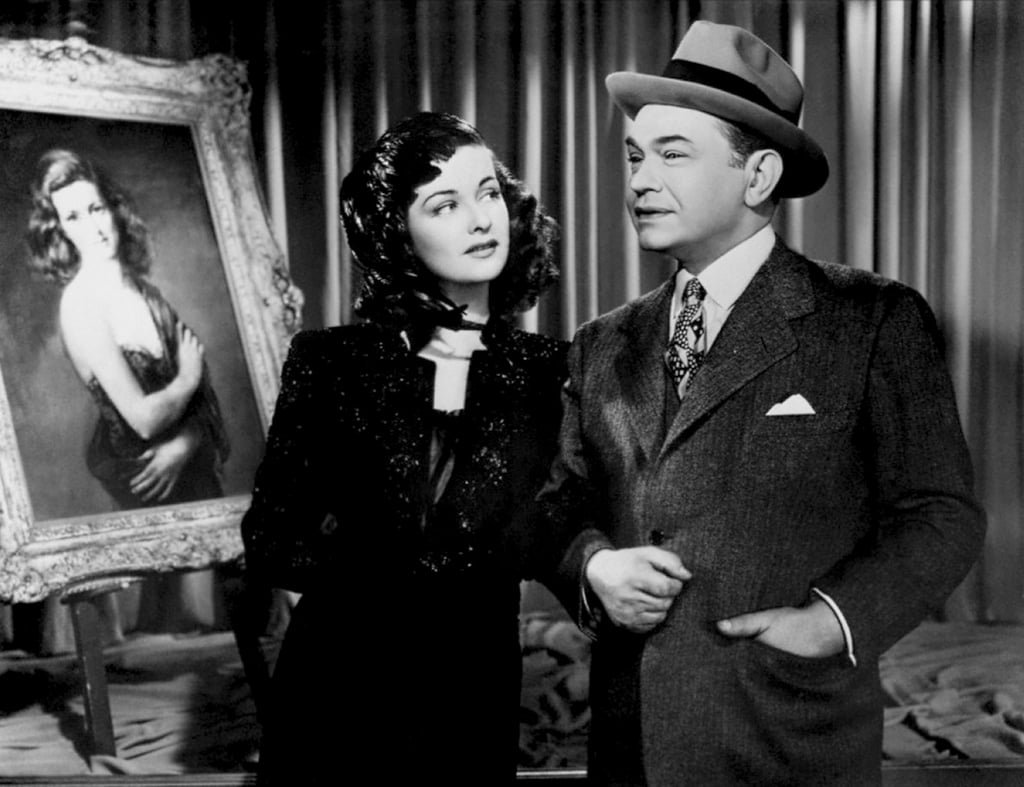
PROFESSOR WANLEY (EDWARD G. ROBINSON) MEETS ALICE (JOAN BENNETT), WITH THE PAINTING BEHIND THEM.
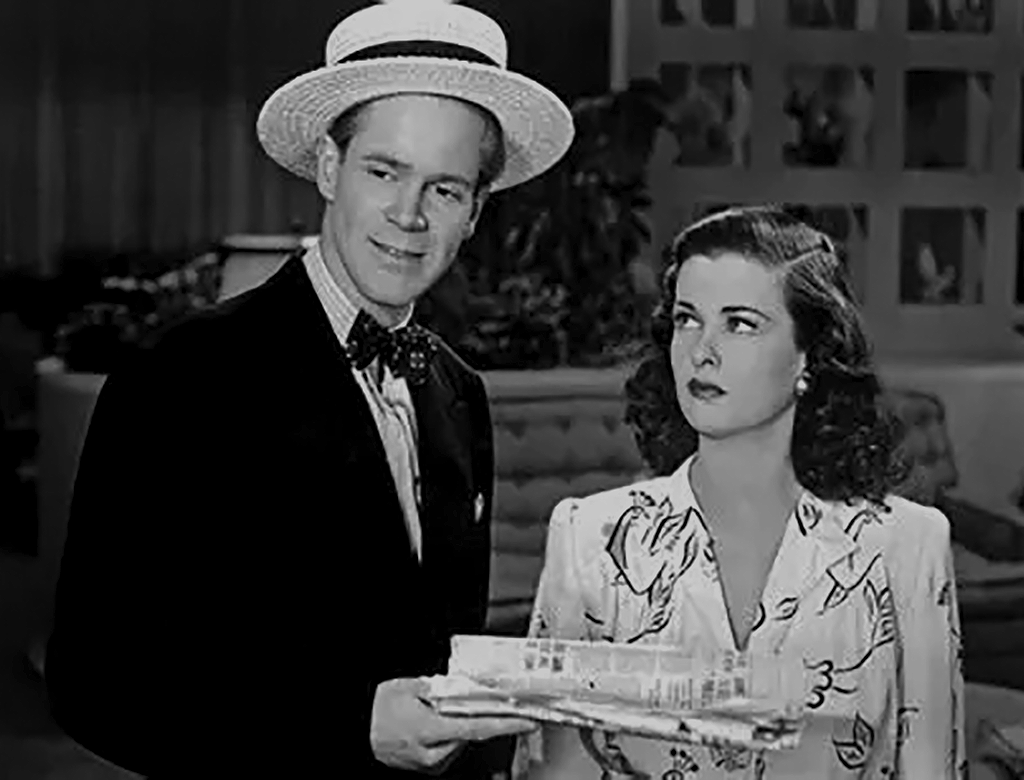
MAZARD'S BODYGUARD HEIDT (DAN DURYEA) BLACKMAILS ALICE FOR HIM TRO KEEP HIS MOUTH SHUT.
garysvehla509@gmail.com