
The Monolith Monsters
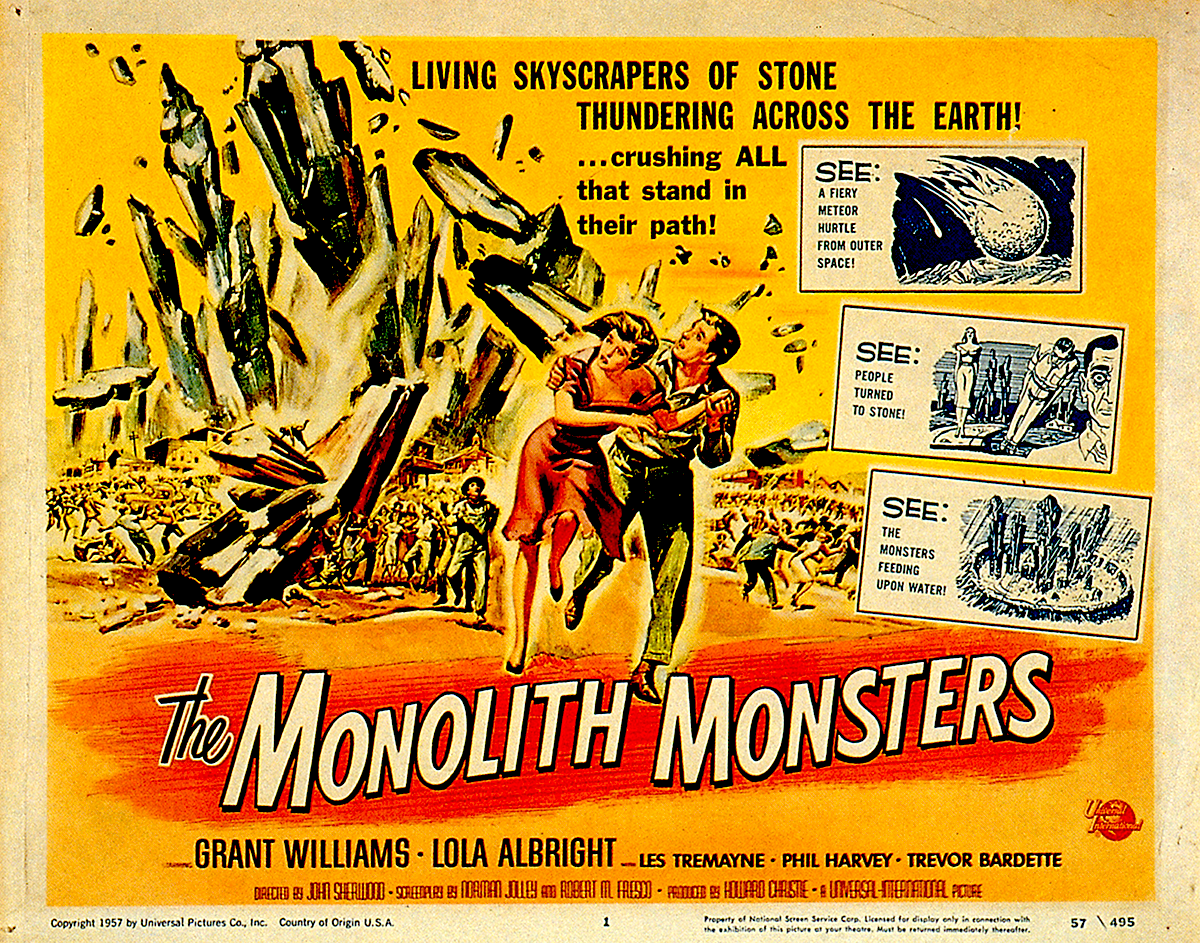
Not giant insects, not mutated humans, but an invasion of Earth by rocks that grow and multiply in size becomes another winner from Universal! 1 HR 17 MINS 1957 Universal-International
HORROR/SCIENCE FICTION
written by Gary Svehla
2/10/20268 min read
Story
The Earth, seen in outer space, is pelted with meteorites. Some burn out in the atmosphere, while a few hit in the desert, causing explosions and craters. From the burning desert, black rocks appear on its surface, ignored.
A government worker stops his car to add water to a steaming engine. Unknowingly, he splashes water onto strange, black rocks. He drives away, while the black rocks smolder from the water. He drives to a small town in the middle of the desert, San Angelos. He goes inside the small Department of the Interior office, prepared to study the black rock. Newspaper owner Martin Cochrane (Les Tremayne) enters the office and calls out to Ben (Phil Harvey). Martin asks about the strange black rock on the table, and Ben says he does not know, citing that a ton of it exists off the old San Angelos Road. Breaking off a piece of the rock, Ben starts to examine it. “Still, somehow it just doesn’t seem to belong,” Martin says, noting the salt flats that used to be an ocean bed, which flourished in the desert; it has since dried up. An ocean bed also did not belong in the desert. They conclude the desert contains strange, unidentified things.
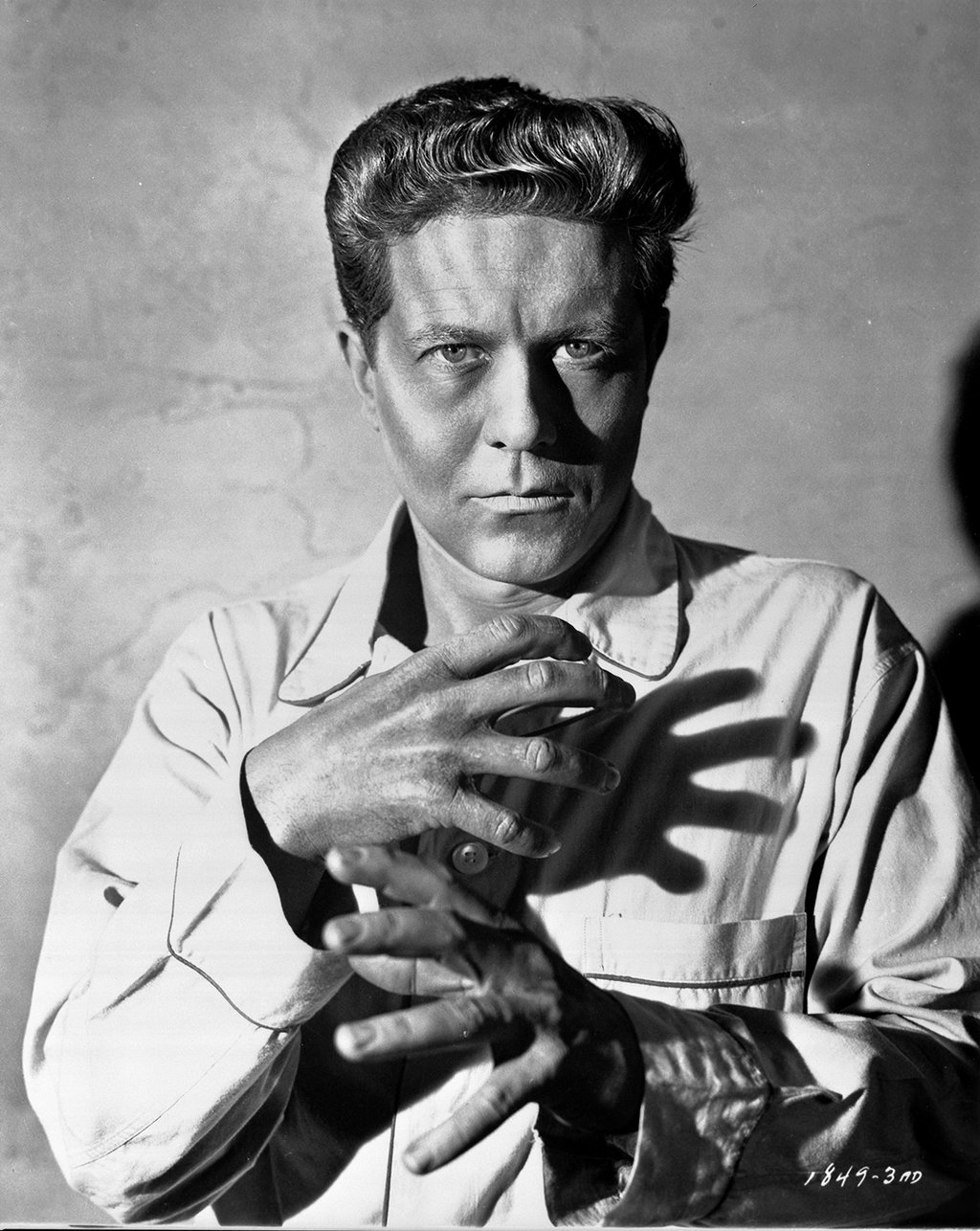
That night, the desert wind rips through the government office, blowing a vial of distilled water onto the strange rock. The rock seems to grow and smoke as Ben enters the area. The next morning, fellow geologist Dave Miller (Grant Williams) enters the government office. Dave first telephones his teacher girlfriend, Cathy Barrett (Lola Albright), who’s unavailable because she’s taken her class to the desert on a field trip. As he enters the lab, Dave sees walls and staircases busted out, with piles of black rocks on the floor and stairs. Ben, near the bathroom, stands stiffly, and Dave examines his friend. He discovers his fellow geologist is dead, petrified. Ben gracefully falls forward.
In the desert, Cathy is driving her pickup with screaming younger children. The children are ready to run and explore. One student, Ginny Simpson (Linda Scheley), sits alone, so Miss Barrett goes over to talk. Ginny has found two lizards, and Cathy adds that they might be married. The young girl knows differently. She asks why she and Mr. Miller don’t get married, as she looks at him just as her mom looks at her dad. As dramatic music swells (courtesy of Irving Gertz, Henry Mancini, and Howard Stein), Ginny picks up one of the black rocks and carries it away. Later, Cathy drops each child off at their home. Ginny still carries her rock. Ginny’s mother doesn’t allow her to bring the rock inside and tells her to wash her hands. Ginny carefully washes the black rock in a basin of water outside, leaving it there. As Ginny goes inside, we see the rock in the basin begin to bubble.
Dave and his friends await the autopsy report. The doctor arrives and says he’s shipping Ben’s body to the Medical Research Institute to determine the cause of death, since he cannot. The doctor says the body, “… has been welded into a solid mass.” Dave theorizes that the black rocks found throughout the laboratory might be the cause. Cathy examines Dave’s rock and says one of her students, Ginny, picked up this type of rock while exploring the desert. Dave worries about Ginny Simpson’s fate. Dave and Cathy decide to drive out to the Simpson place, even though it’s late at night. They arrive to find the house a mass of rubble, with hundreds of black rocks surrounding it. Cathy worries about Ginny and goes exploring. She finds Ginny walking stiffly from the ruins of the house, as though in a trance. Her parents have already found dead in the ruins. Dave mutters, “Just like Ben, their bodies have turned to stone.” While the crew rushes Ginny to town, Dave’s deputy remains.
Seeing Dr. Reynolds (Richard Cutting) again, he administers a shot. Ginny is in shock and has a very low temperature. Dave examines the rock and declares it’s almost solid silicone, “And everywhere it goes, someone dies.” Dr. Reynolds wants someone to drive to California to take Ginny to the Research Institute immediately. The doctor says her hand has turned to stone … and it’s spreading. There, Ginny is placed in an iron lung, and Dr. Hendricks (Harry Jackson) is ready to see Dave and Cathy. It seems the calcification is quickly spreading throughout her body. Dave says he will take the black rock to Dr. Flanders (Trevor Bardette), an old professor of his.
Flanders states the rock is unknown because it may be a meteorite from not of this Earth. Cathy enters the lab distressed, saying Ginny has at best another eight hours left.
Dave and Flanders drive to the Simpson place, and Flanders immediately examines the black rocks. They discover that the surrounding silicone is missing and that the multiplying rocks absorb all silicone, even from humans. They also learn from Dr. Reynolds that silicone makes human skin more flexible. Dave and Professor Flanders decide to go to the desert to find the original meteorite, not only fragments. In a crater, they find huge black monoliths. Dave only wants to know what makes them multiply and what starts the process. Back in California, the doctor will attempt to replenish Ginny’s body with synthetic silicone.
Meanwhile, in the Flanders lab, he and Dave try fire, electricity, and other catalysts to make the rock grow, but nothing works. In the background, a thunderstorm rages, and the huge meteorites in the crater begin to smother. Back at the lab, a small rock falls into the sink, and when Dave makes a fresh pot of coffee, the rock burns and begins to grow vertically. They figure the catalyst is water. Amid the torrential rain, the scientists drive back to the meteorite crater and find giant monoliths rising from the ground. The huge rocks keep growing until they topple, smashing into huge boulders, and growing again. The professor predicts they will continue to multiply and topple into San Angelos.
The sheriff tells Dave to evacuate the entire town now. Dave says, “We’re like an avalanche over an ant hill.” Meanwhile, Ginny’s hand starts to look normal. She flexes it and awakens. The doctor examines Ginny, smiles, and says she’s going to be all right. Meanwhile, all electricity and telephone service go dead in San Angelos, but the doctor can contact Dave via the Highway Patrol and shares the scientific formula used on Ginny, to help others and find a way to destroy the rocks.
People begin reporting giant rocks smashing down on their farms, killing their livestock, and more people are beginning the process of turning to stone. The formula that worked for Ginny will be used on these unfortunate victims. Now the rocks appear to be growing and spreading without the benefit of rain. Images appear of giant black stone monoliths hovering above farms and tumbling, at least three times as tall as the buildings they destroy. Martin Cochrane uses children on bikes to deliver the message to evacuate. The monoliths draw water from the desert sand to sustain their growth cycle. Dave figures they have about seven or eight hours before San Angelos is destroyed.
Dave and Flanders are trying to replicate Ginny’s formula to create a weapon against the monoliths, but every variation fails. They soon realize that a saline solution, salt, which holds the components together, hasn’t been tried. When liquid saline is dropped on the rock sample, it smolders and collapses. Dave wants to blow up a privately owned dam to flood the salt flats and carry the salt water to the monoliths. Meanwhile, the monoliths are clearly visible from the town, approaching, growing, and tumbling. Dave rushes to fetch dynamite to blow up the dam and has a team ready to position it. Dave blows the dam, and raging waters sweep over salt-filled lands. The water hits the monoliths and does its job. The giant rocks crumble and fall to the ground under the pressure of the salt water. San Angelos is safe once again.
Critique
By 1957, the Universal-International science fiction monster cycle was in full swing. Director Jack Arnold was very much associated with this production, having written the original story with Robert M. Fresco, and Norman Jolly and Fresco wrote the screenplay. Once again, the story shows all the earmarks of Jack Arnold’s style, especially the mystery of the desert. To Arnold, the desert was the closest thing to an extraterrestrial world, harboring mystery, death, and the unknown. But Arnold was assigned to another project, The Tattered Dress, by Universal, and since it was closer to an “A” production, a drama, Arnold wanted to demonstrate his directorial chops outside the science fiction genre, and because of the scheduling conflict, was unable to direct Monolith Monsters. So the studio assigned one of their contract directors, John Sherwood, to the science fiction project. Even though Jack Arnold did not direct, his fingerprints are all over the product.
Most science fiction films during this decade were about mutated humans, animals, or insects, either growing super tall or shrinking to super small. Or the films contained menaces from outer space or blob creatures from here on Earth. Pretty much this formula existed to be followed.
But a meteorite! How does a studio make a rock monster believable and terrifying?
First, as in Quatermass II, the rock must be otherworldly, with new properties that suggest it came from outer space. Here, it causes a virus that slowly turns exposed people into stone. In this manner, it most closely resembles the Hammer film production. But the rock multiples and grows with water, towering over simple homes and farmhouses, crushing them, growing, and then tumbling downward again, shattering into more pieces that grow and tumble over and over again. And since water is the catalyst that begins this process, nature’s act of wonder, the rain, is also a catalyst for these alien boulders. And as John Fogerty once asked, who will stop the rain?
Universal made one of its best monster-thrillers with The Monolith Monsters, featuring several sequences with towering monoliths approaching small homes and farmhouses, destroying everything in their wake after first hovering over them. These set-pieces are both terrifying and awesome. Resembling big and small black crystals, they may be included among the most original monsters ever created. Universal did a terrific job making rocks look strange and horrifying. The sequence when the scientists drive to the crater pit in the rain and see huge monoliths emerge is awe-inspiring.
And to increase the terror quotient, they make the city of San Angelos isolated and alone in the desert, almost cut off from the rest of the country. Also, to increase fears about the petrifying disease they can cause, they use a child, Ginny Simpson, to illustrate the process of turning to stone. While a child’s life is in danger, with less than 12 hours to live, the horror of turning to stone seems more horrifying. It wouldn’t have quite the same effect on an adult.
Irony exists in this movie. Grant Williams and Les Tremayne talk about how an ocean does not belong in the desert, and then at the movie’s end, the dried-up ocean leaves a residue of salt, which is essential to destroy the monoliths. Someone knew that, indeed, things that do not appear to belong in the desert sometimes certainly do.
So, essentially, two threats exist in the movie: the monoliths and their smaller black rock fragments, which grow, tumble, and destroy anything in their path; and the “virus” emitted by the black rocks that turns citizens to stone. It is refreshing in our current country to see an old-world of small towns where everyone knows each other, where one family helps another, and where citizens pull together to confront and defeat the threat. Much has changed in the country since 1957.
The Monolith Monsters was long considered a minor “B” picture, a lesser movie in the great science fiction craze made famous by Universal and others, until time set it apart. Who would consider for a minute that monster rocks grow and threaten communities? Nothing like it existed, and the film becomes one of the most innovative entries of the 1950s. Too bad Jack Arnold wasn’t around to direct, but his original story was transformed into a particularly effective monster movie that is both nostalgic and mysterious, and more than keeps its audience entertained. All its components seem to work, including the one that emphasizes the power of science, and the film remains a one-of-a-kind thriller.
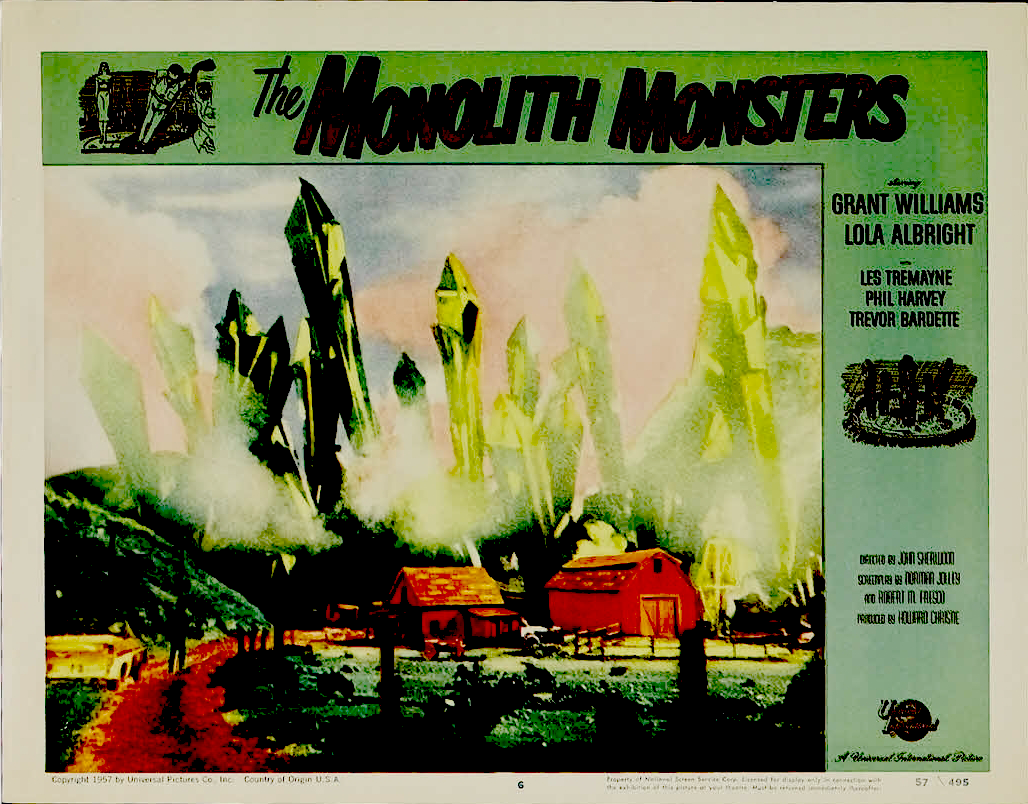
THE MONOLITHS DESCEND UPON A FARM.
IN A PUBICITY PHOTO, BEN GILBERT (PHIL HARVEY) IS TURNED TO STONE.
garysvehla509@gmail.com