
The Maltese Falcon
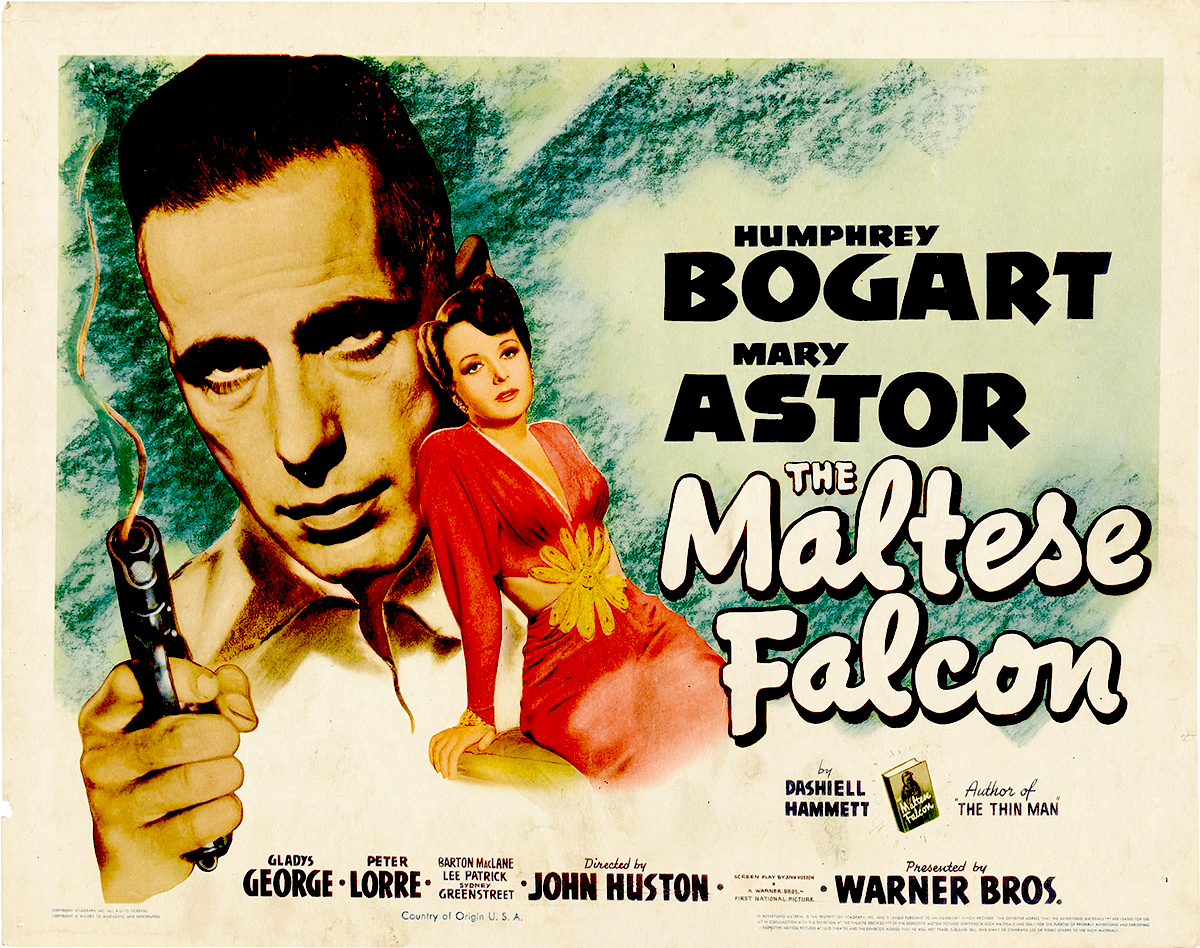
Dashiell Hammett's classic detective novel about Sam Spade involves the search for a black bird filled with treasure, "the stuff that dreams are made of!" 1 HR 40 MINS 1941 Warner Bros.
FILM NOIR/DARK CINEMA
written by Gary Svehla
3/10/202617 min read
Story
In the offices of Spade and Archer, private detectives, Sam Spade (Humphrey Bogart) rolls a cigarette. A woman, Miss Wonderly from New York, is looking for her sister, Corrine. She believes she is here in San Francisco with a man named Floyd Thursby. Miss Wonderly wants to get her sister away from Thursby and back home. She warns that Thursby is a dangerous man. The detectives plan to trap Thursby in the hotel lobby.
That night, Archer waits outside the hotel for any sign of Thursby when a gun enters the scene, exploding into Archer’s body. Fatally wounded, he rolls down a hill. In the middle of the night, Spade is notified of his partner’s death and says he’s 15 minutes away. He phones his secretary, Effie (Lee Patrick), to notify Archer’s wife, Iva (Gladys George), but to keep her away from him.
Spade rushes to the scene of the crime, while Detective Polhaus (Ward Bond) talks to him. Polhaus tells Sam he got it “right through the pump” with a British-made handgun, one shot fired. Archer was found with cash and his gun unfired. In speaking with the detective, it is clear that Spade was not fond of Archer, not even taking the time to view the body.
When Sam goes home to his apartment and pours a drink, the door buzzes. Polhaus and Lt. Dundy (Barton MacLane) enter. They are suspicious of Spade. They know that Effie informed Archer’s wife of her husband’s murder, not Spade, and that he could not take the time to look at Archer’s corpse. The policemen knew Archer had been shot a half hour after Spade was seen on Bush Street, fairly close to the murder scene. Sam is agitated that he remains a suspect, but calm since he knows what it’s all about. Thursby was also killed, shot several times in the back from across the street.
Effie dreads telling Sam that Iva Archer (Gladys George) is waiting for him in his office. Wearing black for mourning, Sam and Iva kiss. He calls her “darling,” and she asks if he killed her husband. Sam is more than upset by her insinuation. Sam says goodbye to her. Iva puts down her veil and leaves as Effie enters. Sam announces that Iva thinks he murdered Archer, and says the cops believe he killed Thursby. Effie asks if he intends to marry Iva, and Sam wishes aloud that he had never laid eyes on her.
At this point, Spade receives a phone call from a woman who must see him immediately. After getting her address, Sam tells her he’ll be right over. Before Sam leaves, he tells Effie to take Miles’ desk out of the office and have his name removed from all the office decals, “And have Samuel Spade put on.” When Spade gains entrance to the apartment, Miss Wonderly is there. Wonderly sheepishly tells Spade the story she told him yesterday was only a story. Wonderly says her real name is Brigid O’Shaughnessy (Mary Astor), but Sam admits he really didn’t believe her story. “We believed your $200,” Spade says. He admits Archer was married, had no kids, had $10,000 in insurance money, and had a wife who didn’t like him. “That’s just the way it is!”
But Spade says there’s no time for that now, with policemen and assistant district attorneys running around “with their noses to the ground.” Brigid pleads with Spade to protect her, but he must know the whole story first. But she avoids the answer. Spade looks at her and says, “You won’t need much of anybody’s help, you’re good! Chiefly your eyes and that throb you get in your voice … Now you are dangerous!” Brigid tells Spade that Thursby killed Archer. After Brigid weaves her convoluted explanation, Spade throws his arms up, saying it’s hopeless. Spade doesn’t know what she wants and doubts whether she even knows. Spade is about to write her off, but he accepts $500 from her to take the case.
A well-dressed foreign-looking gentleman enters Spade’s office, Mr. Joel Cairo (Peter Lorre). He asks Spade to help him find the black bird, acting on behalf of its owner, who will pay $5,000 for its recovery. Momentarily interrupted by Effie. Cairo draws a pistol and tells Spade to put his hands behind his neck. Cairo threatens to shoot Sam if he interferes with a search of the office. When Cairo attempts to search Spade for weapons, Sam quickly turns the tables, disarming and punching him unconscious. Cairo slowly awakens, complaining about what Spade did to his shirt. Cairo assures him his $5,000 offer was genuine and that he can be contacted at his hotel. When Lorre seems ready to leave, he asks for his gun back, immediately turning it on Spade once again. With his hands raised, Spade breaks into a hearty laugh as Cairo is preparing to search his office for the second time.
After being freed, Spade is followed by a threatening little man. Spade notices him and enters a taxi to escape. The short hoodlum also grabs a taxi and pursues Spade. Spade orders his cab to stop and heads into an apartment building. Spade exits by another door, leaving the little man to search for him inside.
Spade calls on Brigid and accuses her of putting on schoolgirl airs, and she confesses to being a bad girl. Sam tells her she met Joel Cairo tonight, and Brigid strokes her fireplace to give her time to react. Spade tells her, smiling, she’s really good, once again. He tells her he was offered $5,000 for the black bird. Spade accuses her of trying to buy his loyalty with money, but when she asks what else is there, Sam plants a big kiss on her. “I don’t care what your secrets are, but I can’t go ahead without more confidence in you than I have now. You’ve got to convince me that you know what this is all about.” … Spade plans a meeting at his place for Cairo and O’Shaughnessy tonight.
Spade looks out his apartment window and sees the little man nosing about as Cairo enters. Brigid asks $5,000 for the Falcon, but Brigid says she doesn't have it yet; she’ll have it in a week at most. Cairo asks if she knows where it is, and why wait a week? Brigid says she’s afraid and wants to sell it fast. She mentions Floyd and the fat man. Cairo asks if he is her? Suddenly, the duo starts attacking one another, and Spade slaps Cairo. “When you’re slapped, you’ll take it and like it!” Dundy and Polhaus return, saying he heard Spade was having an affair with Archer’s wife. Spade refuses to let the cops in, but an eruption of violence and shouting occurs inside, and the cops enter. Cairo has bloody scratch marks on his face and is highly agitated. Brigid, inflamed by Cairo’s talk, gets up and kicks him. Spade concocts a made-up story to explain their violent actions and clear themselves, but Dundy still takes a swing at Spade, which incenses him. The two cops and Cairo leave. Brigid calls Spade, “The wildest and most unpredictable person I’ve ever known.” Sam wants to know more about the Falcon. Brigid tells a story, and Sam concludes that she is a liar. She soon admits that she’s always been a liar. Sam offers her fresh coffee and says we will try again.
Later at the Hotel Belvedere, Sam telephones Joel Cairo when he spots the little man who is tailing him sitting in the lobby reading a newspaper. Cairo is not available, so Spade sits in a chair alongside the little man. He asks aloud, “ Where is Cairo?” The little man tells him to shove off. “Keep asking for it, and you’re going to get it!” the little man simmers. Sam finds the hotel detective and walks over to the little man. “Why do you let these cheap gunman hang around the lobby with their heaters bulging in their clothes?” The detective makes the gangster uncomfortable, and he leaves.
Cairo appears disheveled at the hotel desk. Cairo admits he was at the police station being grilled all night. Sam returns to his office to hear Effie tell him that Gutman called, saying his boy passed along the message. Brigid awaits Spade outside his building, saying an intruder was in her apartment. Sam asks Effie if she could put up Brigid for a few days, and she agrees.
Spade goes to meet Kasper Gutman (Sydney Greenstreet) immediately for drinks and conversation. Gutman toasts to plain speaking and clear understanding, asking Spade if he likes talking, which he confesses he does. Gutman, lighting a cigar, says, “I’ll tell you right out, I’m a man who likes talking to a man who loves to talk.” Gutman asks who Spade represents, Cairo or O’Shaughnessy, and he answers … himself. The Fat Man seems amused by all his answers. Gutman asks Spade if he knows how much money could be had for that black bird? Spade admits O’Shaughnessy or Cairo never told the worth of the bird, but when you do, two of us will know. But Gutman decides not to tell him, and Spade explodes because he’s had it with close-lipped crooks. Spade threatens to kill his gunsel if he gets in his way and says the Fat Man will have to talk with Spade or he’s through, which Spade declares he is. Now rising, Sam raises his voice in anger and frustration. Storming out the door, Spade tells Gutman he has until 5 o’clock to decide if he’s in or out. But he walks toward the elevator, calm and smiling broadly.
Wilmer Cook (Elisha Cook, Jr.), the gunsel, the little man, appears on the street, telling Spade that Gutman wants to see him. Walking together toward the apartment, Spade makes his move, restraining Cook with his long coat and snatching his pistols, which he promptly returns to Gutman, further embarrassing the gunsel. Gutman briefly apologizes while serving Spade a drink. Gutman tells Spade about the Falcon's complex history and offers him $25,000 upon delivery and another $25,000 at a later date. Or he will offer Spade one quarter of what he gets for the Falcon, a vastly greater sum, worth in the range of $100, 000. By now, Spade is getting very fuzzy from his drink, obviously drugged. He attempts to stand up and leave, but Wilmer kicks out his leg, and he collapses. Wilmer continues to kick him when he’s down. Cairo appears from another room, and all three men exit.
After dark, Spade slowly revives and washes water on his face. Sam telephones Elffie to talk to O’Shaughnessy, but she never showed up at the office. He searches the place for any clues and finds a newspaper with the following circled: “La Paloma arriving 5:35 from Hong Kong,” but the ship is immediately set ablaze. Talking to Effie, Sam says, “Maybe they went down to the ship, maybe they didn’t.” Abruptly, an obviously dying man, Jacoby (Walter Houston), barges into the office, dropping the Falcon, which is wrapped in a newspaper. The man falls into a sofa dead. Spade searches for I.D. and finds he is the Master of the ship and wishes he’d stayed alive long enough to tell him something. Then Sam unwraps the package and discovers he possesses the black bird. Spade delivers instructions for Effie to follow, and he leaves the bird with the hotel’s baggage storage department and mails the claim slip to a post office box.
Returning to his apartment, Brigid appears, emerging from the shadows, spent. She can barely walk. Entering his apartment, Wilmer, Cairo, and Gutman are all present. Gutman asks Spade and Brigid to take seats. Spade asks for the first payment for the black bird, and he hands him $10,000, less than the money promised. Gutman says there are a lot more people to be taken care of now. Cairo, holding a gun, says, “You might have the Falcon, but we certainly have you.”
Spade says first, we need a fall guy. The police must have a victim that they can pin those murders on …”I’m in this up to my neck, Gutman. I have to find a victim when the time comes. If I don’t, I’ll be it! Let’s give them the gunsel. He actually shot Thursby, and Jacoby didn’t, did he?” Anyway, he’s made to order for the part.” The Fat Man laughs and calls Spade a character. Kasper gets serious, thinking of Wilmer as his own son. He could not sell him out.
Wilmer approaches Spade and tells him to get to his feet. “I took all the riding from you that I’m going to take. Get up and shoot it out.” Kasper says Sam’s plan is unsatisfactory; let’s not talk about it. Sam says, "Okay, I got a second suggestion: give them Cairo." Slowly, the crowd agrees with Spade, turning against Wilmer. Spade punches him out when Wilmer gets rattled. His gun falls, and Brigid picks it up in the commotion. She hands the gun to Sam. Wilmer slowly awakens to see that former friends have sold him out. Gutman says, “Wilmer, I’m sorry indeed to lose you, but I want you to know I couldn’t be fonder of you if you were my own son. Well, you lose a son and possibly get another. But there’s only one Maltese Falcon!”
Spade calls Elfie to bring the Falcon over. The crowd inside is slowly falling asleep as the door buzzes and Effie delivers the package. Gutman unwraps the black bird like a teenager reading his first copy of Playboy, saying, “After 17 years.” He scrapes at the black bird with a blade to test its authenticity, then, in frustration, declares it a fraud. Cairo explodes, insults Gutman, and cries. Gutman wants them all to journey to Istanbul to continue the search for the elusive black bird. Spade chuckles, “A fine lot of thieves,” as Wilmer slips out the door. The fat man demands his money from Spade at gunpoint, but Sam keeps $1,000 for time and expenses. Gutman slips out the door, saying goodbye to everyone.
Spade makes a quick call to Polhaus, telling him that a 20-year-old kid, Wilmer Cook, killed Thursby and Jacoby, working with Kasper Gutman, and Cairo, who are headed to the Alexandrea Hotel. “They’re blowing town, so you have to act fast.”
Spade then turns to Brigid, telling her, “We are sitting on dynamite,” and that they have only minutes to prepare for the police. Spade realizes that with Archer’s experience, he would be wary of anyone except O’Shaughnessy and would allow her to get close. She wanted either Thursby or Miles to be killed so one could be accused of killing the other. Realizing Gutman was back in town, she needed Spade for protection. “I hope they don’t hang you, precious, by that sweet neck.” Spade intends to turn her over to the police. ‘You're taking the fall! I won’t play the sap for you!” The police arrive, and Spade promptly offers that Brigid killed Miles and presents evidence. Polhaus asks about the black bird and what it is. Spade pauses and answers, “The stuff that dreams are made of.” Stoically, Brigid descends in the elevator to face the future as Spade walks down the stairs.
Critique
Considered the definitive version, the 1941 Warner Bros. version of Dashiell Hammett’s The Maltese Falcon was actually the third filmed version of the novel. The earlier versions were The Maltese Falcon (1931), directed by Roy Del Ruth and starring Bebe Daniels, Ricardo Cortez, Dudley Digges, Una Merkel, Otto Matieson, and Dwight Frye, and Satan Met a Lady (1936), directed by William Dieterle and starring Betty Davis and Warren William. But the 1941 Bogart version is the iconic one. Who said remakes are never as good as the originals?
The question again arises: Is this film noir or a complex detective/mystery? Noir did not exist until after the Second World War, mirroring the malaise of returning veterans. And The Maltese Falcon was released before the U.S. even entered World War II.
Humphrey Bogart, in one of his best starring roles, a role that allowed him to graduate from “B” productions, played detective Samuel Spade as a street-wise private dick who really failed to fully comprehend what was going on. He knows little about the Falcon and even less about what it’s worth. He is originally offered $25,000 upfront for delivering the black bird; instead, he is given $10,000, and he finally winds up with a paltry $1,000. But that’s still more impressive than the $200, which impresses the two detectives when Miss Wonderly offers that much to take her case. As Spade put it, the detectives did not believe her story so much as they believed her money.
The trio of world-traveling crooks is brilliantly cast and performed. The big boss, Kasper Gutman, is played by Sydney Greenstreet, a debuting screen actor who began a new career late in life at 61, coming from the theater. The Fat Man is sophisticated and smooth-talking, and he bellows a schoolboy laugh every so often, softening his character. When he’s deadly serious, he’s intense. While he tries to exhibit a playful, accommodating side, we know there’s deep violence beneath the surface. There’s also an effete side to him that breaks out every so often, mainly in his swishy wave goodbye to O’Shaughnessy in his final scene as he exits the apartment. With the flicker of his arm and a too-friendly farewell, it is terribly clear he is soft in the loafers. Not negative in itself or being critical, it just is Hollywood’s way of displaying homosexuality.
Next is the flamboyant Joel Cairo, as played by Peter Lorre. He is just too well-dressed at any time of day and smiling too broadly. He is the lap dog following Gutman incessantly. The way he draws pistols on Spade is too merry, even when he displays his darker side. He will, on the flip of a coin, turn raving lunatic, and when the Falcon turns out to be a fraud, he literally erupts in frustration and literally cries. He is too sweet a man with a dark underside. Another way Hollywood uses to display homosexuals is as half-crazed individuals who turn on a dime.
Thirdly, we have Gunsel Wilmer Cook, portrayed by Elisha Cook, Jr. Over the years, I assumed a gunsel was a hoodlum gunman. But no, I was really off base here. A gunsel is literally a man being kept in a sexual relationship with an older male. Psychopath Wilmer Cook is referred to as the kid, a very dangerous kind. He does not seem the least interested in Gutman, except as his employee. But when Gutman turns him over, which he resists for as long as he can, he says he is as fond of him as his own son. He likens the relational to a father-and-son relationship, when in fact the relational was considered perverted in 1941. But as the Fat Man tells Wilmer, you can get another son, but there is only one Maltese Falcon.
But the third criminal of the trio is Brigid O’Shaunghnessy, played by Mary Astor. She is the only one conventionally sexual, preferring males. But in the most perverted manner, she is a love them and leave them type of woman, using sex and her womanly wiles to snare victims. She is so used to lying that she doesn’t know the truth if it smacked her in the nose. She is deadly deceptive, a woman that Spade says will use anything that she has over a person, and is quite capable of walking directly up to a person and shooting them dead without a qualm. But one major flaw of the movie was Mary Astor’s character, Brigid, who, early in the movie, is described by Effie as a “knockout.” At around 35, Mary Astor was only a few years removed from playing matronly women, mothers, and unsexy characters. Here, her Brigid is a sexual bombshell who reduces men to drooling idiots, and she’s hardly “a knockout” to cause all the commotion. She plays the criminal jpredator ust fine, and her obsession with distorting reality with half-truths and bald-faced lies is remarkably effective. But as a bombshell … no!
At this time, Hollywood depicted homosexuals as psychopathic, antisocial, and deviant. Gutman is a criminal, but with Cairo, Wilmer Cook, and Brigid O’Shaunghnessy, he forms a small, deviant society that clings to one another for support more than it needs the Falcon. The obsession with the black bird is more important than finding it. As Bogard states at the end, the black bird is the stuff of dreams, and their never-ending quest for the Falcon gives direction, purpose, and mystery to their then so-called deviant lives.
To help decide whether this is film noir, look no further than the movie’s conclusion. Spade realizes that Brigid is a compulsive liar, out for herself and no one else. He explains his twisted morality to Brigid, turning her over to the police for Miles’ murder, since it seems to be important. “When a man’s partner is killed, you are supposed to be something about it. It doesn’t make any difference what you thought of him; he was your partner, and you are supposed to do something about it. And it happens we’re in the detective business. When someone in your organization gets killed, it’s bad business to let the killer get away with it. Bad all around, bad for every detective everywhere. I have no earthly reason to think I could trust you. And if I do this and get away with it, you’ll have something on me you can use whenever you want. Since I got something on you, I couldn’t be sure that you wouldn’t put a hole in me someday. All those are on one side … look at the number of them. What have we got on the other side? All we got is maybe you love me, and maybe I love you … I'll have some rotten nights after I put you over, but that will pass … I won’t because all of me wants to, regardless of consequences. And you counted on that with me just as you counted on that with all the others …”
I say twisted morality because Spade has been having a secret affair with his partner’s wife, not a moral thing. He earlier says he did not believe O’Shaughnessy’s story as much as he believed her $200. As a private detective, he skirts the moral world of what’s right because his profession dictates that. It’s apparent he does not like his partner Archer, but because of the credibility of the detective profession, he feels he must do something. One Private Investigator’s death is “bad for business” and must be punished. In other words, his morals are entirely based on practicality and what’s best for business, not necessarily what’s morally right or wrong.
At the end, he “turns over” O’Shaughnessy because he has demanded a fall guy for the murders, so he will not be accused. When Cairo is outright rejected, and Wilmer Cook escapes, Brigid is the only remaining candidate for the position. As Spade defiantly states, he will not play the patsy for her; he has something on her, making it so he can never trust that she wouldn’t kill him like she killed Miles. He would be looking over his shoulder for the rest of his life. His morals are based on what is practical for his survival, not on what is necessarily right or wrong. In other words, an ambient code of morality is essential to film noir.
Also, the shadowy, angular cinematography and harsh lighting of Arthur Edeson (he photographed the 1931 Frankenstein, the 1933 The Invisible Man, the 1942 Casablanca, and many others) define the substance of film noir even before noir existed. When the film noir style of photography was followed, others imitated Edeson’s style. In other words, the film noir style was emerging here in 1941.
Debuting director John Houston, formerly a screenwriter, was given his creative break with The Maltese Falcon. The studio thought Houston was filming yet another programmer, not realizing he was redefining the detective movie genre and turning Humphrey Bogart into a star. Given a very limited budget and a tight schedule, there was no room for error. John Houston carefully storyboarded the Hammett novel and stayed true to its plotline. He snuck through a homosexual underbelly, a nuanced performance from Bogart, ambient morality, and the central detective was molded into the pragmatist, never the hero. Houston created a new type of movie, one that is fuzzy around the edges, much more complex than its audience suspected, and he created a film classic, something the two earlier filmed versions of the Dashiell Hammett novel were not. All on a limited budget and truncated shooting schedule. But sometimes such is the stuff that cinematic classics are made of.
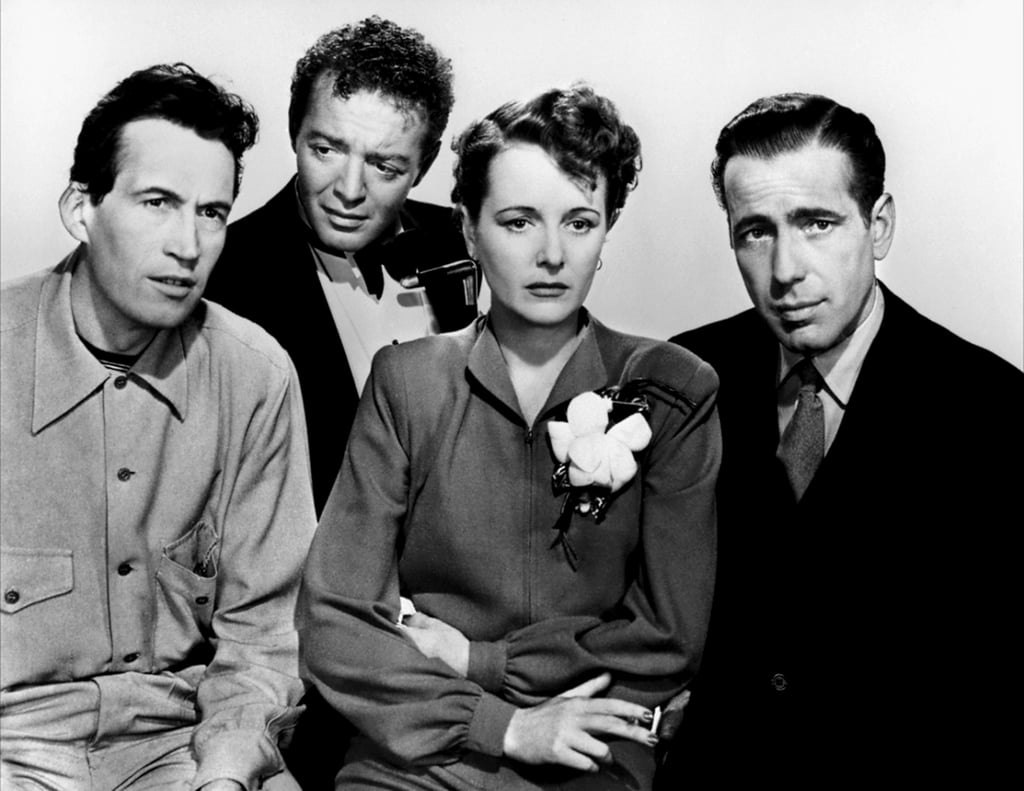
DIRECTOR JOHN HOUSTON, PETER LORRE AS CAIRO, MARY ASTOR AS BRIGID, AND HUMPHREY BOGART AS SAM SPADE
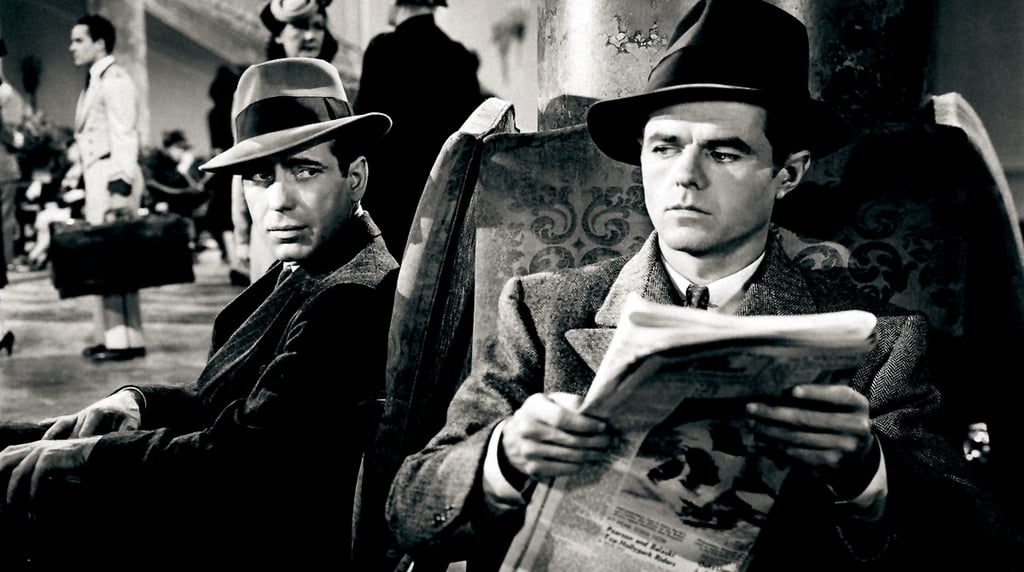
SAM SPADE LOOKS UPON THE KID WHO HAS BEEN FOLLOWING HIM, THE GUNSEL WILMER COOK (ELISHA COOK, JR.)
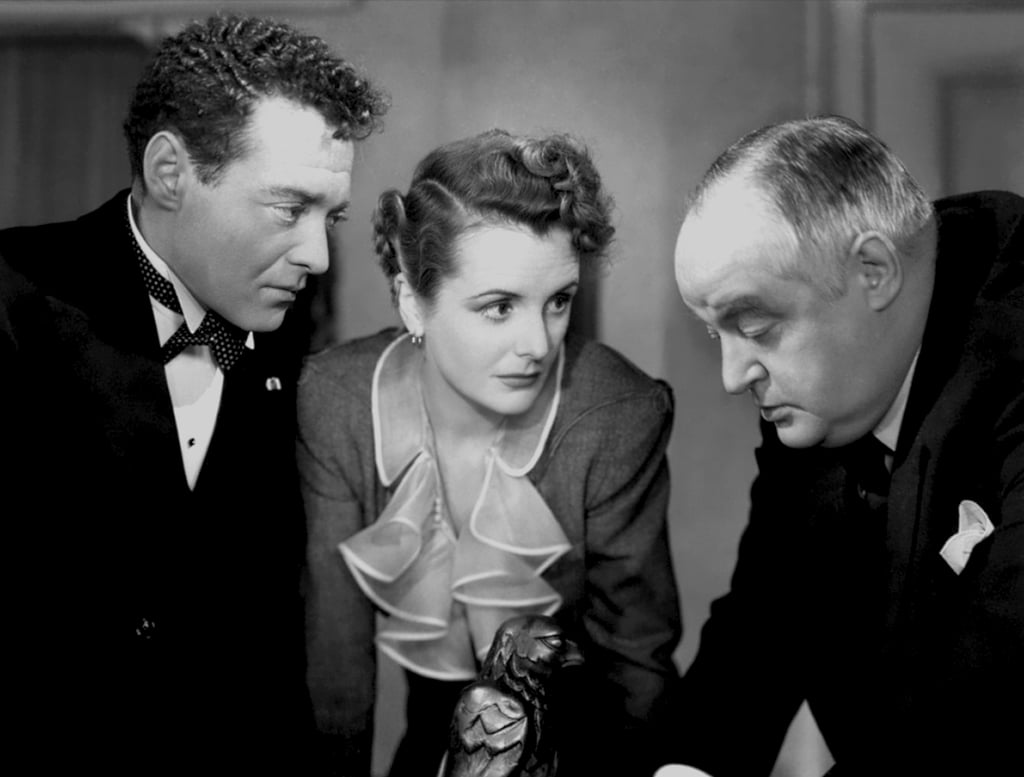
A PUBLICITY SHOT SHOWING PETER LORRE, MARY ASTOR, AND THE FAT MAN, KASPER GUTMAN (SYDNEY GREENSTREET)
garysvehla509@gmail.com