
The Hitch-Hiker
The primary woman director of the 1950s, Ida Lupino, creates a thriller that contrasts middle-class mores against the world of a serial killer. 1 HR 11 MINS 1953 RKO
FILM NOIR/DARK CINEMA
written by Gary Svehla
11/18/202511 min read
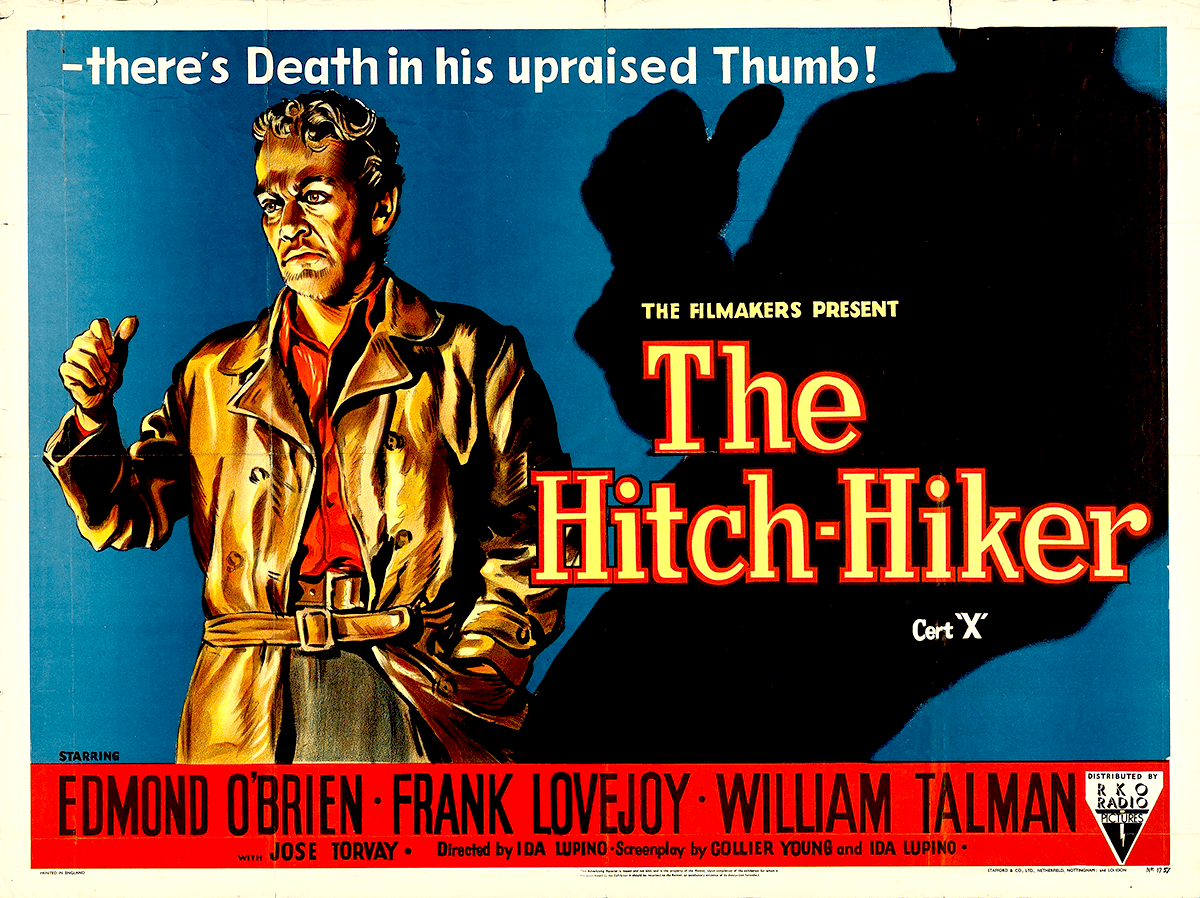
“This is the true story of a man, a gun, and a car. The gun belonged to the man. The car might have been yours—or that young couple across the aisle. What you will see in the next seventy minutes could have happened to you. For the facts are actual.” Pre-title blurb. Against this blurb, s static frame, we hear highway sounds, horns honking, vehicles moving along. Then the screen transforms into the opening credits, with a close-up of a gun pointed at us. Dramatic music by Leith Stevens erupts as credits continue. The main action occurring is a car picking up a hitchhiker and stopping the car in a wooded area, the hitchhiker exiting and shooting the two inhabitants of the car, a woman screaming, and the man soon walking away. A highway patrolman finds the car in the dark and its two victims dead inside. Newspaper headlines flash the news.
Soon, a car pulls over to pick up a hitchhiker as they drive through the Western states. The exhausted man keeps driving as day turns into night and then back to day. Soon, he is also dead, thrown outside the car in another wooded area, while the hitchhiker searches his clothes for money and valuables. Then he drives off in the murder victim’s car. Soon, another victim is abandoned in a wooded area as the murderer steals his valuables.
Then, we see two men navigating the desert, discussing turning off at the next road. They talk about heading to a fishing spot. Then, they plan to get a drink at an old destination they both know. The two men, Roy Collins (Edmund O’Brien) and Gilbert Bowen (Frank Lovejoy), talk about Bowen’s first time away from his wife and kids after the war. They drive to a busy part of Mexico that they’re trying hard to remember.
Then, while driving down a dusty highway, they come across a hitchhiker thumb in hand next to a broken-down car. The hitchhiker, sitting among the shadows in the back seat, doesn’t speak. When Gilbert turns around to offer him a cigarette, he sees the man has a gun pointed at him. The man, Emmett Myers (William Talman, soon to be famous as Hamilton Berger on Perry Mason), tells the men not to turn around and keep driving, warning them not to make any quick moves because there are a lot of false heroes back there. Emmett then tells the two to turn onto the next road, stop, and open the glove compartment. Inside, they find junk, including gun cartridges. Emmett orders them to always exit the car in the same way. Once outside, Emmett frisks the men and watches as they open the trunk. Inside, they find blankets and a rifle. Emmett takes the rifle.The car is now speeding down the highway, Emmett sitting in the backseat with a pistol. Playing around with his gun, Emmett panics when Roy hits a bump in the road, which he refers to as making a fast move. The car drives on. Emmett asks the men about their private lives and when they are expected home. Then a highway checkpoint appears with a policeman with a rifle. They drive directly past without incident. Emmett comments on how well their car rides: “Pretty good!” He plans to sell the vehicle when they arrive at their destination. But for now, he orders the men to fill up with gas and get a map.
Looking at the map, he orders the men to take the first side road they come to. After making that turn and being unable to continue straight ahead, Emmett tells them to exit the car, as they learned, and spread the roadmap on the hood. The men are instructed to search for Santa Rosalia. Gilbert informs Emmett that it is about 500 miles away. Emmett asks about a ferry across the Gulf, and Gilbert says they should make it by Friday. “After that, I won’t be needing you guys anymore, shooting at a wild rabbit,” Emmett declares. Roy cracks a joke about missing the rabbit, then Emmett places a can on a large rock, which Emmett easily shoots off. He then hands Gilbert the rifle, still holding a gun on him, and tells him to take a shot at the can. Gilbert makes the shot easily. Impressed by Gilbert’s shooting, Emmett tells Roy to put the can on a rock further away. Instead of putting the can on a rock, he wants Roy to hold it close to himself while Gilbert takes another shot and shoots the can out of Roy’s hand. Finally, Emmett says the fun is over and calls Roy back in.
Back in the car, Emmett asks Roy to turn on the radio, and a Mexican station comes on, and Emmett requests Collins to find a station with an American news anchor. Their newsmen are reporting the capture of the elusive Emmett Myers. Due to so many crimes, Emmett is believed to be in several different states. As a result, many police checkpoints are being set up across Western states.
Stopping and getting out of the car in the usual way, Emmett gives each man a blanket and announces they will sleep here for the night. The men stare at Emmett while supposedly sleeping, and Emmett says they will die, but it’s a question of when. Emmett has one bum eye that never can close, so he sleeps with the good eye closed so the men cannot tell if he is asleep or not.
The next day, while riding on the highway, they stop at a general store to buy food. Loading a box with essential canned goods, Roy is ready to make a move on Emmett, but a Mexican child attaches herself to Emmett, making his move impossible. They then load the backseat of the car and drive off. That night, stopping to camp, the two captives cook some of the food while Emmett stands and watches. He asks about the watch Gilbert is wearing, and he says his wife gave it to him. When asked, Gil is told to throw the watch to him, and he says he had one like it when he was 17. Nobody gave it to him — he took it! “I got what I needed my own way,” Emmett says, declaring the two captives are soft. Emmett goes off to the car to listen to the news, but Roy and Gil know that as long as he needs them, they are okay. When the time comes to kill them, they must act first to strike. The car hits a bump, and the horn gets stuck. Roy tells his captor he must disconnect it under the hood, but what he really plans is to disconnect the radio so Emmett knows less about those pursuing him. A Mexican with a donkey hauling wood passes them while the car is stopped.
The police are discussing a witness who saw all three men at the general store and knew which way they were heading. They believe they are traveling toward Santa Rosalia and then Guaymas. Meanwhile, the three men camp for lunch when a car passes their spot in the desert. When they return to their car, where Emmett tells them to speed up, they get a flat tire. Emmett, panicked, orders the men to change the tire with the spare. Meanwhile, an old car pulls up. The driver asks if they need help, but they stay silent, so he drives on. On the news, which Emmett can no longer hear, authorities from both the U.S. and Mexico have increased their search for the three men, who are traveling together. Meanwhile, the jalopy is stopped by the police, and a report is made about the broken-down car in the desert. An officer is sent back to find the car and discovers the missing vehicle's tire tracks. The three men ride through the night and stop for gas, first breaking the pump-lock because the station is closed. A dog barks in the distance. Emmett shoots the barking dog while Gil places his ring on the pump. The next morning, Mexican police find the ring on the pump.
Thinking Emmett is listening to the news about the latest police reports, the Americans announce they will start issuing false reports to throw Emmett off track. Camping again that night, Emmett sleeps with one eye open, while Roy slowly slips out of the campsite, with Gil quietly following behind. Suddenly, Emmett’s good eye opens. He notices the two men are gone. Emmett then chases after them to the highway in his car. He stops the car just a few feet from the huddled escapees. Gil could have escaped, but he helps his friend Roy, whose ankle is caught in a metal loop. Emmett says, “You guys are starting to have ideas, and I don’t like them thinking.” Gil has to punch out Roy to save him.
The next day, driving along the desert highway, they stop at a well and throw a rock down the shaft to see if it’s dry or wet. When the rock hits bottom, Emmett says, “Nice and deep.” Roy explodes, yelling, “Cut it out. If you’re going to kill us, just do it and get it over with!” Emmett orders them to take the canned goods out of the car. The killer says they’ll have a really good meal. While eating, the men hear one of the fake news reports, and Emmett says, “What do you know, this kinda changes my plan. Looks like you and I are going fishing after all.” Roy sabotaged the car by putting a hole in the crankcase, so Emmett decides they will walk, though that’s not good for Roy’s bad ankle. Emmett makes the two captives carry the fishing gear. Roy collapses onto Gil because his ankle is unreliable, but all three men keep going. While they are hiding, a helicopter flies overhead searching for them. Emmett orders them to hit the ground, and Roy is slow to get up. Soon, a small airplane flies overhead. The men hide behind a large rock, and when Roy finally steps out and yells, “Here we are!” the plane flies past. Roy eventually falls to the ground, crying.
Meanwhile, a Mexican police car comes across the trio’s broken-down vehicle and investigates. He sees the well where they ate, with several cans of food lying empty. The three men are traveling down a river, and when a jeep appears, Emmett yells for them to hide beneath a bridge. The jeep continues on its way, and the men rest under the bridge. Suddenly, Emmett has a new idea: he and Roy are the same size, and no one in Santa Rosita has ever seen him. So he demands that Roy and he switch clothes so that, if they’re captured, people will think Roy is Emmett. Shots show the Mexican police car racing down the highway trying to catch the fugitives. Soon, reaching the seaside, the three men see a small village and decide to check out the outskirts. Emmett says he might buy the two men a beer.
The three men enter an empty, small bar, and Emmett orders three beers. Then they find out there isn’t any ferry running to Guaymas for two months. But he has a friend who owns a boat, and Emmett wants to see him right away. While the Mexican hesitates, Emmett throws some cash his way, and he becomes more interested. The Mexican thanks the Americans for the money and says his friend should be here soon. But Emmett wants the three of them to go to the shore and wait until it’s dark. Emmett gloats that Roy and Gil are fools; one could have gotten away, but they chose to stick together. Emmett smiles and says, “Yes, tomorrow I’ll be in Guaymas. Too bad you won’t be making the whole trip with me.” Roy yells at Emmett, “You stink!” ... Emmett may get to Guaymas, but he’ll eventually be caught, Roy screams. And the statement angers the criminal.
The Mexican, picking up mail at the post office and placing his newfound money in his coat pocket, just happens to see a wanted poster with a picture of Emmett, and he recognizes him. The man immediately calls the local police.
The three men walk in the rain outside a cantina, down an alley leading to the dock, sending Roy ahead to find the boat. As they silently walk along the pier searching for the boat, a gun barrel appears from behind the dock. As expected, the police shoot at Roy, who is wearing Emmett’s clothes, but Gil manages to turn the tables on Emmett, gaining the upper hand and knocking his gun into the water. When Emmett tries to escape, he is soon cornered by the police, overseen by the Mexican cop who has been after him for so long. He is cuffed by the police, appearing small, but a burst of strength allows him to rally, though Roy’s frantic punches help subdue him. Roy and Gil calm each other down and are told they need to fill out a report. Still, they walk safely down the pier to freedom, arm in arm, as the end title appears and the music crescendos.
Ida Lupino was a true force of nature. She was an actress, screenwriter, director, and producer. She mostly worked in B movies, where she had much more creative freedom. In the late 1940s, she founded, with a few others including her husband, a production company called “The Filmmakers, Inc.” and made socially conscious films about poor Americans facing prejudice and bigotry, deviant sexual activity, rape, poverty, and illness. She made her films quickly and cheaply, but they often had something meaningful to say, with a focus on realism, and provided opportunities for new stars to shine. With The Hitch-Hiker, she became the first woman director to make a film noir, and it was a gritty one. In fact, as a woman working in a largely male-dominated industry, she was the most prominent female filmmaker during the 1950s. She broke many glass ceilings for women aspiring to work in film.
Usually, Mexican actors’ portrayals were simplified and stereotyped, depicting the culture as sleepy and unambitious, often adding comic relief. In The Hitch-Hiker, Mexicans become the main focus for tracking down and capturing the serial killer Emmett Myers. They are portrayed as being focused, committed, and dedicated to their mission. While it seems just a matter of time before captives Roy and Gil are killed, the Mexican police do everything so that doesn’t happen. Instead of speaking slow-draw dialect, the Mexicans speak their own language, undubbed, reflecting their diligent character and sounding very different from the manner Hollywood depicted Mexicans for decades. It gave the entire culture dignity.
The Hitch-Hiker was a film noir thriller that aimed to explore the mind of Emmett Myers, frequently contrasting the typical middle-class man with the emotionally hollow Emmett, the crazed killer with the lazy eye. Noticing Roy’s wristwatch, Roy proudly mentions that his wife gave it to him. Emmett replies proudly that, at age 17, he took it, viewing gifts and love as signs of weakness because he believes he must always be in control. Worrying about others is seen as losing one’s way and depending on others, a weakness, while Emmett believes you are alone and gain strength from that solitude. Being connected with others and relying on each other is considered "being soft” in his world. In reality, what Emmett admits is that attachment to others is a weakness because he has never truly been loved. He is a survivor, very much alone in this world, and hates those he secretly longs to be like. Emmett remains the ultimate outsider.
Ida Lupino made a superior film noir with The Hitch-Hiker, presenting a rugged view of life on the road. Roy and Gil are not perfect heroes; they plan to go to Mexico for drinks and women behind the backs of those at home, claiming they deserve some fun after surviving the war in Europe. The film contrasts two types of people trying to find purpose and meaning in their lives: one, a vicious killer considered outside the law; and the other, two middle-class boys seeking fun. It shows that neither side is entirely good or bad; they are simply victims of fate and circumstance in the world of film noir.
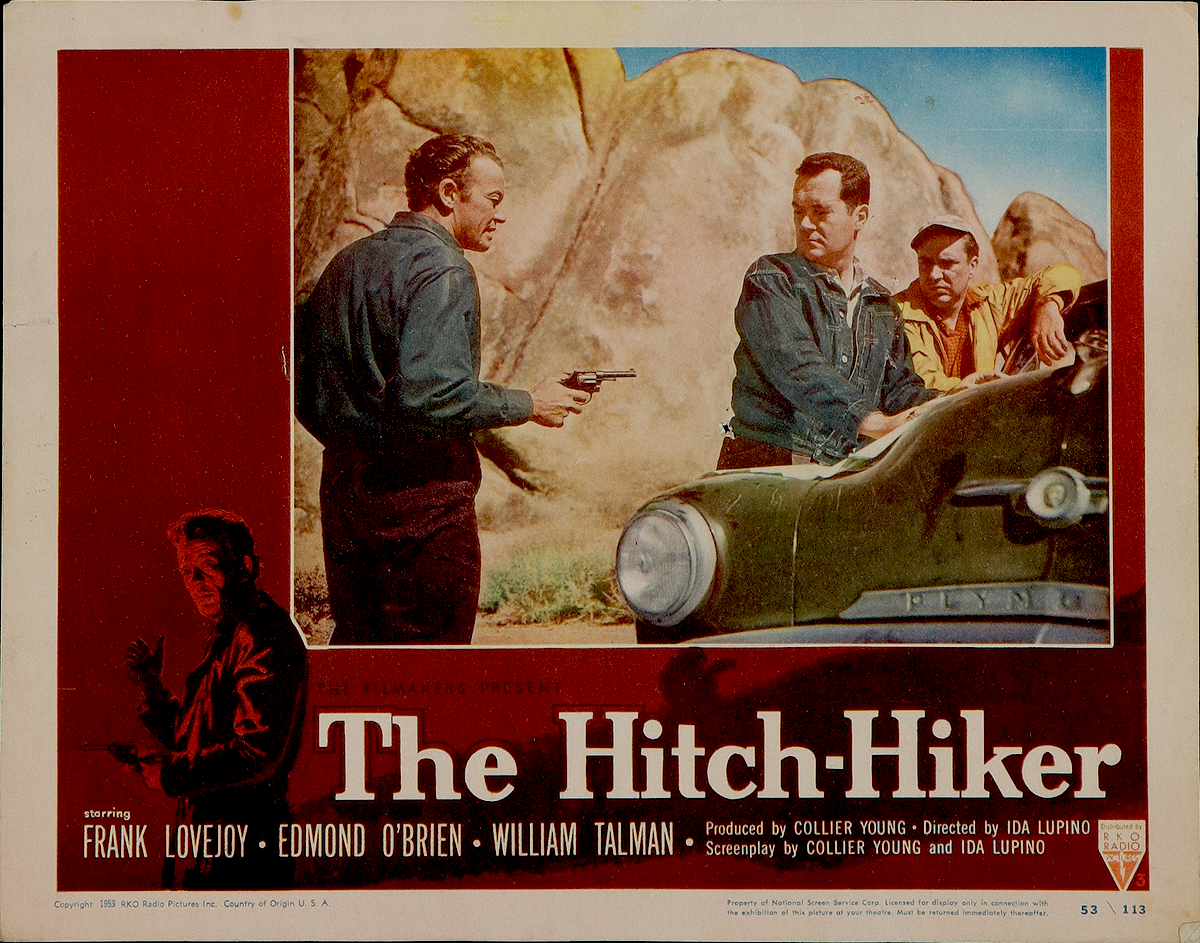
EMMETT MYERS (WILLIAM TALMAN) HOLDS A GUN ON GIL (FRANK LOVEJOY) AND ROY (EDMUND O'BRIEN).
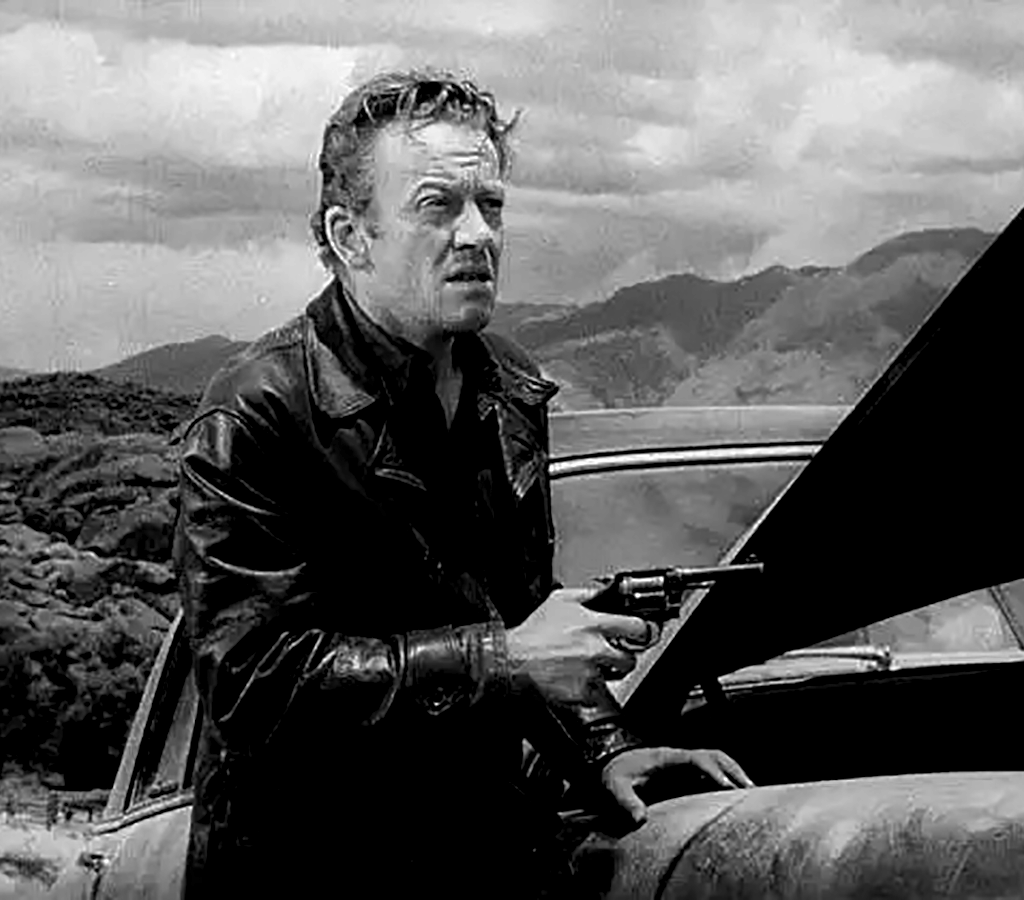
THE SERIAL KILLER WHO DOES EVERYTHING ALONE, EMMETT MYERS
garysvehla509@gmail.com