
The Abominable Snowman
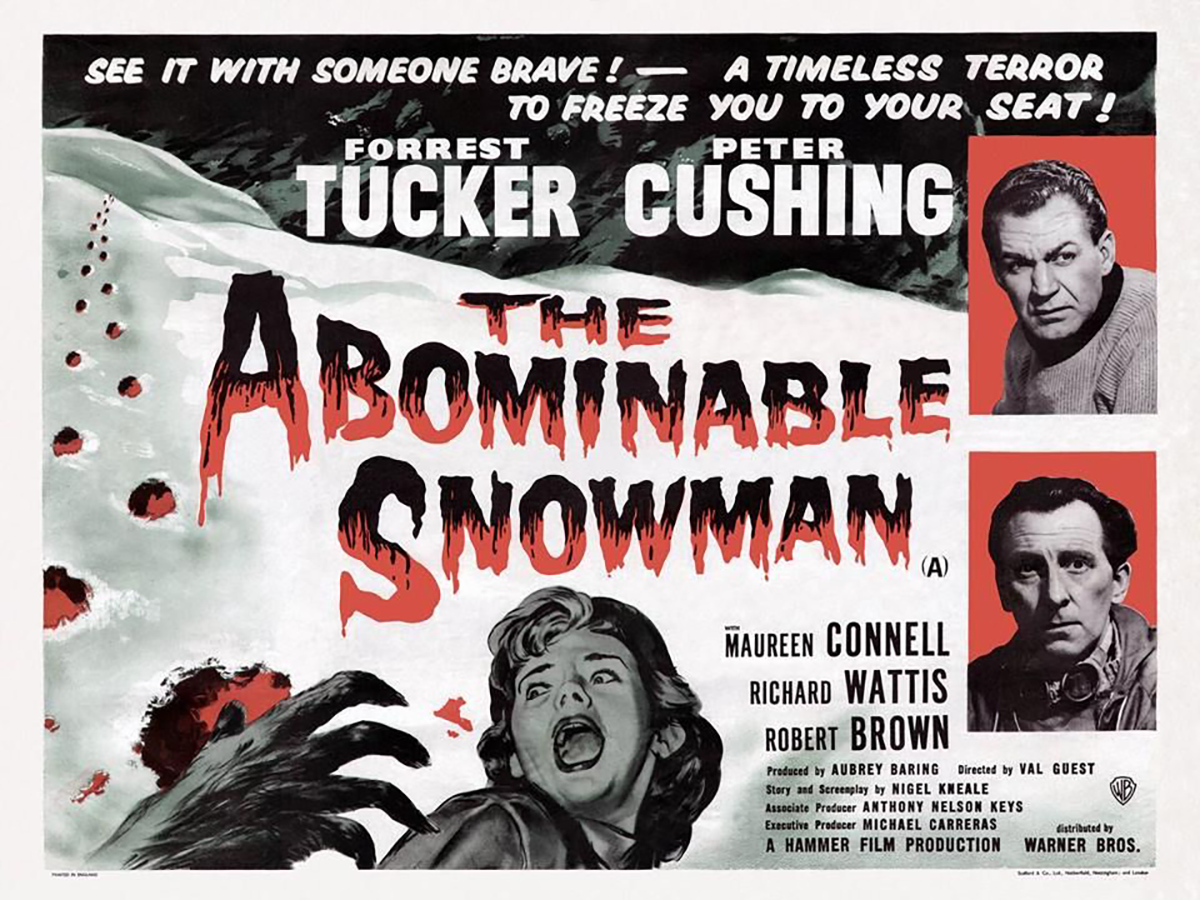
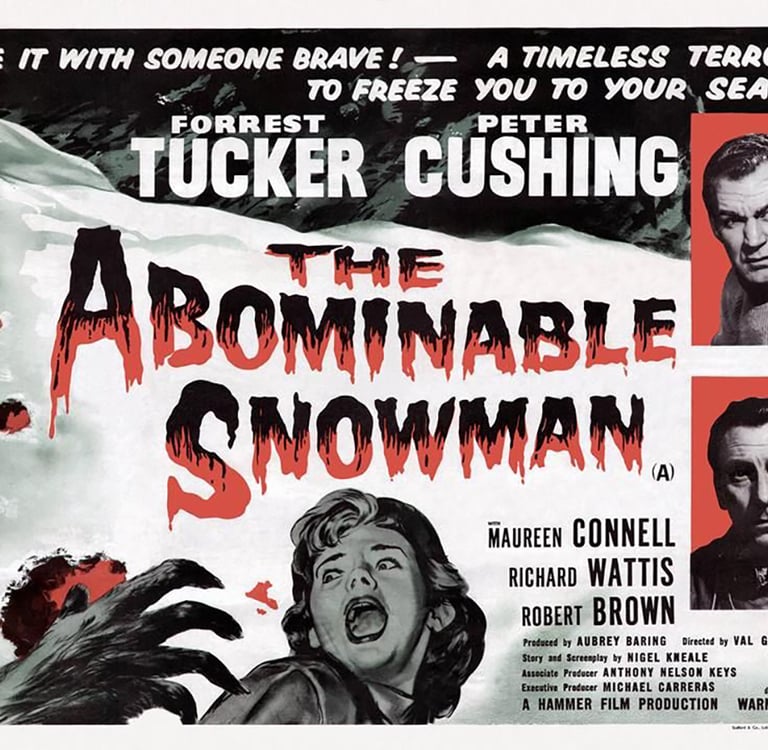
British screenwriter Nigel Kneale concocts a third species superior to man and ape, turning the mythology of the Abominable Snowman and the Yeti on its ear. 1 HR 25 MINS 1957 20th Century-Fox
HORROR/SCIENCE FICTION
written by Gary Svehla
3/17/202610 min read
Story
In the Himalayas, we gather at a temple amid chanting. The High Lhama (Arnold Marle) sits stoically as Dr. John Rollason (Peter Cushing) and his assistant Peter Fox (Richard Wattis) closely examine local flowers. These specimens are new and are used medicinally by the locals. The Lama gives him the flowers to keep with his other specimens, and Rollason declares that the research foundation will forever be in your debt. The Lhama says an expedition will arrive in a few hours. Rollason asks if they have been seen, and he is told no, but they will arrive, nonetheless.
Foxy joins John’s wife, Helen (Maureen Connell), and admits he cannot wait to leave this infernal place, with its cold, bad smells, and superstitions. The Lhama asks John about the expedition led by Tom Friend (Forrest Tucker). Rollason admits not much. The Lhama says Friend was here months ago, but he failed to see him, which is customary. The Lhama asks what this man is searching for and why John wants to help these people. It is apparent that the Lhama is suspicious. The Lhama tells Helen she can stay at the temple while Rollason goes on a climbing expedition with the Tom Friend expedition. Helen knew nothing about the climb, and is fearful since John was seriously injured in a similar climb.
Tom Friend arrives with his party and warmly greets Rollason, introducing Ed Shelley (Robert Brown) and Andrew McNee (Michael Brill), and swearing they will find the creature known as the Yeti. Buddhists stare. Foxy and Helen do not believe the Yeti exists, but McNee announces he encountered one two years ago during an expedition. And Friend possesses a large tooth that obviously belongs to some huge beast. Outside their room, the Buddhists are dressed in costumes and dancing. Returning inside, Friend explains that only five will make the climb, not to alert or frighten the creature. Only one guide, Kusang ( Wolfe Morris), will accompany them, a man who actually saw a Yeti.
Helen, disapproving of her husband going on the climb with the Friend expedition, says she does not like or trust the men and fears for John’s safety. She feels she’ll never see John again. But John is obsessed with finding the Yeti.
As the three men ascend the mountain, they make their way to a cabin by nightfall. After facing some dangerous perils along the way, the men finally find the hut and settle in. Friend has ensured that supplies are planted along the way. Rollason suggests that the latest evolutionary theories suggest that man veered off in one direction, while apes and gorillas veered off in another. Rollason suggests there was a third avenue to follow, one a combination of man and ape. Gradually, the Friend expedition reveals itself as a hunting party, and Rollason is angered by its commercial aspect, while Shelley reveals himself to be a hunter/trapper.
Suddenly, the crew hears a cry outside. The crew moves onward to further explore, while Rollason and McNee stay behind. McNee admits to being obsessed with finding the Yeti and to paying Tom Friend to be allowed to come on the expedition. The duo vows to push ahead and meet with Friend and Shelley. However, without warning, McNee gets caught in one of the modified bear traps Shelley has set, and Shelley reveals that he caught one of those creatures. Returning to Tom and Kusang, they have a four-foot animal trapped in a cage. Rollason says to let the animal go, as it is only a Himalayan Monkey and not a Yeti. Later, Shelley listens to the shortwave radio and hears the weather: snow increasing to blizzard-like conditions. Rollason calls Friend “a cheap trickster.” In the tent, the party hears activity outside and investigates. The cage is twisted, and the monkey is gone. They find 16-inch footprints in the snow leading away from the cage.
McNee, alone in the tent, sees a beast’s hand reach beneath the tent to grab rifles. Kusang enters the tent, sees the furry hand, and screams. Friend and party return to the tent, finding McNee in shock, and Kusang, panicking, running off. Kusang begins descending the mountain, as Friend finds a broken trap in the snow and shows it to the others. Rollason declares, “This creature might have an affinity for man and something in common with us. Remember that before we start shooting.” Friend and Shelley follow footprints in the snow after hearing a pained roar and find a Yeti dead, the Abominable Snowman! Ten or eleven feet of him. Tom Friend wants to get the creature back to camp. Roars of other Yetis echo in the distance.
Back at the monastery, Kusang returns, waking Helen up. The Lhama gives her a potion to drink. He says that she was mistaken about seeing Kusang. And while he says Rollason is indeed in trouble, he can do nothing to affect man’s fate. Foxy then arrives to escort her back. Rollason, asked by McNee to describe the Yeti, says, “It was nothing ape-like about it; it’s nothing human either. I felt it had a sadness, and it’s probably only a surface resemblance, wisdom.”
Friend and Shelley pull the dead Yeti to a cave, where howling is heard outside. McNee ventures outside the tent alone. Rollason and Friend witness as he walks further up the mountain without gloves and one boot, ignoring cries to come back. Then his foot fails, and he plummets off the ledge, hitting a rock below, dying. Friend declares, “They killed him … it was the sound of that howling!” A gunshot is fired in the distance. As the men approach Shelley, giant footprints are around him. Partially in shock, Shelley tells of seeing two Yetis charging him. Shelley says the Yeti know he killed one of their own and are after him.
Friend has Shelley act as a decoy in the cave, ready to spring a steel net. Twitchy with fear, Shelley nervously waits. A blizzard starts, with heavy snow and strong winds. Rollason begs Friend to give up his pursuit of a live Yeti and settle for the dead one. But Friend cannot be deterred. Rollason says, “Listen, it’s strong, intelligent, and it may have powers we haven’t even developed. It might have inherited the Earth, and something went wrong, and here it is, the last species hiding away in misery and despair, waiting for final extinction.”
Suddenly, a growl is heard, rifle shots are fired, and twisted metal sounds. Shelley is in mortal fear, his rifle failing to fire, leaving him powerless against the Yeti. As Friend and Rollason venture out in blinding snow to help, inside the cave, Shelley cries out for help. When the rescue finally arrives, they find the steel net ripped to pieces and Shelley dead. He has no marks on him, and Rollason concludes he must have suffered a heart attack. Examining his gun, Rollason finds it was loaded with dummy ammunition. Friend wanted to be sure to get a living Yeti, so he loaded Shelley’s rifle with dummy shells.
Returning to the cave, Friend gives a short speech about being prepared for the creatures, while Rollason says, “McNee died from an accident, Shelley died of his own fear. It’s not much up there that is as dangerous as what’s in us.” Covering the dead Yeti, Rollason wonders how old that face is. He claims it is 100 years old, perhaps more. “This isn’t the face of a savage thing; there’s gentleness … perhaps we are the savages. Perhaps to them, we’ve been in the dark ages. Perhaps we are not ... thinking man… but man the destroyer.” John surmises that the Yetis live in the barren Himalayas, waiting until man dies out, and their time will come to rule.
In the cave, Rollason thinks he hears the busted radio telling everyone to abandon their gear and rush to home base, and Tom Friend thinks he hears Shelley’s voice crying for help. Falsely believing Shelley is still alive, Friend breaks out of the barricaded cave entrance to search for him. Friend fires his pistol, starting an avalanche that buries him as he quietly waits in the snow. Rollason digs out of the cave trying to find him, but John quickly realizes his quest is useless.
Rollason returns to the cave, where he soon sees the shadows of two Yetis. Rollason sits and waits as two Yetis approach him, one of whom exposes his eyes and part of his face, until John finally passes out. Helen, who is partially up the mountain, her expedition taking her closer to John, is awakened by distant howling and ventures outside into the snow. Helen, struggling to walk in the dense wind and snow, sees John propped up against a rock. Helen gets him down and cradles him; a quick pan reveals Yeti tracks nearby.
Back at the monastery, Buddhists are chanting again as the Lhama expresses condolences to Foxy, Helen, and John. John says he was wrong; what he was looking for does not exist. The Lhama slowly expresses, “There is no Yeti.” And then we have one final pan of the Himalayas as credits appear.
Critique
Hammer's The Abominable Snowman (The Abominable of the Himalayas in the USA) was made the same year as Curse of Frankenstein, filmed first but released after it. Thus, The Abominable Snowman was Peter Cushing’s very first Hammer Film Production. He arrived at Hammer fully developed, with an eye for small props, a keen intellect, a sympathetic nature, a background in odd sciences (in this case, horticulture), and an obsession with discovering new avenues of knowledge. Cushing came to Hammer as a treasure and left as one.
With American Forrest Tucker as Tom Friend, this is another example of the British film industry hiring an American to secure wider distribution and box-office returns. The Trollenberg Terror, as previously discussed, did the exact same thing with Forrest Tucker. And the first two Quatermass films employed American Brian Donlevy.
Nigel Kneale was the British author and screenwriter who created the Quatermass series. The Abominable Snowman was originally based on his 1955 play, The Creature, which was broadcast on BBC television and starred Peter Cushing and Stanley Baker as Tom Friend. The play was expanded into the 1957 movie, also starring Peter Cushing.
The movie highlighted the conflict between pure science and commercial interests. This scientific pursuit was contrasted with the Tom Friend expedition, whose goal was to profit from scientific discovery and exploit it. Dr. Rollason believes he will be climbing with an expedition dedicated to improving mankind, but he slowly discovers that Friend has hired a tracker-hunter to capture the Yeti and bring it back to civilization to exploit it.
The scenario assumes there were three evolutionary tracks for mankind: man, ape, and a third combination. Nigel Kneale assumes this third species lurks in the shadows, in the most desolate section of humanity in the Himalayas, awaiting mankind's death so it can take over. When we compare the purely altruistic interests of the Yeti and Rollason to the cold-hearted commercial interests of Tom Friend and his hunting expedition, we can quickly see that the Yetis are more than worthy to take control. The Yetis save Rollason by taking him down the mountain to be discovered alive by his wife, Helen. The people killed have no marks from these superior creatures but have simply succumbed to heart attacks, fear, or other natural causes.
The Lhama, a Buddhist, is the Yeti gatekeeper, denying their existence in any form to keep vicious mankind away from them. Even Professor Rollason clearly sees what the Lhama is doing and also denies that the Yeti exists in the final sequence. He recognizes the humanity in these non-human beings who long to be alone.
Directed by Val Guest, who helmed the first two Quatermass films, he was very familiar with translating Nigel Kneale’s intellectual screenplays to the screen, earning co-screenwriter credit. Kneale was most interested in expressing his sometimes profound ideas in his movies, but while Guest respected these ideas, he also knew he was directing a movie that required action, conflict, and suspense. He was the cinema master who translated Kneale’s complexities to the screen. In other words, each needed the other.
The blending of stage-bound sets with second-unit footage from the recently filmed French Pyrenees (subbing for the Himalayas) gave the modestly financed Hammer production a bigger-budget feel. But Hammer was famous for stretching its budget to add value to its movies. Hammer always distinguished itself from other low-budget productions, which found it difficult to compete creatively.
Although the credits list Exclusive Films rather than Hammer, most of the Hammer luminaries appear: John Hollingsworth, Arthur Grant, Bernard Robinson, Don Weeks, Len Harris, Phil Leakey, Molly Arbuthnot, Anthony Nelson-Keys, Val Guest, Bray Studios, and Michael Carreras. The British credit the widescreen process as HAMMERSCOPE, but the Americans changed it to REGALSCOPE. However, Abominable Snowman remained pure Hammer without using that moniker. This marked the end of its black-and-white films, as it transitioned to color with The Curse of Frankenstein. Still, some psychological thrillers were filmed in monochrome.
Hammer was known for generating suspense, as shown by the creatures' guttural howls, their silhouettes, a furry claw reaching under the tent, gunshots, and giant footprints in the snow. When the Yetis are clearly shown in a climactic sequence, the standout shot captures the Yeti’s face and eyes. Even the man whose eyes were shown in this scene was not given screen credit, but is known to be John Rae.
A film that portrays the Yeti as superior to man in intelligence and empathy, managing to flatten its audience’s ego and crippling its popularity by criticizing most of its ticket holders, is bound to be less popular. In spite of this, The Abominable Snowman is perhaps the greatest Yeti movie made to this day, because the Yeti is not simply a Bigfoot-style monster but a third species superior to man.
The idea that humankind is number two is not a popular one, but looking at our country today, the concept is more than clear. The Abominable Snowman is a superior thinking man’s monster movie, and it seems made more for adults than the kiddie trade. It’s another reason Hammer ruled supreme even before the Gothics appeared. So much can be said with very little money, and we seem to have lost that concept today.
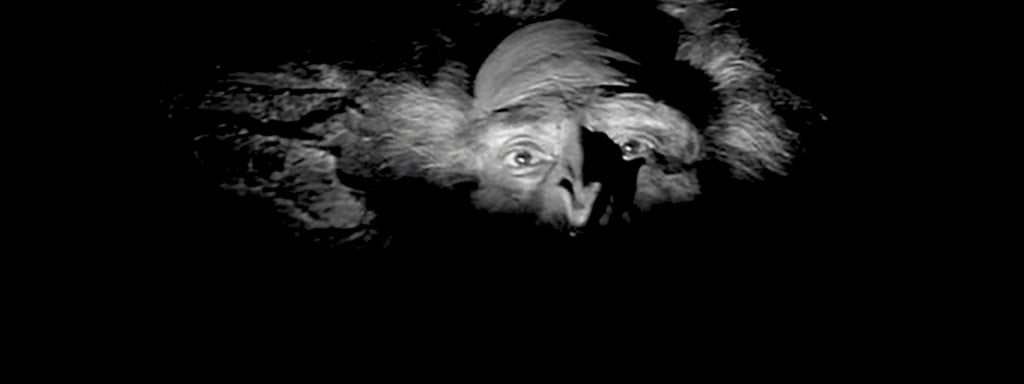
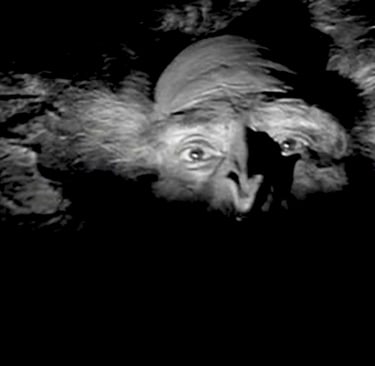
THE YETI APPEARS TO ROLLASON, EXPOSING HIS PIERCING EYES AND FACE.
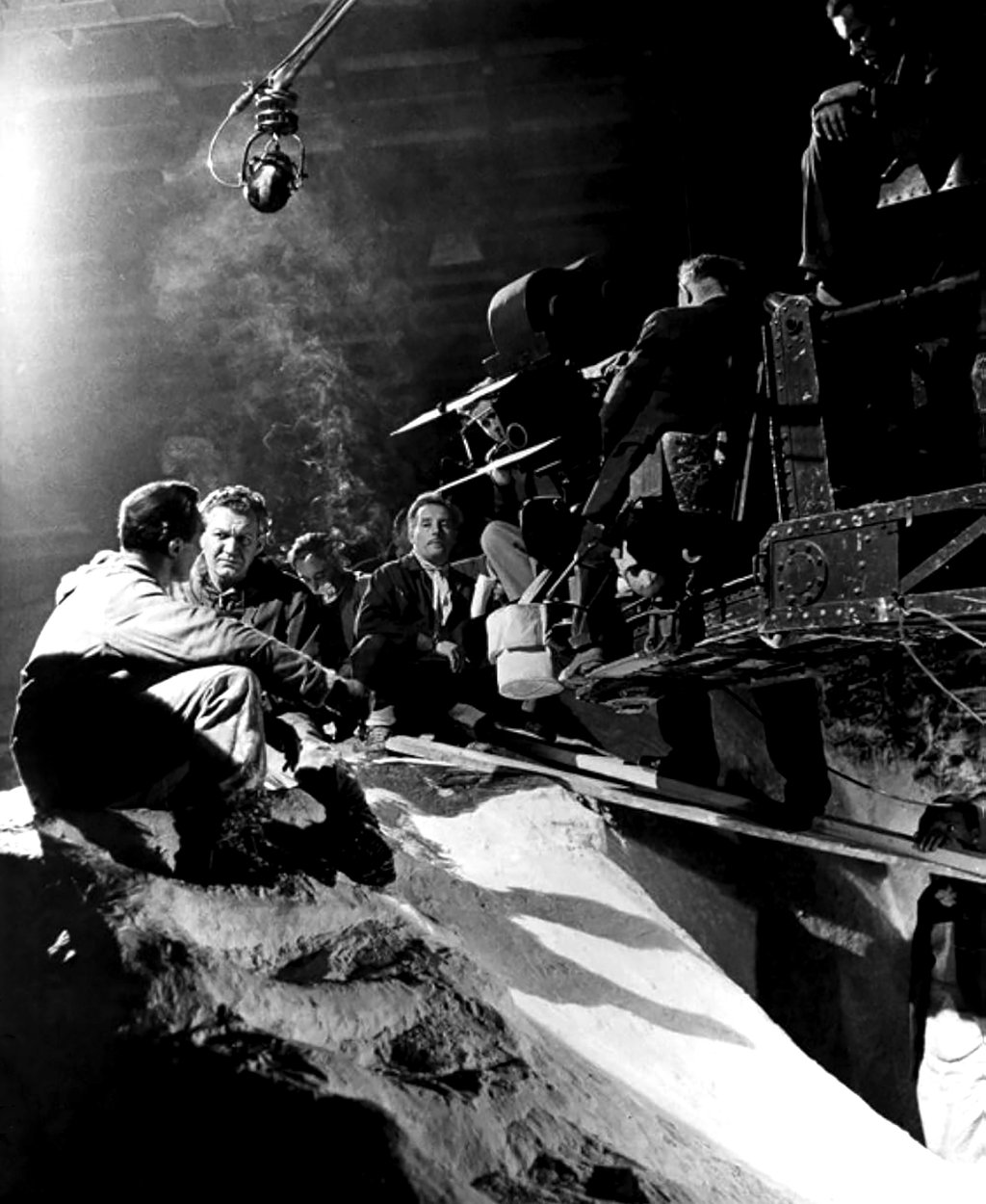
PETER CUSHING AND FORREST TUCKER WITH THE PRODUCTION CREW ON THE SET.
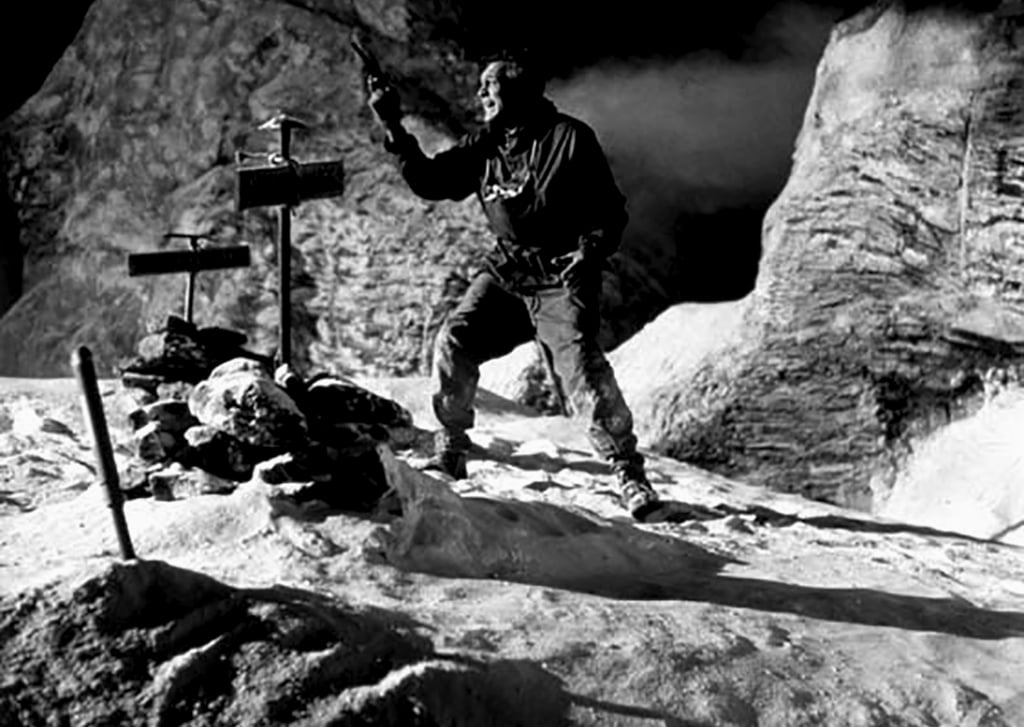
TOM FRIEND RUSHES OUTSIDE THE CAVE, FIRING HIS GUN, STARTING AN AVALANCHE.
garysvehla509@gmail.com