
Tarantula
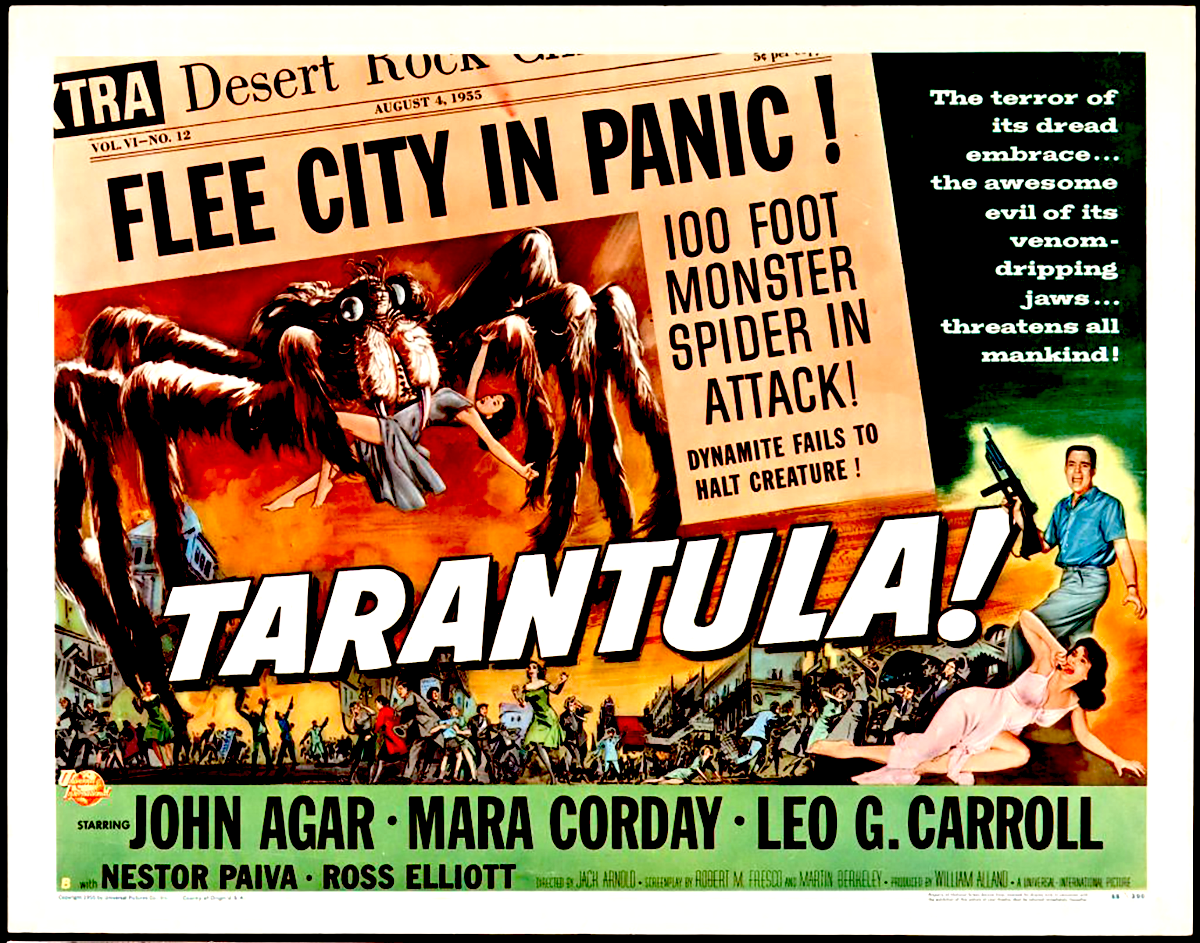
In small-town America, a doctor finds the way to create increased nutrition for expanding populations, only to create human mutations and animal growth. 1 HR 20 MINS 1955 Universal-International
HORROR/SCIENCE FICTION
written by Gary Svehla
7/20/20267 min read
STORY
Scanning the Western US desert, a man enters the frame, a man wearing pajamas and staggering as he walks. He soon falls, and then rises. We see his mutated face, very simian-like. The man staggers and falls again, predatory birds flying overhead. As he lies face down, his right hand digging into the sand, we pan up to survey the desert as credits appear.
A small, private plane lands at Desert Rock Airport, and Dr. Matt Hastings (John Agar) exits, commenting, “The desert gives people wonderful ideas.” He enters his waiting convertible and drives to a small desert town. There, he enters his medical practice and almost immediately receives a phone call from Sheriff Jack Andrews (Nestor Paiva) asking him to come to the sheriff's office.
The sheriff announces that his men found the mutated human this morning, who looks like nothing he has ever seen. Jack says he looks similar to a man named Jacobs. He is a biologist who works for the mysterious Professor Deemer (Leo G. Carroll) out in the desert. Hastings went over to Deemer’s when he first opened his practice, but he never felt welcome, so he never went back. Deemer is coming over to identify the body. In the meantime, the sheriff asks Deemer to say why he looks that way and why he was missing. Both Hastings and Deemer say it looks like acromegaly, the pituitary disorder that causes distortion of the face, hands, and feet. But Matt says he saw Jacobs two years ago and saw no signs of disease, which takes many years to progress. Deemer says his deformity came on suddenly just days ago.
Professor Deemer returns home and enters his laboratory, where he injects a serum into a white rat, while we see giant rats in the cages behind him that have been injected for longer. Then Deemer holds a small cage housing a normal-sized tarantula, while a man-sized tarantula runs around in a glass cage behind him. Then, squirming behind a door, another human mutation sneaks up on Professor Deemer. The disfigured human attacks Deemer, swinging a chair and smashing the cage that houses the giant tarantula. While Deemer fights for his life, the giant tarantula slowly walks outside, and the lab erupts in fire. The mutant human injects the unconscious Deemer with his formula and then collapses on the floor. Deemer awakens and flees the fiery lab. He returns with a fire extinguisher, but the damage has been done. That night, Deemer buries the mutated human somewhere in the desert.
A woman carrying a suitcase asks how to get to the Deemer place. Matt Hastings appears to say he will take “Steve” Clayton (Mara Corday) with him to Deemer’s place. During the ride, after they introduce themselves, Matt asks why she is going out to Deemer’s house. Steve says she is doing graduate work in biology. Jacobs decided to hire her for the summer after reading her paper on the nutritional effects of expanding populations. Unknown to them, a giant spider follows behind their car.
Finally arriving at Deemer’s place, he is talking to Joe Burch (Ross Elliott) about the damage to his lab. Steve and Matt enter the scene. Deemer makes it clear he wants Steve to stay, even though Jacobs is dead. Deemer shows the duo what remains of his lab. He shows the others a vile of synthetic food which he is working on, saying that the food supply diminishes as the population swells. Receiving a phone call that forces Hastings to leave, Deemer asks him to perform an autopsy on Jacobs. But Hastings discovers nothing. At the same time, Deemer is teaching Steve his work. Deemer starts to rub his shoulder as he works.
Hastings runs into Steve in town and offers her a tour of his favorite place, the desert. Steve asks Matt to stop where there are mountains of rocks forming fascinating structures. They rest while Steve takes a smoke. Suddenly, rocks begin to fall, triggering a landslide. Steve and Matt run for cover, and the couple immediately leaves. But before they go, unseen by them, a giant spider climbs across the peak of the rock formation.
Arriving at the Deemer house, Steve invites Matt inside to see the giant rabbits. Deemer, strangely, hides upstairs. The one rabbit Steve observed earlier is now much larger. When Matt is called away, Steve is abruptly confronted by Professor Deemer, who tells her his lab is not open to the public and asks why she brought Hastings here. At the same time, his face is beginning to distort.
Matt Hastings returns to the huge rock formation to investigate. While glancing around, Sheriff Andrews sneaks up on Matt. The Sheriff asks why he’s here, and he says he wanted to find the cause of the landslide. Jack relays that a farmer said something was eating his cattle. The farmer says he has a stack of bones to show him. He asks Matt to drive along. Arriving at the ranch, the farmer takes the sheriff and Matt to see the bones, their meat picked clean. That night, the horses grow restless as the giant tarantula comes careening over a hill. The farmer enters to see horses attacked by the approaching tarantula and backs away holding a rifle, which he fires, but the tarantula overcomes him. The creature confronts two men in a truck who drive directly under it. The tarantula easily tosses the truck into the air. Investigating the scene of the wreck, only stripped clean bones are found, and white pus is near the victims, which Hastings discovers is insect venom.
Rushing out to Professor Deemer’s place, Hastings finds Deemer in a drastic state of transformation, which has now horribly mutated him. Deemer drinks some water and utters that there isn’t anything anyone can do. He admits his assistants rushed the formula for food production, injecting themselves with it before the formula’s effects on humans were proven. Hastings is told the insect venom is tarantula venom, enough to be created by a hundred tarantulas.
The tarantula, having grown to its maximum size, dwarfs the highway it crosses. Telephone lines are mysteriously down, cutting off all communication. Two men are camping out in the wilds after dark as the giant tarantula crawls over the hill behind them. The men see the monster approaching and run. Of course, one man falls as the second stops to help him, both men perishing.
Hastings calls the sheriff to order the state police. Hastings speeds toward the Deemer house as the tarantula approaches. Steve prepares for bed as the creature appears outside her bedroom window, leering inside, Steve unaware. The tarantula ultimately smashes one side of the house, Steve screaming and fleeing. The tarantula and the debris it causes kill Deemer as Steve tries to escape the mayhem. Running outside, Steve outruns the mutated creature as Hastings’ car approaches, picking her up and speeding away. The police intercept Hastings and Steve, calling for his men to use machine guns as the tarantula appears, but they do no good, and the police try to run away, but definitely not in time to save their lives.
Hastings tells Jack to call in the military and bring bombs. In the heart of the small town, citizens load dynamite into trucks, ready to defend themselves. Military aircraft take off. Citizens lay explosives across the highway as the giant tarantula approaches in the distance. As the tarantula walks down the road, the dynamite explodes at a specific point, engulfing the monster in smoke. But it emerges unscathed. The men drive back to town, only to see the arachnid approaching. They are delighted by the fighter jets flying overhead. The main commander (Clint Eastwood) barks orders to the others. The four jets drop napalm bombs on the tarantula, striking their target. The creature seems unfazed at first, but gradually the napalm does its work, causing a huge fire that incinerates the tarantula. As the monster burns, the closing credits appear.
Critique
Two years after Universal’s Jack Arnold-directed It Came from Outer Space, Jack Arnold’s Tarantula appeared in 1955. Again, a tribute to the Western desert, Tarantula, co-written by Arnold, deals with the challenges of feeding an ever-increasing world population. Animals are genetically modified to grow larger, allowing them to feed more people.
The special effects, rather simplistic for the time, use a regular tarantula made to look gigantic through special photography that alters perspective, making the tarantula appear larger alongside ordinary objects and people. However, this simple effect works effectively in the movie. At least we get to see the monster a great deal throughout.
The affable John Agar plays Matt Hastings, and his chiseled good looks and friendly manner serve the picture well. He is joined by many in the Universal stock company who are well known and always effective.
The problem of famine across the world is much more pertinent today in 2026 than it was in 1955, but the screenplay writers were forward thinkers and knew the horrors ahead.
Universal was effective in offering two types of creatures in this one science-fiction/horror “B” feature, which consistently kept its audience entertained.
First, we have the human mutants who take the food formula before it has been tested. These men, including the professor portrayed by Leo G. Carroll, are victims of their own impatience (though Carroll himself is a victim of a brutal attack). But they all develop acromegaly within days, not years, which horribly disfigures them more than the disease itself does. The 1940s actor Rondo Hatton, playing the role of “The Creeper,” is the best example of a person deformed by this disease. In the first portion of the film, these human mutants dominate and create the on-screen horrors.
In the second half of the double-bill feature, the horrors are dominated by enlarged animals, mainly the tarantula, which towers over everything it encounters. Mystery and suspense are generated by the way cattle disappear and by small groups of people being threatened by the fiend. The tarantula appears frequently and does not just appear toward the end.
The sets appear to be the same as those used in Monolith Monsters and tend to warm the heart when envisioned. Today, there is an air of nostalgia and a folksy reminder of small-town America that probably never existed, yet it still warms the heart as an American myth.
The musical score created by the Universal house orchestrators is always a plus, delivering rousing, energetic music to enjoy again and again. These scores create so much tension and are memorable, a rarity for “B” movies.
Jack Arnold’s love of the desert, the weird, haunting ground of all things unknown, and the lore of small communities cut off from the rest of the country, which fight like hell to remain intact, constantly demonstrates that the common man can destroy any unknown threat and persevere. Films such as Tarantula demonstrate the power of the everyday citizen to win against overwhelming odds. Back then, the good guy always won, and small-town America was safe once again.
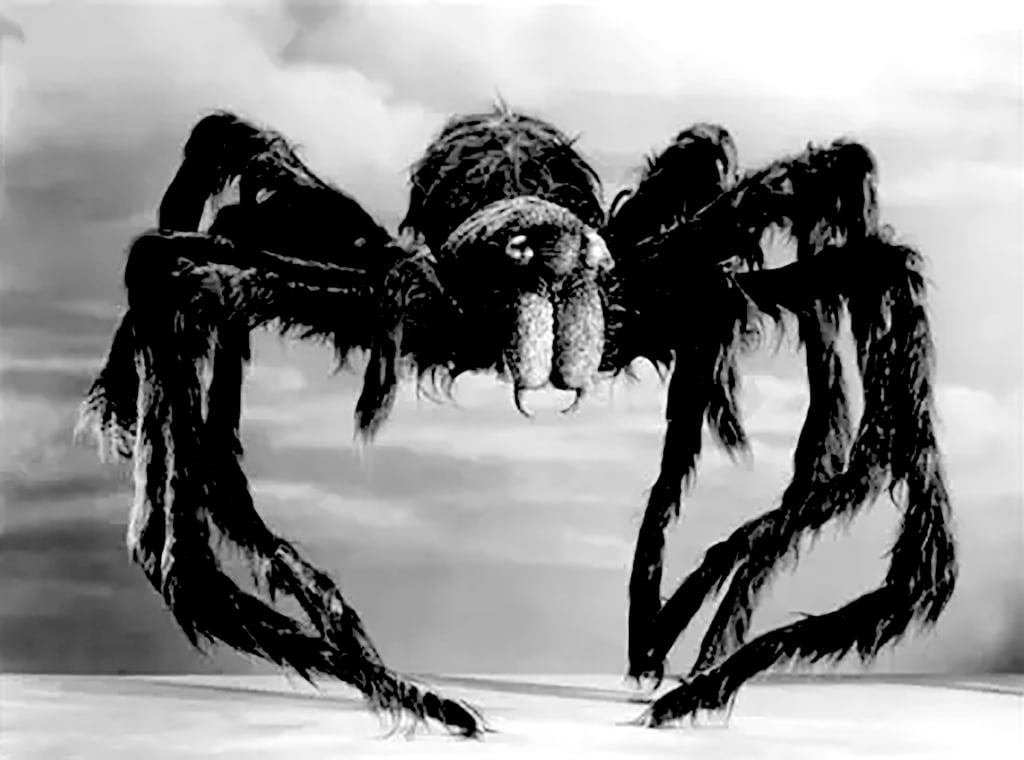
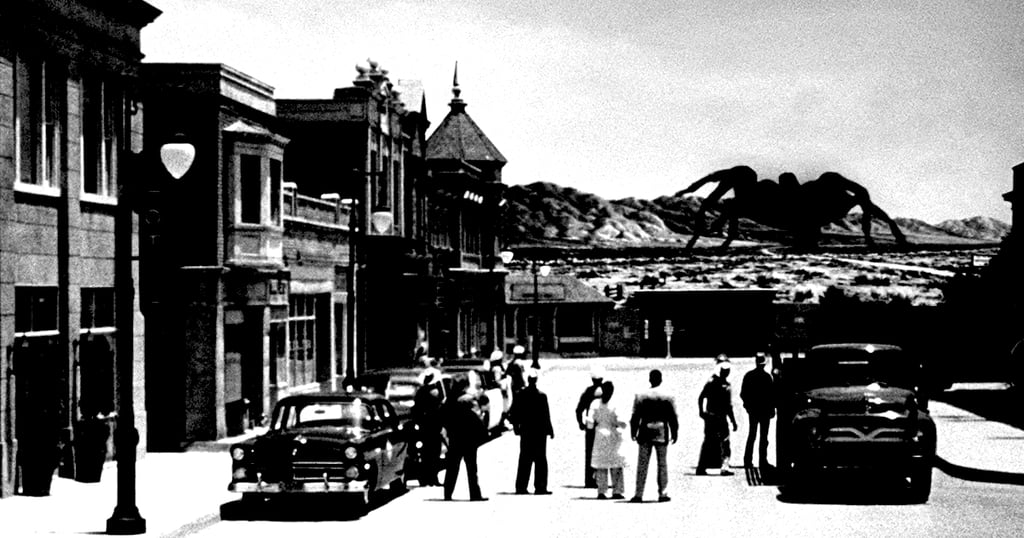
A PUBLICITY SHOT OF A TARANTULA NOT USED IN THE ACTUAL MOVIE.
AT THE CLIMAX OF THE MOVIE, THE GIANT TARANTULA APPROACHES THE SMALL TOWN.
garysvehla509@gmail.com