
Stranger on the Third Floor
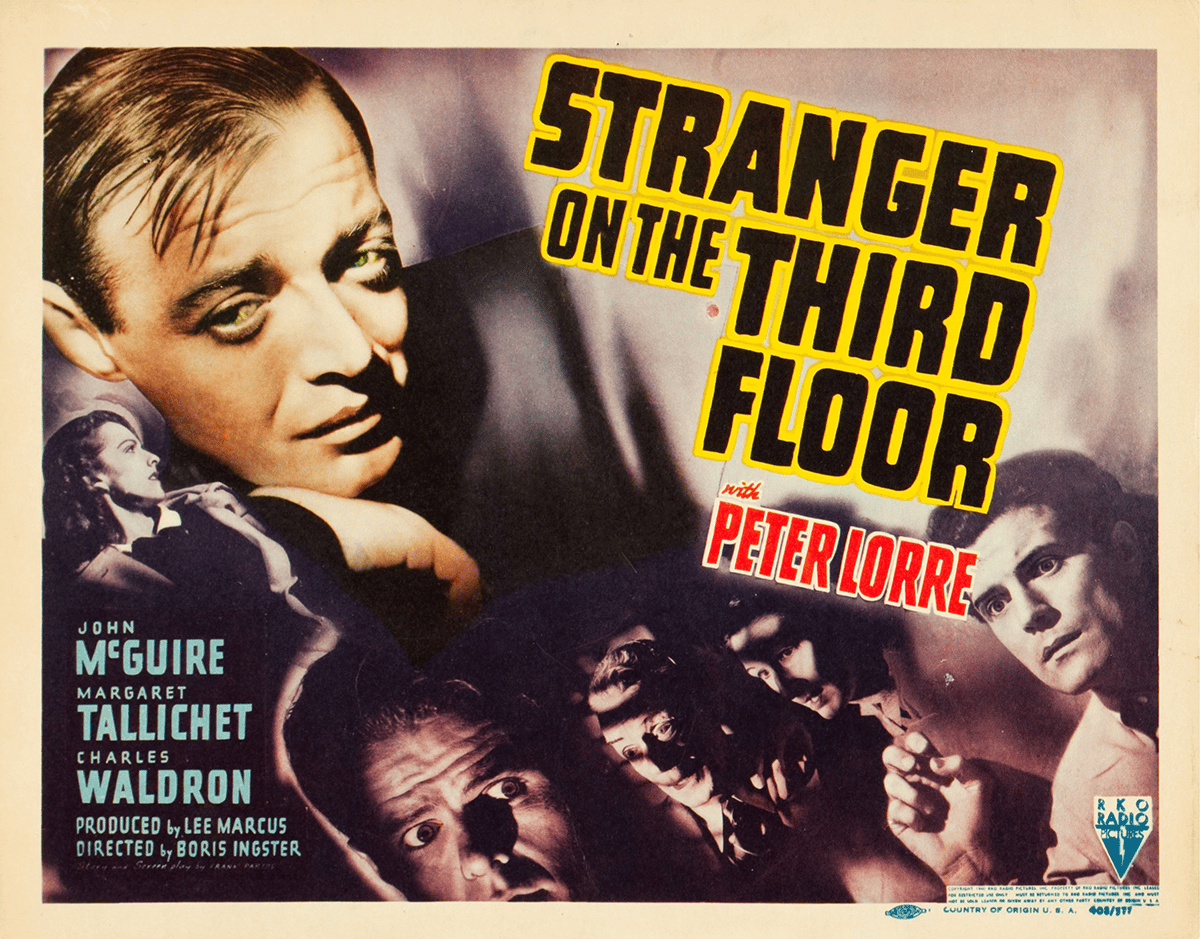
Many consider this to be the first film noir, but what film noir elements does the film contain? 1 HR. 4 MINS 1940 RKO
FILM NOIR/DARK CINEMA
by Gary Svehla
12/22/202510 min read
THE STORY:
Michard Ward (John McIntire) meets his fiancée Jane (Margaret Tallichet) at a crowded restaurant counter, where he shows Jane a front-page newspaper story just published with his byline. He wants Jane to take off tomorrow from work to marry him. Michael announces he earned a 12-dollar raise. For some strange reason, Jane feels Michael would be better off if he had never been involved with the news story.
When the accused murderer Joe Briggs (Elisha Cook, Jr.) is standing trial, Michael testifies against him. Nick was slumped over the register, his throat cut, and Briggs was present, running to the rear of the store. On the stand, Briggs testifies he returned to Nick’s to pay Michael back for a meal he bought him, on the chance he would be there. Briggs says he found Nick already dead. Jane, upset, runs from the courtroom in fear that Briggs might be innocent. The jury finds Briggs guilty of murder in the first degree. Briggs audibly gasps aloud at the thought of execution.
Michael thinks to himself that Briggs might not be guilty, as all the evidence is circumstantial. He wishes he weren’t mixed up in the sordid case. Walking the streets, he finds a stranger (Peter Lorre) sitting on apartment steps, looking quite forlorn. The stranger rises and tips his hat to Michael. They both enter the apartment building. Michael notices what a dump the building is. “It will be a great day in my life when I’m out of here.”
Thinking back two years ago, typing at his desk, the landlady, Mrs. Kane (Ethel Griffies), and tenant, Albert Meng (Charles Halton), burst in, claiming he couldn’t sleep because of Michael’s typing. The landlady tells Michael to stay off the typewriter at night. Looking momentarily outside his apartment, he sees the stranger quickly close the apartment door directly across from him. Then Michael darts outside and catches the stranger leaving the apartment, descending the staircase. “Looking for somebody,” Michael utters. The stranger flees down the stairs and out the front door. He is nowhere to be found. But unknown to Michael, the stranger is hiding beneath the outside staircase. Michael notes, “What an evil face!” As Michael enters his apartment, he notices his neighbor, Meng, is not snoring as he always does, and he begins to think the stranger has done something to him.
Then, in several flashback sequences, Michael thinks about his Meng while holding a knife, recalling past incidents where the neighbor annoyed him so much that he wanted to kill him. Taking a risk by bringing Jane to his rooming house, where he isn't allowed to bring women, he sneaks her in. But soon enough, the noisy Meng and Mrs. Kane burst in, claiming Michael has a woman there. After Michael becomes upset, the couple leaves.
Michael sits in a chair in his apartment. “What’s the matter with me. I’m just tired. I can’t think straight anymore. If I could only drive it out of my mind!” Michael buries his head in his hands as the screen blackens and he hallucinates. Michael finally awakens in a cold sweat, splashing water on his face. Michael now believes his neighbor is alive, so he goes outside his room and knocks on Meng’s door. He finds the door unlocked, so he enters to find his neighbor dead.
In a frenzy, Michael quickly packs his suitcase and leaves his apartment, calling Jane. He asks her to meet him in the park and bring all the money she can. Panicking, Michael says that once they find Meng’s body, the police will probably arrest him and charge him with the crime. Before saying goodbye, she gives Michael her cash, but he remembers that both men, Nick and Meng, had their throats cut in identical ways. Michael also suspects the stranger he’s been encountering.
A police siren blares as the stranger hides behind a car, and policemen flood into Michael’s apartment building. A medical examiner says Meng has been dead for about six hours, his jugular severed. Michael tells the detective of a slant that might help them, about a strange man hanging about the building. Michael and the officer see the Commissioner to tell him the theory. Michael is only concerned about clearing Briggs, since he is the one who got him convicted. The Commissioner thinks it is suspicious that Michael discovered both murders.
Jane scours the ethnic neighborhood, stopping at fruit stands and asking if anyone has seen the stranger. But no one, she asks, can help her. Finally, she stops at a small restaurant, exhausted. And then, unseen, the distinctive voice of Peter Lorre rings out, “I want a couple of hamburgers, and I would like them raw.” Just to put a body to the voice, Jane turns to her left and sees the man she has been tracking. “No, thank you, I don’t care for the buns … just put them in some paper. I want to take them with me,” the stranger states. Paying a whopping 20 cents, the stranger leaves. But Jane is curious and follows the man out, where he feeds the hamburger to a famished dog. Jane talks to the stranger and bends down to pet the animal. The stranger wishes Jane and the dog a good night.
Jane sees the stranger crossing the street and flipping his scarf. She asks if he would walk with her, as protection. Slowly, he begins to trust Jane and rants on about prosecution and killing a man. Jane rings Michael’s apartment building and tells Mrs. Kane she must call the police. But the landlady accuses her of being drunk and threatens to call the police on her, which the stranger overhears. The stranger approaches Jane in a threatening way. “Why did you lie?” he asks. Jane panics, saying she made a mistake about the building. The stranger begins to choke her, saying, “You’re here with them!” again raising his voice. The stranger says, “They know I would trust a woman!”
The stranger grabs her when she starts screaming for help. Jane manages to run from him, slipping out of her coat, and the stranger pursues her across the street when he runs directly in front of a truck. The driver stops to examine the stranger and begs Jane to witness what just happened. Before dying, the stranger admits to all the murders, but says, “But I’m not going back.”
Michael meets Jane in the same busy restaurant where they met at the beginning of the picture, but this time he has the marriage license to marry Jane officially. As they fetch a cab, the couple is delighted to see that the driver is Briggs, who offers them a free ride.
THE CRITIQUE
Even though Stranger On The Third Floor is basically a low-budget programmer, distributed by RKO in 1940, it rises above thanks to Peter Lorre (who delivers a small, stellar supporting role) and its status as the very first film noir. Rather than ask if it is the first noir, a better question is what noir elements are contained within the film? Film noir resulted from the malaise of returning soldiers from World War II and their reinsertion into a changing society. But Stranger on the Third Floor was released in 1940, one year before World War II began. So it fails to address the war's aftermath.
Film noir explores ambiguous morality, where individuals cannot rely on clear-cut parameters of right and wrong, and whether they are doing the right thing in a highly complex world. Michael Ward is such an individual caught up in a moral dilemma. He witnesses the murder of shop owner Nick, sees him with his throat cut, leaning over the cash register, and also sees Joe Briggs running to the rear of the shop and fleeing outside. It’s pretty apparent to him that Briggs was the escaping murderer. And he so testifies at Brigg’s trial. But his girl Jane has an intuition that Briggs just might be innocent. When Briggs is ultimately convicted of first-degree murder, Michael is even less sure he’s the cold-blooded killer, and guilt clouds his every thought.
In another film noir trope, we encounter a series of flashbacks featuring Mr. Albert Meng, the noisy neighbor, who teams up with Mrs. Kane, the landlady, to make life more miserable for Michael. He is a reporter who writes and types at night, but Meng complains that the typing keeps him awake. In another sequence, spying Meng reports that Michael is bringing a woman to his apartment. Of course, this is none of his business, but he is a die-hard whiner. Michael eventually hates his neighbor and says he wants him dead, but not really. Michael is simply agitated. He relates his personal feelings for Meng to his testimony in court for Briggs.
Sitting in his room at night, burying his head with his hands, he begins to dream. Such stylized hallucinations were a standard trope of film noir, even in the cheapies. As Michael wrestles with his conscience, his face and head covered in shadows, the room grows totally back—the Roy Webb music crescendos. A voice cries, “Wake up! Why did you do it? A crowd of people appears behind him, yelling, “Why did you do it?” The people yell for him to confess. Michael, engaged and scared, yells, “I didn’t do it!” The sound of a newspaper boy implores people to “Read all about it.” The scene melts to one of Jane reading the headlines, “Reporter Indicted For Meng Murder!” Jane screams out. Hundreds of similar newspapers whirl together, merging into another highly stylized sequence, where MURDER is featured in giant print on several newspapers.
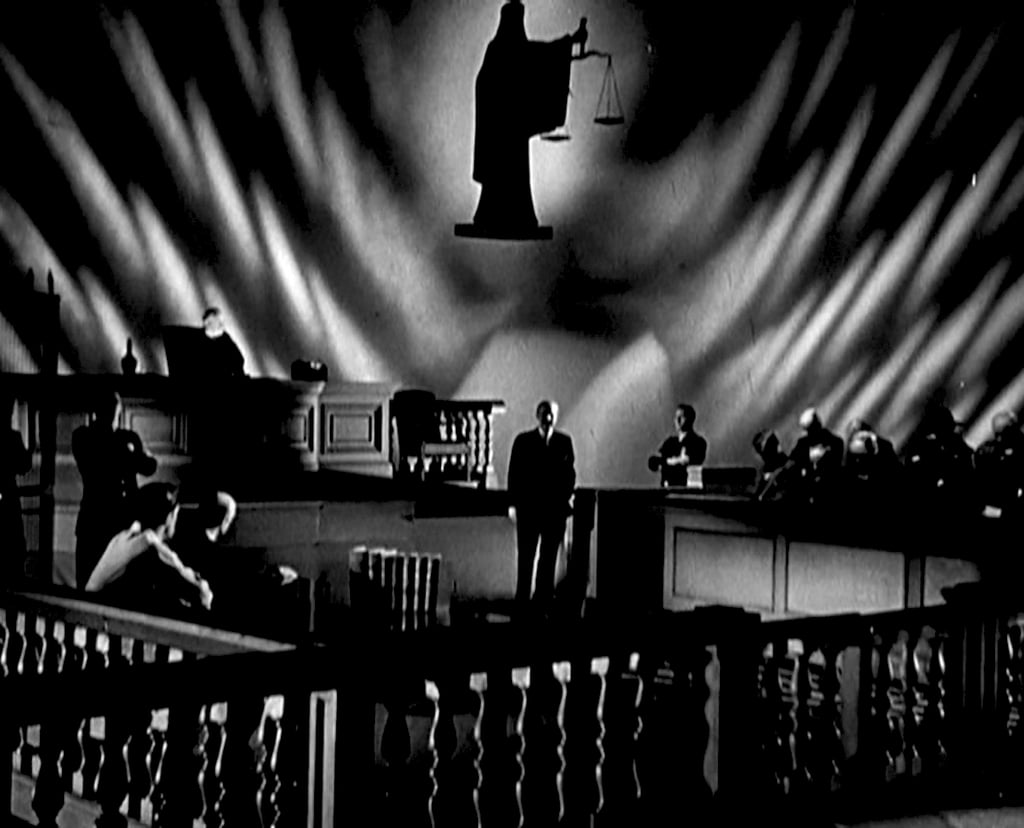
That scene melts into another, one of Michael in prison, visited by Jane as one policeman watches. Jane cries out to Michael, “Why did you do it?” He blames the stranger he saw. He asks, “Do you believe me?” And when Jane doesn’t answer, he yells, grabs her, and shakes her. The next scene introduces his lawyer, who demands to know the truth: “Did you do it?” When Michael sincerely answers no, his lawyer breaks into laughter and says, “That’s what they all say!” The lawyer advises him to plead guilty and throw himself on the mercy of the court. The attorney laughs even louder as the next scene fades in. We are now in a minimalist courtroom where a lawyer is arguing that Michael Ward killed Albert Meng. Then we see several witnesses testifying against Michael, including a hesitant Jane. The trial and grilling of Michael continues.
When Michael makes an impassioned plea to the jury, their heads are all down, asleep. He shouts to the judge that none of the jury is listening. Suddenly, the stranger appears in a gallery of one watching the trial. When the judge asks for the jury’s verdict, they all stand pointing at him, “Guilty!” Michael points out the stranger in the audience who flips his scarf as Michael pleads. But the judge stands and announces that Michael will be sent to the State Prison and put to death. This scene melts into one where Michael declares he’s not afraid to die but asks the priest to believe him. Before he answers, the laughing figure of Briggs appears, mocking Michael. Briggs tells him, “Go and die!” Michael takes that long, last walk and enters a room where a giant silhouette of the electric chair hovers. As Michael is slowly led to the chair, Meng, alive, appears, and Michael, screaming, points him out to the police, who continue to ignore him. Yelling, “He’s alive,” the scene ends, focusing on Michael’s face.
The stranger is merely a convenient piece of the puzzle. While at first, Michael suspects Briggs, just as circumstantial evidence led the police to suspect Michael of the murder of Meng. Neither man is guilty of murder; they were just in the wrong place at the wrong time. The stranger is The Other, the foreigner who is guilty because of his probing eyes and accent. True, he acts mysteriously around Michael, but he does not commit any crimes. He stands out as a foreigner, different, and to be feared.
Jane hunts down this stranger to save Michael, only to exhaust herself trying to find him. Jane runs up to the stranger, who, agitated, asks, “What do you want! Why are you following me?” in a gradually lowering voice. Jane says they are going in the same direction, so perhaps they could walk together. The stranger says, “Come along, I’ll see that nothing happens to you.” When Jane mentions the murder at number 39, which the stranger seems unaware of, he grows excited again and says, “Were you sent here to take me back? Don’t you know? The people will lock you up. How do I know I can trust you?” She nervously answers, “They wouldn’t send a woman, would they?” The stranger laughs and says, “No, they wouldn’t.” He says the only person who was kind to him was a woman, “But she’s dead now! … They could lock you up, and put you in a shirt with long sleeves … that man said he was going to report me, so I had to kill him.” Jane says, “This is my apartment. Won’t you come up for tea?”, intending to contact the authorities. But this is really Michael’s apartment, and the landlady sends her away, threatening to call the police. Then the stranger suspects Jane of working with “Them.” This greatly agitates the stranger, who literally drags her away.
Who is the paranoid-causing “Them”? Could they be agents of a corrupt but all-powerful government that the stranger fails to conform to? Or, since he is wearing a long-sleeved shirt, could he be a mental patient in a straitjacket? Obviously, a mental patient. He slips and confesses to murder while conversing with Jane. But with murderous and insane intentions, he spends his own money to feed a famished dog. He might be a killer, but he has a heart, even though he may be a paranoid schizophrenic.
I do not know if this is the first film noir. Still, the hour-long movie features flashbacks, narration of people’s thoughts, moral ambiguity, stylized minimalism sequences, and scenes of a psychological nature. It dots the “I” of major film noir conventions. It reflects film noir in many key aspects of the story. But rather than building a film noir framework, it accidentally hits on important film noir tropes. Since film noir did not exist in 1940, the director had nothing to conform to. Just like film noir, aspects of this movie occurred by happenstance and dumb luck. Even if the film is a perfect model for noir, it did so by accident, not by intent. But it was leading filmmakers to film noir.
As for the movie, Stranger On The Third Floor is a superior “B” film programmer, with a quirky Peter Lorre performance, an extended, stylized sequence, and a hero whose moral choice is unclear, rattling him to the core. It illustrates that when an individual does good, that individual might in fact be doing great evil. And Karma might be a bitch. One expects thought-provoking dilemmas in “ A” pictures, not in low-budget programmers. Stranger On The Third Floor delivers the goods! It remains a superior "B" movie.
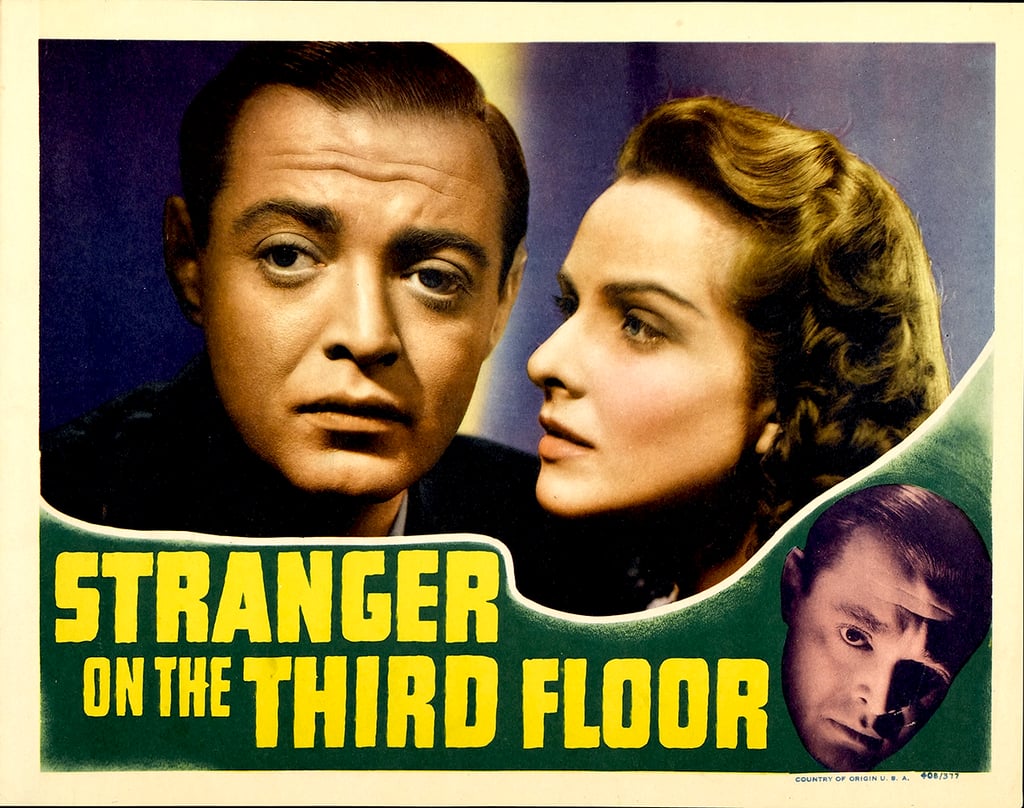
A LOBBY CARD FEATURING THE STRANGER (PETER LORRE) AND JANE (MARGARET TALLICHET)
A STYLIZED DREAM HALLUCINATION SHOWING THE COURTROOM AND TRIAL.
garysvehla509@gmail.com