
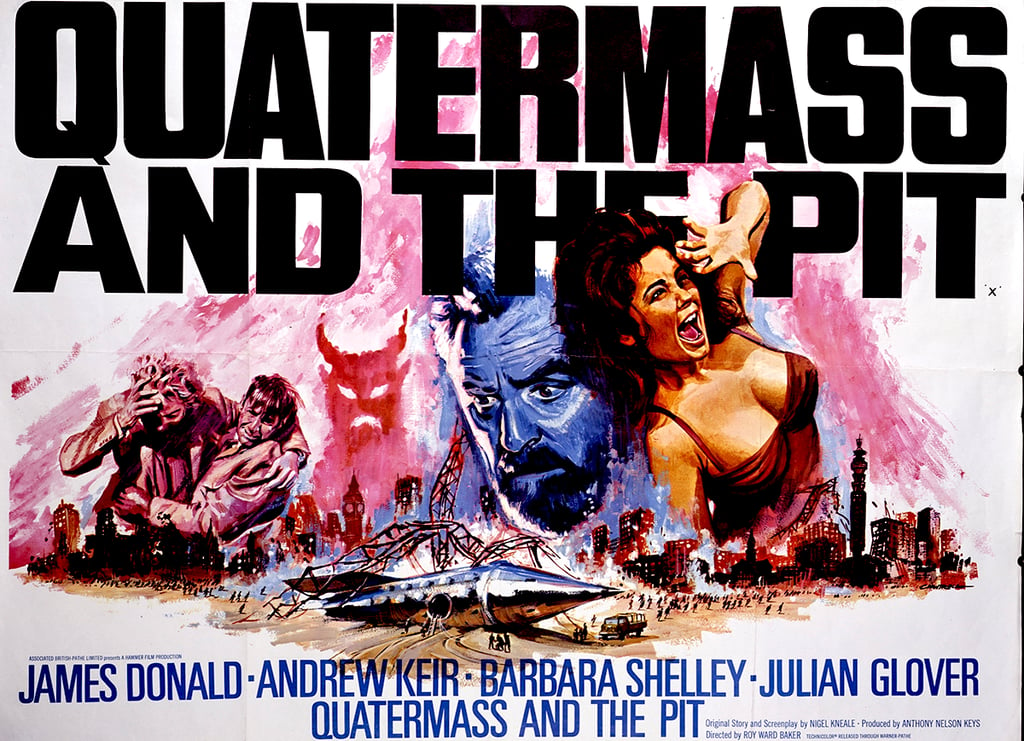
Quatermass and the Pit (aka Five Million Years to Earth)
Potential Martians, resembling horned demons, suggest that humanity was genetically altered to evolve into modern humans. 1 HR 37 MINS 1968 20th Century-Fox
HORROR/SCIENCE FICTION
written by Gary Svehla
8/10/20268 min read
Story
An English policeman walks his beat at night, stopping at the Hobbs Lane Underground station, where men are working to renovate it. While collecting rock on a conveyor belt, a strange-shaped skull is found. As the workers dig into the wall, full skeletons are unearthed. Newspapers herald “Underground Ape Man” as curiosity seekers try to enter the renovated portion of the station.
Doctor Roney (James Donald) holds a press conference at the site. He asks the public to demand that the scientists extend their stay to learn more about their discovery. He proclaims that creatures similar to man walked the earth 5 million years ago. Roney has had a sculptor recreate a model of what the creatures most likely looked like. Roney and his crew need more time to get everything out. Citing an unexploded bomb that was recovered, it is part of the exterior of a spacecraft. Many members of a bomb disposal crew enter Hobbs Lane Station to dismantle the weapon. Examining the partially uncovered haul, Colonel Breen (Julian Glover) concludes that the ship’s surface is not actually metal and is foreign matter to Planet Earth.
Enter Professor Quatermass (Andrew Keir), who is speaking to Colonel Breen (Julian Glover), declaring his research group exists for peaceful scientific research. The government men talk about their policy change, which seems to disgust Quatermass. They speak of military bases with weapons on the moon and Mars. Quatermass speaks of a new age of discovery, one without war. The government official announces that Breen will be joining the rocket group by the end of the week.
Breen and Quatermass travel to Hobbs Lane Station to eyeball the mostly uncovered ship, which Breen feels is a German weapon from World War 2. Near the vessel, men unearth another skull. Roney declares that it’s no bomb and tells Quatermass these beings are around five million years old. Quatermass speaks with an elderly constable who said that here in Hobbs Lane (a nickname for the devil), various haunting paranormal activities occurred when he was little.
Quatermass goes to witness the work being done at Roney’s research facility. Roney hopes to discover what the ancient, five-million-year-old humanoid man must be thinking and feeling. Roney feels these creatures were of this Earth, not aliens. Quatermass must leave the facility to return to Hobbs Lane Station. As Quatermass is leaving, he is confronted by Barbara Judd (Barbara Shelley), who has brought something to show him: newspaper articles from August of 1927 that report construction at the railway station was held up by strange phenomena.
Back at Hobbs Lane Station, the vessel has been uncovered and shined up. Welding equipment cannot penetrate its surface. In fact, the surface is not even warm. Investigating the interior, Quatermass discovers perfectly drawn pentagons. After Quatermass exits the ship’s interior, one soldier screams inside, saying he saw a figure inside the wall. Barbara Judd asks, a figure small like a hideous dwarf? Quartermass and Barbara discover that Hobbs’s Lane is notorious for paranormal activity. Westminster Abbey has records that, as far back as 1641, there were reports of imps and demons manifesting. All the hauntings throughout history occurred underground.
Quartermass returns to Hobbs Lane Station to find a military man, Sladden ( Duncan Lamont), trying to cut through the storage vessel with a super saw. Quatermass wants all operations to be closed, but Colonel Breen says the station's extension will proceed. Quatermass enters the vessel and encounters Sladden. When the man tries to cut through the haul, the saw wavers.
Trying for a second time, the saw fails once more. The third time produces a deep, rumbling vibration. And the three men are impacted by the noise. Roney and Judd return to the station just as the machines are powered down. Returning to the scene of the drilling, a small hole now appears, looking not like drilling but like melting. And the ship’s wall burns and crumbles, revealing a glass-like wall behind with insect creatures. Quatermass calls them demons.
The creatures are long dead but intact. The stench is like rotting fish, but Quatermass describes the creatures as locusts. These creatures, when exposed to Earth’s atmosphere, quickly deteriorate. Quatermass helps grab one of the creatures. The creature gradually drips and decays. Similar creatures are removed from the ship. Examining the interior of the ship, Quatermass concludes the ship seems to run by itself, without propulsion. Scientists cut into the bug’s body, producing fountains of green blood. Another creature is slowly being dissected. Roney describes them as arthropods or insects. Quatermass describes them as the horned demons in old prints. He calls them devil demons etched into our minds. Roney says the creatures are dead, but a few million years ago they could have been teeming with life. Quatermass thinks aloud, could these creatures actually be Martians?
Quatermass is called before the angry Minister of Defense, barraged with never-ending phone calls, perturbed that Quatermass went to the press. Quatermass stresses that these creatures are not of this world. He theorizes that millions of years ago, these creatures, potentially from Mars, visited Earth, where human-ape creatures roamed. They most likely came here to colonize this planet when their own atmosphere was doomed. Quatermass assumes these man-apes were taken to alter them, to change their genetics. And they were returned to Earth with higher intelligence. The Minister repeats that our course of human development is controlled by insects. Breen still theorizes that the vessel was a German propaganda rocket from World War 2 meant to terrorize us.
Sladden returns to the rocket at Hobbs Lane, and Barbara Judd returns as well, having forgotten to take out important equipment. Suddenly, a loud vibration erupts from the vessel. Objects start flying around the ship haphazardly. Soon, objects start to fly around outside the ship. Suddenly, Sladden jerks and seems to fall into a trance following the flying objects, passing and ignoring Judd. The harsh wind continues at the station’s exit, still transporting the man along. The energy storm extends farther as Sladden attempts to scream. The howling wind hits an outside food stand and creates havoc. The man, seemingly free of the mayhem, drifts into a cemetery and collapses as the ground below him ripples.
The next day, Barbara and Quatermass journey to a church, beckoned by a preacher who shows them Sladden, totally exhausted, sitting in a chair. The preacher says he felt sure this man had been in contact with spiritual evil. The man, half aware of his surroundings, simply stares off into space. The man screams, stating he had to run to get away. “They were coming, them!” It is apparent he was chased by hundreds of the creatures, alive, before they flew into the sky. Quatermass feels the man saw a vision on Mars five million years ago. Their powers can be awakened by the thing in the pit. Using scientific apparatus, Barbara taps into memories stirred in the alien ship’s haul, which show the Martian insects being kicked and killed, but the Minister thinks Quatermass is wrong and instead allows workers into Hobbs Lane once again.
While Quatermass confronts Breen. A scream and bright lights erupt from the alien vessel, and one man is dead. Barbara approaches, saying the ship is coming alive. Quatermass attempts to evacuate the underground station, but most people are content to stay put. The vessel soon explodes, and the gathered people panic and rush out. The ship begins to pulsate, its surface arteries appearing. The power force of gusting winds soon returns. Buildings start to collapse, roofs falling in. Small fires erupt. Roney saves Quatermass from the transfixed mob. Breen goes closer to the ship and is burned alive.
Quatermass feels the cosmic force growing stronger again, turning the professor into a trance-like state ready to follow the mob until Roney intervenes. Quatermass, now normal, admits he had the urge to kill Roney because he was “different.” The Martians planned to colonize Hobbs Lane. Soon, a devilish figure, bathed in white light, appears in the sky before white gases that emerge below. Buildings break apart in the turmoil, and the ground splits.
Quatermass asks Roney how to defeat this terror, and Roney declares, “Mass into energy.” Roney explains that they should ground the energy field by attaching a metal object to the earth and touching the apparition. Quatermass, still dazed, looks to save the wandering Barbara, while Roney climbs a huge metal crane. The ground cracks beneath the crane, freeing it to fall directly into the path of the white electronic horned devil. Sacrificing his life, the crane swings into the devil, creating tremendous exploding sparks. The crane then falls to the ground, burning. Still dazed, Quatermass wanders back to the equally dazed Barbara, where the camera lingers, dogs bark, and ambulances sound, as the end titles appear.
Critique
The 1968 Quatermass and The Pit/Five Million Years to Earth is drastically different from the first Quatermass films, The Quatermass Xperiment (1955) and Quatermass 2 (1957). These earlier features were filmed in black-and-white, written by Nigel Kneale, and directed by Val Guest. Quartermass was played by American actor Brian Donlevy to pull in more American dollars. Donlevy played the quirkier Quatermass, obsessed with his scientific work and prone to emotional outbursts. Monotone photography was used, intended to create a gritty, almost noirish look.
The third Hammer Quatermass production, filmed in Deluxe Color, starred the English actor Andrew Keir, whom screenwriter Nigel Kneale considered a far better Quatermass because he was British. But though Keir is a great actor, his Quatermass is more traditional, establishing a calmer presence. Brian Donlevy tends to stand out far more. Even though Quatermass and the Pit is considered one of the top five Hammer productions, the standout script dominates, but I would like to see the movie done in striking black-and-white tones with that old grittiness. Somehow, the third film's more expensive look lacks the look and mood of the superior first two productions. In this case, a stronger budget does not necessarily produce a superior movie. I much prefer Val Guest's direction to that of Roy Ward Baker.
The ultra-intelligent script of Quatermass and the Pit is sometimes confusing and becomes far more complex than it needs to be. The script could remain just as intelligent if it both expanded and simplified the story. In this one, Nigel Kneale, the writer, makes this film difficult to comprehend. The script makes Quatermass secondary to Dr. Roney, who receives top billing and creates the emotional ending by sacrificing himself. Roney ultimately figures out the process for saving the day, even rescuing Quartermass himself.
The trouble I have with the script is the way scientists believe the insect-horned devils were from Mars. Just because Mars is a nearby planet with a fading atmosphere, they assume Martians came to Earth to colonize it. For instance, why can’t these beings come from Venus, another planet with a dying atmosphere? And the manner in which these insect demons with the horned devil look inspired Earthly images of iconic demons, and the look of the dreaded Devil is a bit too far-fetched for my taste. A scientific explanation for religious mythology is, well, unscientific!
And I admit to not fully understanding that a spacecraft whose haul carries memories of a dying Martian civilization is a bit extreme for me and to my mind is never adequately explained. The film of the Martian insects on Mars shows various Martian insects scurrying about, not killing other insects and being killed themselves. The interpretation tries to make us see what really isn’t there to see.
The special effects in a Hammer Film are quite decent but still pale compared to those in other films of the time. The insects resemble mechanically-made models, while the ape-human skulls are effective. The devil against the smoke effect is effective for a moment, but it fails to develop beyond that singular shot and never changes. The trace-like sequences of people subjected to harsh winds, irritating sounds, and city structures disintegrating before our eyes are very well constructed and are actually quite scary. But its explanation is rather hazy.
Though I’ve been rather critical, Quatermass and the Pit is rather intelligent science fiction and quite fun to watch. Nigel Kneale’s super-complex screenplay is hard to comprehend and perhaps goes a bit overboard. But the lead actors' performances are compelling, and there are many sequences of pure horror. You can’t knock a Hammer Film for trying hard to be ambitious, and this certainly is a Hammer Film that tries to rise above. But I happen to love the earlier films’ expressive cinematography and Brian Donlevy's performance. Sometimes higher production standards do not make superior movies.
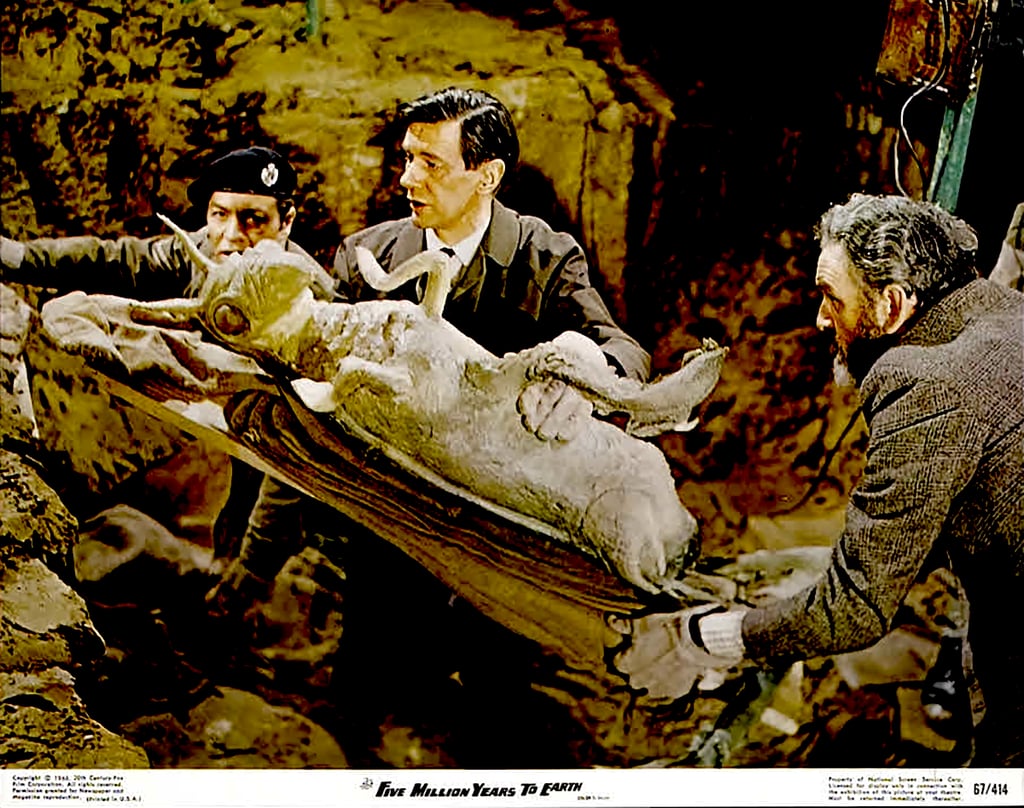
DR. RONEY (JAMES DONALD), MIDDLE, PROFESSOR QUATERMASS (ANDREW KIER), RIGHT, INSPECT A MARTIAN INSECT.
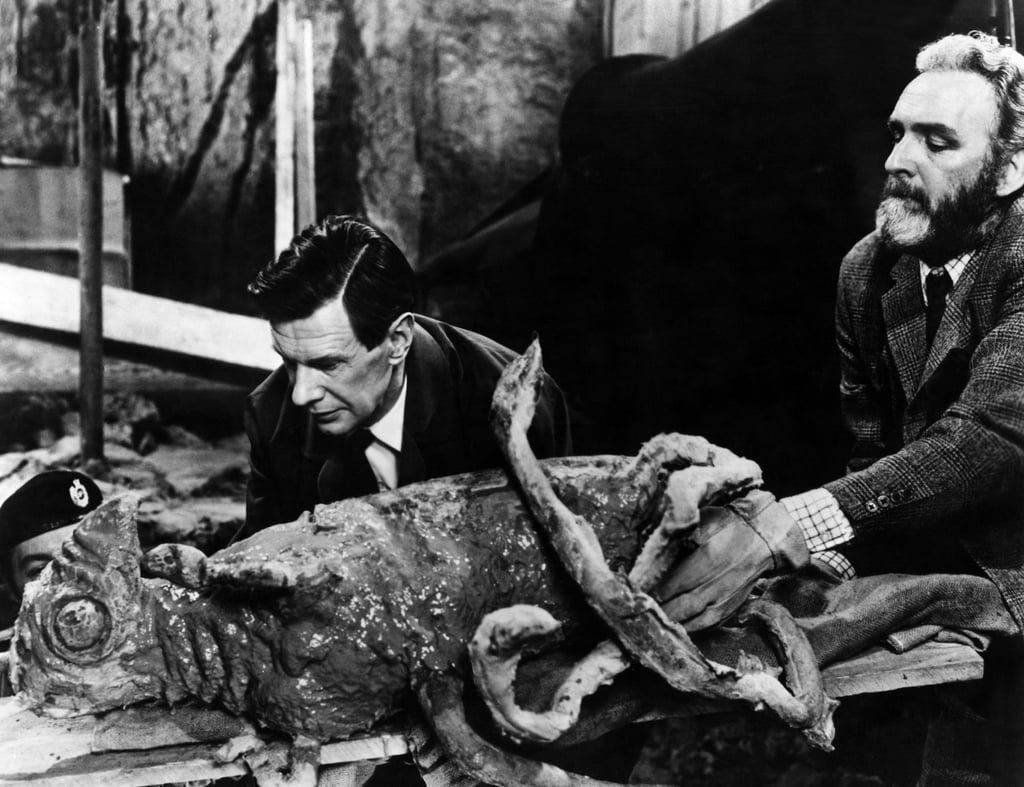
RONEY AND QUATERMASS INSPECT A MARTIAN BUG.
garysvehla509@gmail.com