
Odds Against Tomorrow
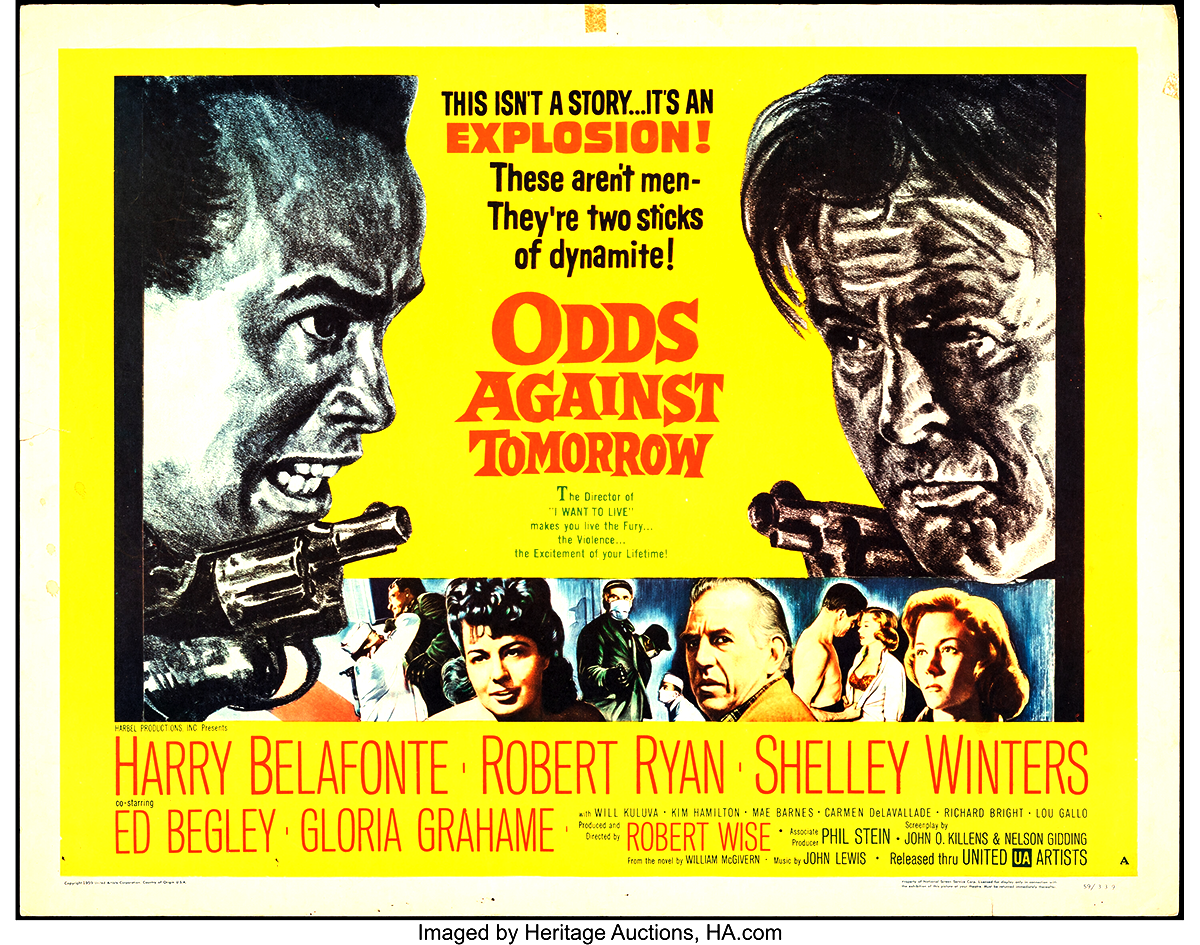
Three desperate men plan a supposedly easy bank robbery, but their plan is undermined by racial bigotry, mistrust, and the pressures of living life. 1 HR 36 MINS 1959 United Artists
FILM NOIR/DARK CINEMA
written by Gary Svehla
6/29/202610 min read
Story
At dusk, water runs rapidly down the curb-side sewers, as a man ventures out of the Norcit Hotel. A group of children, both black and white, race single-file through the streets, and Slater (Robert Ryan) playfully lifts a black child who he refers to as a picaninny. Letting her down, he goes inside the nearby Hotel Juno. Banging loudly on the counter to get the hotel clerk’s attention, he asks for the room of one David Burke. While ascending the hotel elevator driven by a black operator, Slater remains stoic and uncommunicative while the operator talks away.
The Burke door opens to a smiling man, Dave Burke (Ed Begle), offering Slater a whiskey. Slater knows Burke is a former policeman who was jailed a year for contempt, “Because I wouldn’t talk,” saying he was on the force for 30 years and was everybody’s friend. And Burke knows Slater served two session in prison, one for assault with a deadly weapon and the second for manslaughter. Slater, insulted, is about to quickly exit when Burke offers him 50,000 just for himself. Slater asks what he would have to do, and Burke says walk into a bank and take the money. Burke continues, he wants it a one and done kind of heist.
Johnny Ingram (Harry Belafonte) approaches the Hotel Juno, giving coins to neighborhood children and then goes to the Burke apartment, where he is warmly greeted. Johnny is into a gambling debt of around seven and a half grand. Burke knows a way Johnny can pay off his debt. Johnny says, “I’ll go down the drain on my own.” Burke says he’s talking about 50,000 dollars. Hearing that news, Johnny offers to take the drink offered. But then he rejects the deal leaving before hearing the details. He doesn’t appreciate the risk involved. Burke asks for a ride when Johnny hears he is going downtown.
Downtown, Burke goes to a park where he meets Bacco (Will Kuluva) who is feeding the pigeons. When he mentions Ingram owing him money, Bacco has a flippant response which angers Burke and he leaves. Next at Slater’s place, Slater quickly finishes dressing and goes outside. His groggy wife Lorry (Shelley Winters) is disturbed that Slatter has to go out at 7:30 in the morning. Lorry doesn’t want him to take the Burke deal, but Slater says with her now being an extra expense, he has expenses to meet. Later seeing Burke, Slater has the whole bank job laid out, explaining that the accountants are ready to retire or are sickly. The bank stays open till six and has 200,000 dollars held for payment to factory workers on Friday. Burke is pleased that the job is so easy, but Slater said he was not told the third man “was a nigger.”
We cut to Johnny in a small jazz combo playing the vibes and singing. Bacco and associates enter the club and sit. One associate says Bocco has a message for him, and to stop by his table. Bacco says he wants all his money owed by tomorrow night, but Ingram says that’s impossible for him, and when associate Moriarity (Lew Gallo) goes to beat him up, Ingram draws a gun and Bacco stresses tomorrow night at eight he better have the money or else.
Slater is dropped off by Burke, who still plays the race card because “I wouldn’t trust my own self with a deal like this with a colored boy.” Meanwhile, Johnny takes his daughter on a ride on the carousel, and as they whirl around, Johnny notices Bacco’s two enforcers hanging around outside and he grows suspicious. Confronting them, Johnny tells them not to bother his wife or daughter or he’ll shoot them. The men drift away when Johnny approaches a police patrol car, but says nothing. Calling his friend Dave Burke for the money, Dave tells him to call back in 15 minutes. Meanwhile, Burke calls Bacco to say he’ll personally pay off Johnny’s debt in two weeks, but Bacco says he worsened the situation by pulling a gun on him in public.
Picking up a dress from dry-cleaning for Lorry, getting into a bar fight on the way home, and telling a neighbor he won’t babysit for her, Slater is in a deep funk arriving home. Lorry tells her husband she got a higher position at work and will be making much more money, and this only makes Slater feel emasculated. They wind up having a fight. And Slater, in a huff, calls Burke to get back in on the bank job.
Johnny, separated from Ruth his wife (Kim Haltimon), obviously wants to come back into her life. She says the door’s never been closed, except for Eadie (Lois Thorne) their daughter, who Ruth desires to provide a good life free from crime. Johnny accuses her of belittling herself to the white world. Johnny rants, “It’s their world, Ruth, and we’re just living in it!”
While Burke is explaining details of the bank job to Johnny, Slater enters the apartment and all three continue to discuss details of the robbery. Slater tells Johnny not to trouble himself with all the details, implying all black males are dumb. But Dave cools the air and Johnny’s okay for now.
Slater returns home to Lorry, who has been crying. Lorry apologizes for telling Earle how-to live and not letting him be what he is. They kiss and make up. And Lorry, sobbing, asks Earle not to leave her. And Earle, who admits to always half-committing in life, says for the first time he is fully committing, referring to the bank job.
With Slater driving the souped-up car with Burke, a car station attendant opens the hood and sees the engine, and with Johnny riding a bus and exiting, he is stopped by a cop because he witnesses a car accident. The two outlaws in the car see Johnny talking to the policeman and grow suspicious.
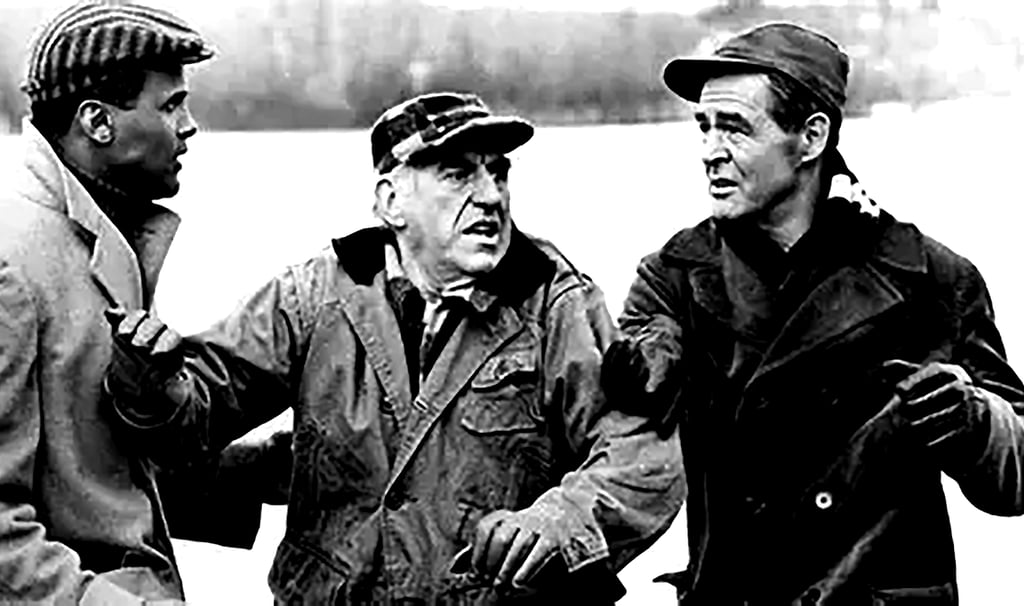
The three potential robbers meet on a muddy parking lot overlooking the waterfront and a small harbor. Slater once again insults Johnny, calls him, “Another black spot on Main Street.” But Burke keeps the two separated, while waiting for 6 to arrive becomes a monotonous chore.
The night grows dark and the street lights turn on. The bank clock shows six o’clock and Burke, walking, approaches the bank. Johnny waits nervously on the side of the street, while a passing train stops Slater’s progress in his car. Slater finally arrives, picking up Johnny. The coffees he is to deliver are sitting in a box in the back seat. Slater pulls up to the bank while Johnny dons a delivery boy uniform. Burke is across the street from the bank as the men approach. Johnny waits in the car while Slater approaches the bank but faila to give him the car keys, as was the plan. As the real delivery man exits the restaurant with his package, Burke trips him up. Johnny approaches the side bank door with the tray of coffees. Burke and Slater hover close to Johnny outside.
Johnny knocks loudly on the door twice ands no one answers. After a long wait, a man inside answers the door. The man unchains the door to get the trays inside, and all three men rush to enter. It is almost six-ten, the robbers don masks, and walk their way inside. The bank workers, terrified, fill Burke’s hunting coat with wads of money while Burke fills his satchel. It’s now almost quarter past six. Charlie, the real delivery man, walks with a tray to the bank. He knocks on the door. Slater answers the door and hits Charlie over the head. Instead of giving the keys to Johnny, Slater hands them to Burke.
A patrol car happens to stop across the street and he sees Burke exit the side bank door. The policeman calls out to him. He approaches the cop smiling. A bank alarm sounds and Burke is shot, with Slater opening the side door. Johnny and Slater run out the side door headed to the car, but Johnny realizes Burke has the car key. Burke attempts to escape to meet the other two men, but he is gunned down by the police. The two men try to approach Burke and pull him to safety. But the fire power used by the police is just too much.
While the two yell for Burke to throw the keys, he instead tries crawling to them. Just as Burke prepares to toss them the keys, the cops fire another couple rounds and stop him in his tracks. Burke says he’s sorry and tells Johnny to run for it. Then he commits suicide with his own gun.
Running away, Slater in a glib manner says to Burke that he is guaranteed to never talk now, and Johnny tears into him for being so insensitive. Slater knocks Johnny down and runs. Slater and Johnny trade shots, both missing. The two robbers run further from the crime scene toward a factory, still trading shots. Armed policemen approach the two outlaws. Slater climbs the massive steps to go atop a giant industrial tank and Johnny follows. Atop, the several massive tanks interconnect with a massive walkway. Both men stupidly fire their weapon at the same time, blowing the massive tanks sky high, fire and smoke forming a cloud of mass destruction.
Investigators, including The Red Cross, examine the debris finally arriving at the site of two covered dead bodies. “Which is which?” Another man answers, “Take your pick.” The camera focuses on a sign, “Stop, Dead End” as the end credits appear.
Critique
This very topical appeared in 1950, directed by Robert Wise, written by Abe Polonsky (backlisted at the time being a member of the Communist Party, and starring Harry Belafonte. The American civil rights movement was at its earliest start and top black actor Belafonte though it was his duty to forward a non-racist America in as many of his films as he was allowed.
The stellar cast of Belafonte, Robert Ryan, and Ed Begley add created layered performances. Robert Ryan, actually a liberal, plated racist Earle Slater. He comes from the American South with a bigoted view of black people. At every every opportunity he takes subtle (at least to him) jabs at Belafonte’s character, Johnny. “Don’t worry about it, boy. We’ll be right there with you. All you have to do is carry the sandwiches in a white monkey jacket. And give them a big smile. And say yes. You don’t have to worry, you don’t have to think.” Johnny is outraged and Burke intervenes to cool things down. Slater, smiling, says, “Like you say, it’s just one role of the dice. It doesn’t matter what color they are. So long as they come up seven.”
But nether character realizes just how similar each man is to one another. Both men feel they haven’t found their stride in life. Johnny is a miserable failure at hardcore gambling, with horses and cards. He wants to reunite with his wife but a border line criminal life is not good for his daughter. And while his wife would like to reunite, Johnny still sticks with his dark life. Johnny accuses his black wife of catering and bowing down to white society, and his pride as a man doesn’t allow that. He must succeed on his own terms. And this bank job might allow him that.
And Earle Slater exists in the low ebb of life. He feels he hasn’t committed to a single thing in his life. He simply drifts from one occupation to another, never knowing a purpose in life. Some say bigotry is based on an individual feeling so lost in life that they must denigrate the black man who they secretly feel is superior. Having some corner of society inferior to them makes them feel superior. The bank job is something that he can fully commit, for the first time in his life, and he envisions himself finally emerging fully formed, but his racism gets in the way.
Ed Begley plays the happy-go-lucky amateur bank robber, Burke. Someone who wants to pull off one heist to have enough money to compete in the game of life successfully once again. He feels her needs just one large enough payday. He is a kindly man who offers to pay off Johnny’s gambling debt and is always calming the heated situation between Johnny and Slater. When the heist goes south, he actually apologizes to the other two men. The truth is that the other two cohorts are too damaged to be reliable to Burke to count on.
The problem is definitely male emasculation in that each male wants to feel significant once again, to feel good about themselves, to live the same type of life they see others live and miss or never achieved.
The racism card is played without much subtlety in this movie. The movie constantly hits its audience over the head with its broad ideas. We realize the prejudices of Jim Crow have to go, and that these outdated laws belong in the past. But at the end, when we get our “Top of the world, Ma!” moment, all subtlety is long gone. When the Red Cross come across the blown away covered corpses, one man asks, “Which is which?” Meaning there isn’t just a white man and a black man lying dead, just two men without color. And another man answers him, “Take your pick,” meaning each man could be the other, that they’re no longer dead men of a specific race or culture, they are mangled intermixed corpses overlooking the sign “Stop Dead End.”
Whether it is The Mob, the Police, The White Race, or High Society, these three men are made subordinate by nature of being poor and powerless in a world of superior institutions. Odds Against Tomorrow is a movie that illustrates crippling desperation in a world where the Have-Nots want to be welcomed among the Haves and feel they belong. This movie shows people on the underbelly of life trying to join and be welcomed in another world where they are excluded.
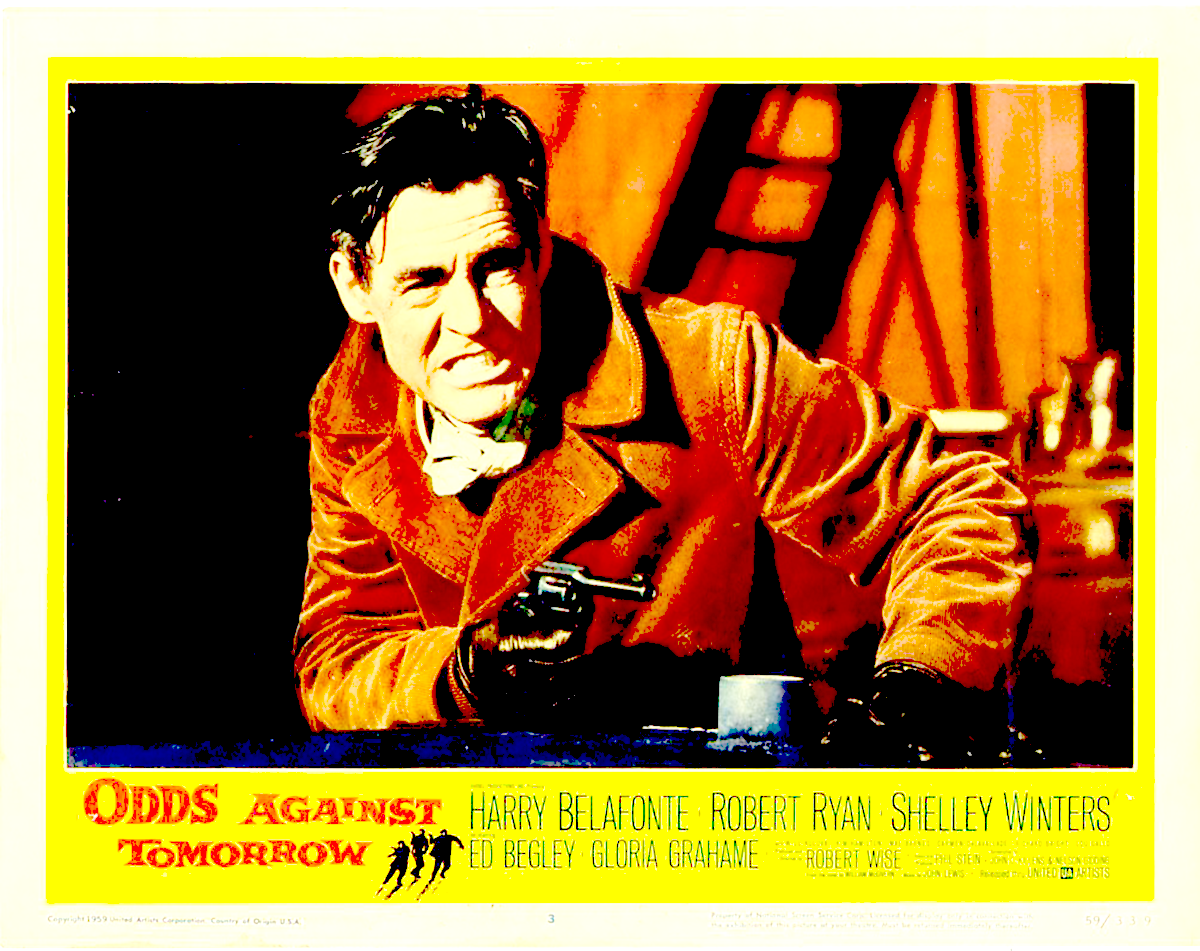
ROBERT RYAN AS RACIST EARLE SLATER
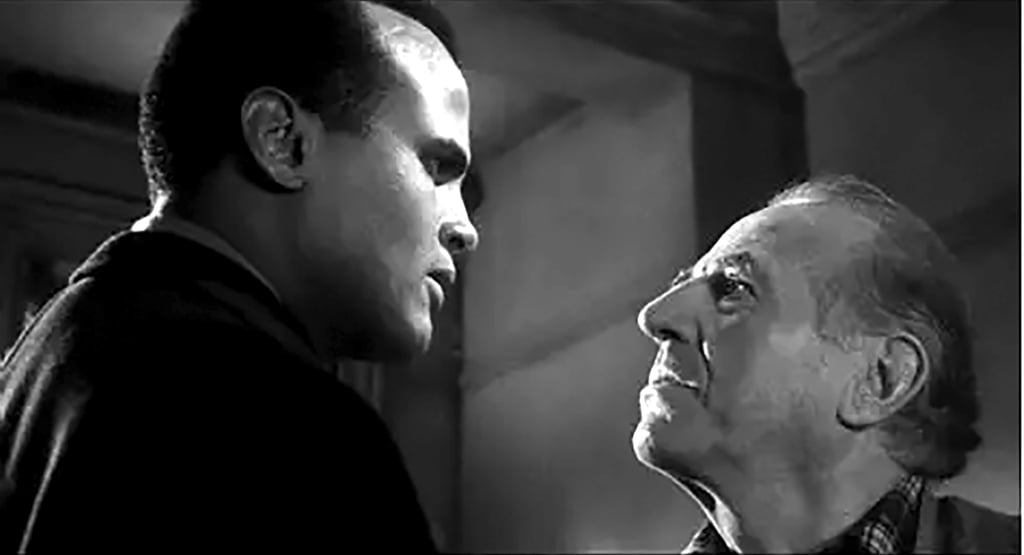
HARRY BELAFONTE AS JOHNNY INGRAM AND ED BEGLEY AS DAVE BURKE
garysvehla509@gmail.com