
Nosferatu (1922)
The original German Dracula adaptation created most of the significant vampire tropes that exist to this day. 1 HR 33 MINS 1922 Prana Film (released 1929 in the US),
HORROR/SCIENCE FICTION
written by Gary Svehla
4/20/202611 min read
Story
A Chronicle of the Great Death in Wisborg
“Nosferatu: Does not this word sound like the call of the death bird at midnight? Take care you never utter it, lest life’s pictures fade into pale shadows, and ghostly dreams rise from your heart and feed on your blood. Long have I pondered the original and passing of the Great Death in my hometown of Wisborg. Here is its story: In Wisborg there lived a man named Hutter (Gustav von Wangenheim) and his young wife Ellen (Greta Schroder) ..."
Hutter and Ellen embrace; he is holding a bouquet of flowers behind his back. They are obviously in love. She asks why he killed the lovely flowers? While walking outside, a man tells Hutter he cannot outrun his destiny.
Also living in Wisborg was a real estate agent named Knock (Alexander Granach). One thing was sure: he paid his people well.” Knock calls in an employee, Hutter, and tells him: “His Lordship, Count Orlok, from Transylvania, wishes to purchase a lovely home ... in our own little town. You could earn a pretty penny ... It will cost you a bit of effort ... a bit of sweat and perhaps ... a bit of blood.” They both laugh together.
Thus, Hutter entrusts his worried wife to the care of his friends, the wealthy shipowner Harding (Georg H. Schnell), and his sister. Hutter leaves, but Ellen looks very anxious. He rides toward the Carpathian Mountains. Soon, he reaches an inn. Drinking quickly, he demands a meal, saying he must reach Count Orlok’s castle. When Hutter says that, all the villagers freeze and stare. The innkeeper says Hutter can't leave now because a werewolf is roaming the forests. Then, we see shots of a wolf stalking wild horses. Before going to bed, Hutter picks up a small book left in his room, "Of Vampires, Terrible Ghosts and Magic, and The Seven Deadly Sins." The book shares stories of Nosferatu and his vampire legends. He throws the book down and prepares for sleep. The next morning, Hutter and his carriage leave the inn, but he still takes the book.
As his driver approaches the Carpathian Mountains, he refuses to go any farther. Hutter continues traveling on foot. After crossing a bridge, the eerie atmosphere becomes more tense. A carriage approaches and stops, clearly ridden by a cloaked Count Orlok. Hutter hesitantly gets into the coach, and they keep driving. The driver halts the coach, indicates the way, and Hutter walks the rest of the way. After a short walk, Hutter enters the castle and is greeted by the slender, rat-like Orlok (Max Schreck). The vampire, towering over Hutter, says he has waited too long. It is almost midnight, and the servants are asleep.
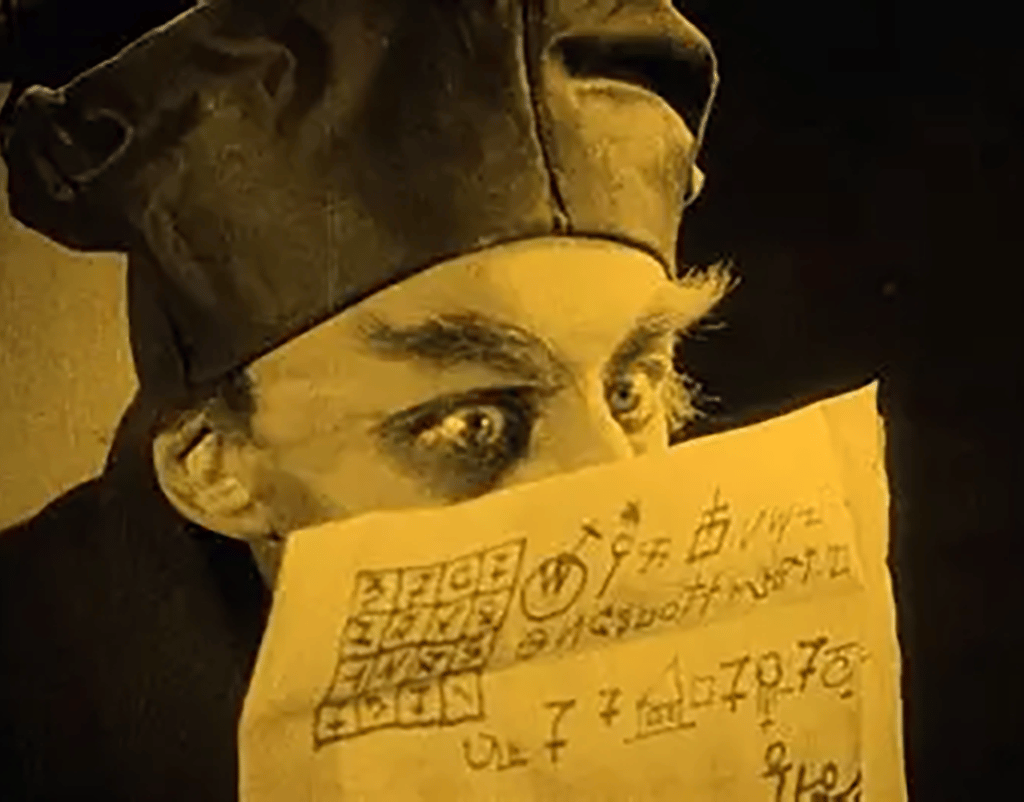
Eating his prepared meal, Hutter sits at the table with Orlok, who intently reads his newspaper. Hutter cuts his finger while slicing bread, and Orlok rises, noticing his loss of precious blood, then his expression turns animalistic. Standing close, Orlok says he sleeps very deeply during daylight hours, and Hutter soon dozes off in a chair. The next morning, Hutter wakes up alone. Examining his neck with a small mirror, he smiles broadly before seeing that breakfast has been set. After eating the hearty meal, Hutter goes outside to explore. He looks at the letter he wrote to his wife, describing two mosquito bites on the side of his neck, as he finishes it.
That evening, Orlok is back, reviewing the paperwork when he appears mesmerized by a photo of Hutter’s wife, Ellen. “Your wife has a beautiful neck,” Nosferatu says. He hands the photo back, saying he's ready to buy the house across from his. The vampire signs the contract and returns it to Hutter. Later, Hutter kisses his wife’s photo, reaches into his pocket, finds the book about Nosferatu, and reads a little more. As he opens his bedroom door, Hutter sees the pale figure of Count Orlok standing silently outside and hurriedly rushes inside. When the door opens by itself, the vampire has vanished. Then he reappears, walking right up to the door and entering his room. Orlok can barely squeeze through the door physically.
Back with Hutter, Orlok’s sinister silhouette rises and cloaks Hutter. Ellen, restless in bed, wears an expression of complete shock. Her arms reach out as she calls her husband’s name. Orlok slowly leaves Hutter’s room, and the door shuts behind him. Ellen gradually drifts back to sleep in her bed. “The doctor described Ellen’s fear to me as an unknown illness. Yet I know that her soul heard the call of the death bird that night. Nosferatu was already spreading his wings.”
Hutter awakens the next morning, terrified and clutching his throat. He runs from the castle and opens a wooden door leading to a crypt shrouded in shadows, with a single coffin inside. Looking at the top of the broken coffin, he sees Nosferatu’s face and a hand. With strong effort, Hutter quickly opens the coffin lid and finds the black-cloaked vampire lying still, with his large hands crossed. Hutter steps back fearfully. Returning to his room, Hutter sits on the floor, trembling. He then watches as Nosferatu, with great strength, loads about five earth-filled boxes onto a horse-drawn carriage and rides away. Hutter creates a rope ladder from sheets to escape his room. Once out, he falls asleep outside from complete exhaustion.
Hutter wakes up in a hospital, having been brought from the mountains by farmers while suffering from a fever. He fearfully yells, “Coffins!” as he is watched over by Professor Bulwer (John Gottowt). Bulwer knows that six coffins filled with earth were loaded onto the ship Empusa, heading for Wisborg. Rats scurry among the earth boxes filled with native soil.
An attendant informs his superior that the patient admitted yesterday, Knock, has gone completely mad, eating flies, and appearing crazed. Knock rants that “Blood is life!” Hutter recovers enough to dress and get out of bed, but he is still very weak.
Knock finds a flyer warning of a plague that has broken out in Transylvania, leaving many victims with neck bites. Ships are being delayed, allowing for further investigation of the plague. Aboard the Empusa, a sailor becomes delirious below deck. Orlok’s transparent figure hovers over the area below deck. The epidemic soon spreads through the entire crew. Wrapped dead bodies are tossed over the side of the boat. One crew member, armed with an axe, ventures below deck. He sees rats leaving a coffin with a broken lid. He witnesses Nosferatu’s figure rise stiffly from his coffin. The crew member cowers in fear. He runs to the ship’s surface and jumps off the side. The sole survivor, the captain, manning the wheel, ties it up to investigate. Orlok slowly moves around the surface of the boat. “The ship of death had a new captain.”
Hutter nearly reaches home by carriage as the vampire approaches Wisborg. Ellen steps out onto her bedroom balcony, arms outstretched, with a dazed expression, saying, "I must go to him. He is coming.” In his room, Knock happily states that the master is close. The Empusa slowly docks, and Orlok emerges from the hatch. Back to Knock, he attacks his guard and quickly gains his freedom. The vampire then steps off the boat carrying his earth-filled coffin. Likely, diseased rats exit the hatch and spread the plague. Finally, Hutter arrives home and is greeted by Ellen, while Orlok still carries his earth-box to his new home.
As men board the returned Empusa, they find all the crew dead. A sailor reports that there is not a single soul alive on board. The ship’s log states that sailors are falling ill and that a strange presence was below deck. Wisborg records the increasing danger of the plague. The streets are deserted as a lone drummer plays, and citizens peer outside. The drummer reads a proclamation calling for people to stay off the streets to reduce the risk of the plague. Houses are marked with white crosses to indicate which ones contain the plague.
Since the vampire’s arrival in Wisborg, the town has been gripped by fear. Coffins are now carried through the streets. Ellen finds and reads from the little book about vampirism, learning about maidens who willingly give their blood. The townspeople look for someone to blame, and it’s Knock. Individual citizens accuse him of multiple strangulations, including those committed by the vampire. Knock runs down the street, chased by a mob. He hides on a rooftop and is pelted with rocks. The mob follows Knock into the rural areas surrounding the town.
Meanwhile, Orlok stares at Ellen’s window from his new home. She wakes up in bed, looking terrified. Ellen, as if in a trance, tries to open her bedroom window. She wakes her husband, who sits in a lounge chair beside her bed. She commands him to fetch Professor Bulwer. Hutter runs out of the house. Ellen returns to her open window as the shadow of Nosferatu creeps up her stairs, and the shadow of his fist clutches Ellen’s heart.
As the rooster crows, Nosferatu bites Ellen’s neck. Slowly rising, Nosferatu hears the rooster, indicating that sunrise is near. Knock calls out for the Master. The sun is rising outside Ellen’s window. Orlok gets up and looks toward the sunlight. As the Undead clutches his chest, the sunlight causes him to disappear. Knock sadly proclaims, "The master is dead.” Ellen awakens, gets up, and calls for Hutter as normalcy returns. “At the same hour the Great Death ended, and the shadow of the death bird lifted... as if blown away by the victorious rays of the sun.”
Critique
Although Bram Stoker’s widow sued the producers of this first, unauthorized version of Dracula to have all prints destroyed, a few survived, allowing this 1922 film to endure to this day. Considered a classic of the screen, I must admit that until now, I had only seen snippets and short segments of Nosferatu. At age 75, I finally watched the full film, and I have to say it was a revelation that impressed me more than I expected.
Compared to other great adaptations of the Stoker novel, Dracula (Universal 1931) and Horror of Dracula (Hammer 1958), I must admit that the screenplay by Hamilton Deane and John L. Balderson for the Universal version, along with Jimmy Sangster's screenplay for the Hammer version, heavily draws from the 1922 German film originally written by Henrik Galeen, which, like usual, was loosely based on the Stoker novel.
Nosferatu was limited by its early 1920s production and budget constraints. Even when Universal and Hammer did it better, they still incorporated sequences from the original version. And often, Nosferatu matched or even surpassed the quality of specific sequences.
For instance, the highlight of Universal’s Dracula was its roughly 20-minute castle sequence, where the Count purchases Carfax Abbey. The similar scene in Nosferatu mostly falls short compared to the Bela Lugosi version, but it remains very effective. When Count Orlok picks up Hutter in his coach and takes him to his castle, it’s clear that Orlok is inhuman and more feral than the refined Count in the 1931 film. The scene where Hutter and Count Orlok meet is eerily supernatural, with the skinny, rat-like Count appearing more monstrous than Lugosi ever managed. Lugosi portrayed the character quite differently, as a twisted Old World noble with an ethereal voice and odd accent. Max Schreck played a more otherworldly role, with an odd gait and completely evil facial expressions. In the scene where Renfield cuts his finger, Lugosi shows excitement, revealing his true nature, while Schreck is ecstatic and much more feral—more beast-like and less subtle. It’s not that one performance is better; both are vastly different, and each is successful.
To further demonstrate what I mean, take the ending of Nosferatu, where the elongated shadow of Orlok creeps through Ellen’s house, finally materializing at her bedside, bending over to drink her blood. When the rooster crows, the vampire is disturbed, knowing daylight approaches. Orlok approaches the bedroom window, sees the sunrise, and becomes transparent, dying.
And let’s turn to 1958’s Horror of Dracula, which is dramatically expanded again, showing the sun’s rays destroying the vampire. But while Nosferatu’s death is generally the worst part of the entire movie, with the Hammer version, it might be the best. Why? The Hammer film just doesn’t end with a barebones version of the vampire dying by sunlight. We have a rousing race to the castle as Dracula kidnaps Mina. When Dracula and Van Helsing both arrive at the castle, there is an elongated chase through its interior, featuring a battle between the Count and Van Helsing. Then, in a very dramatic sequence, Van Helsing jumps and pulls down the curtains, letting sunlight in and ultimately destroying Dracula. The vampire king just does not die or disappear; he slowly turns to dust in a cinematic disintegration that was state-of-the-art for its time. It is exactly the same ending as that of Nosferatu, but dramatically expanded, making the end vastly superior. But if the 1922 feature is a sketch, Horror of Dracula remains a complete painting. But both illustrate the statement: Dracula dies by sunlight.
The 1931 Bela Lugosi classic is renowned for its journey to and investigation of Dracula’s castle. Here, the movie is a classic featuring Lugosi’s iconic performance, the studio’s superb art direction and set design, and creepy, classic dialogue. But the rest of Lugosi’s film is performed as a stage play, featuring some good sequences but nothing like the film’s first 20 or so minutes. Nosferatu is a visual treat throughout its running time, always offering the eyes a treat. It may not manage the highs of the Universal version, but it remains more consistent throughout.
And let us remember that all three versions of Dracula have screenplays that differ from the novel. The 1931 and 1958 versions feature screenplays that heavily borrow from Nosferatu. Perhaps in most cases, later films improved the screenplays, but Nosferatu introduced those classic sequences. Nosferatu included the coach ride to Dracula’s castle; the real estate sale and meal for the guest at Castle Dracula, the scene where the guest cuts his finger; the Renfield/Knock fly devouring sequences, and scenes of him going mad; the sequence where the guest ventures down into Dracula’s crypt and sees the vampire resting in his coffin; the scene when the traveler mentions that his destination is Dracula’s castle and the locals shudder; when Dracula is attracted to a photo of the traveler’s wife; the boat ride to Dracula’s estate via ship, generally killing every crewman on board; and Dracula being killed by sunlight. Some sequences may appear in the novel, but for the film, they were a first-time experience. These iconic sequences might not appear in all three films, but they are present in at least two of them. And while a Renfield sequence does not occur in Horror of Dracula, it does appear in a later Hammer production, Dracula–Prince of Darkness.
But what does Nosferatu accomplish that is unique? First of all, Orlok’s appearance drifts between a distinguished nobleman (like Bela Lugosi) and a raving animal (such as Christopher Lee in the library sequence). While Lee and Lugosi both appear as distinguished human beings, Count Orlok is a giant human rat, attracting the small critters and spreading the plague. Looking at Orlok, one would be terrified by his gaunt features and white skin. While Lugosi and Lee are far easier on the eyes.
The use of supernatural shadows, sometimes elongated, are unique to Count Orlok and show another side of him. Intertitles warn us to remain outside his shadow and avoid their influence. Since we mention intertitles, it must be noted just how poetic they remain, something lost in the soon-to-be-successful sound motion pictures, but the printed narration dazzles.
Count Orlok is often framed by oval shapes, especially during the sequence in which he enters Hutter's bedroom. Because of his extreme height, he barely fits through the oval-framed door. But he manages to slither through.
Director F.W. Murnau created an iconic monster for the ages, one that was copied, expanded, and revised over the course of 104 years. It was a film hampered by its time and budget, though it still managed to impress with its innovative vision and bold approach. Max Schreck created a cinematic icon for the ages. While the original film version of Dracula was overshadowed by more recent films, Nosferatu was first and set the bar high for others. It must not be forgotten.
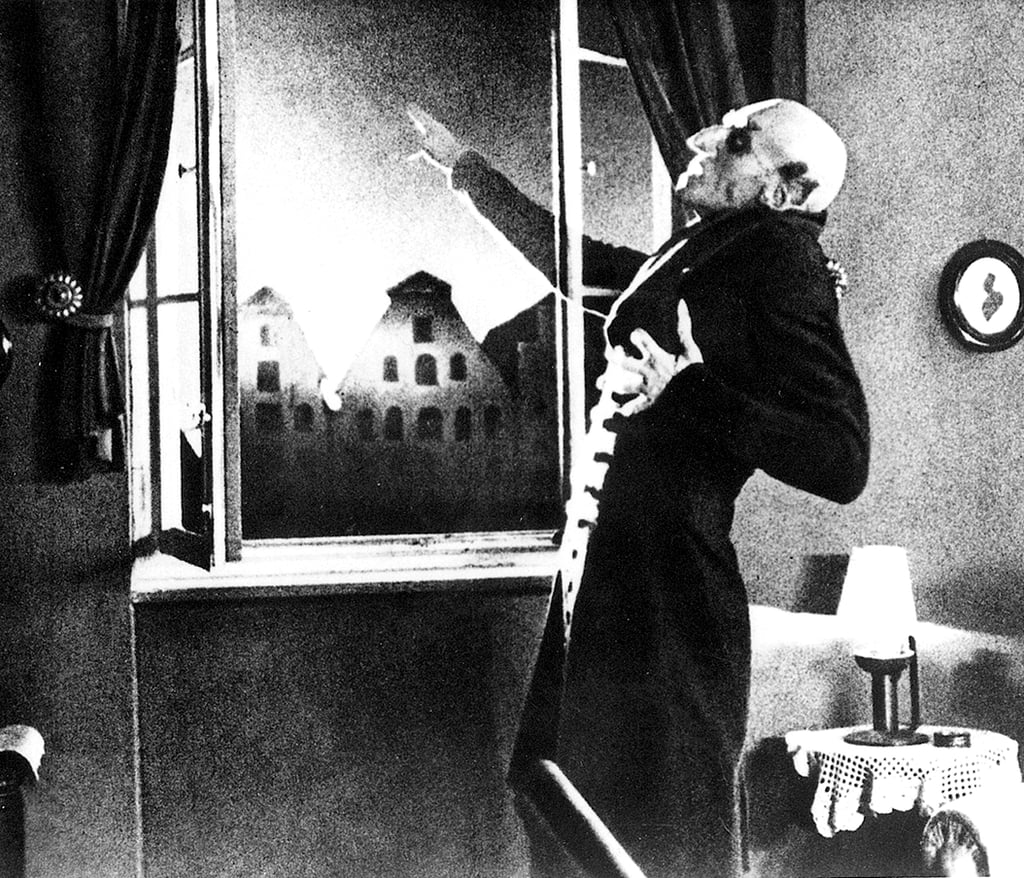
MAX SCHRECK AS COUNT ORLOK IS ABOUT TO BE DESTROYED BY THE RAYS OF THE SUN.
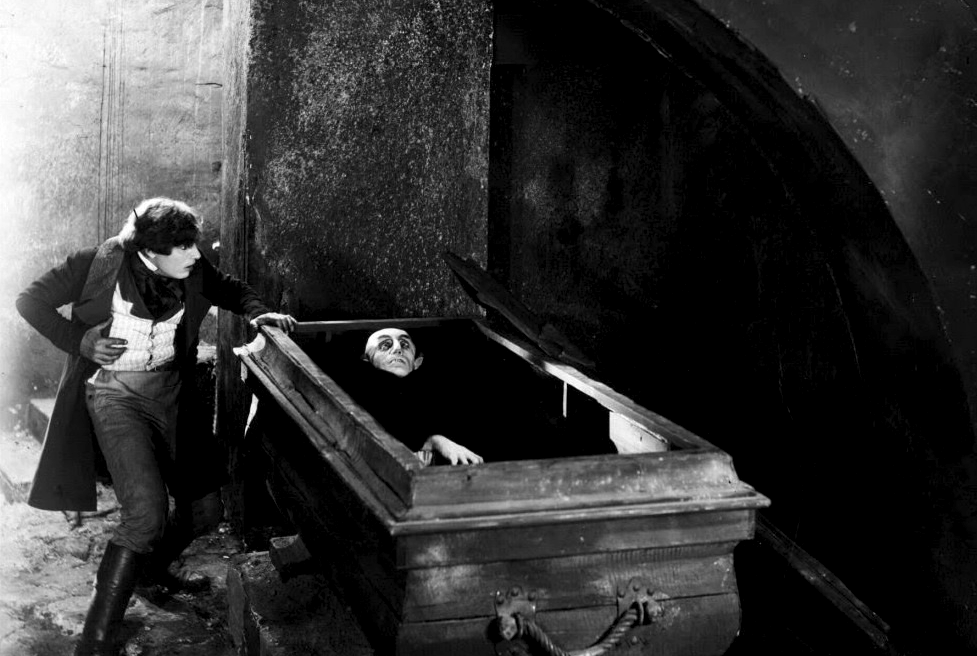
HUTTER (GUSTAV VON WANGENHEIM) WANDERS DOWN INTO THE CRYPT OF COUNT ORLOK
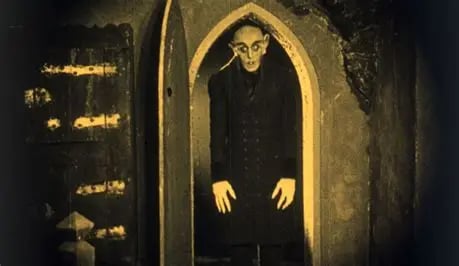
COUNT ORLOK CAN BARELY FIT THROUGH THE DOOR.
garysvehla509@gmail.com