
Ministry of Fear
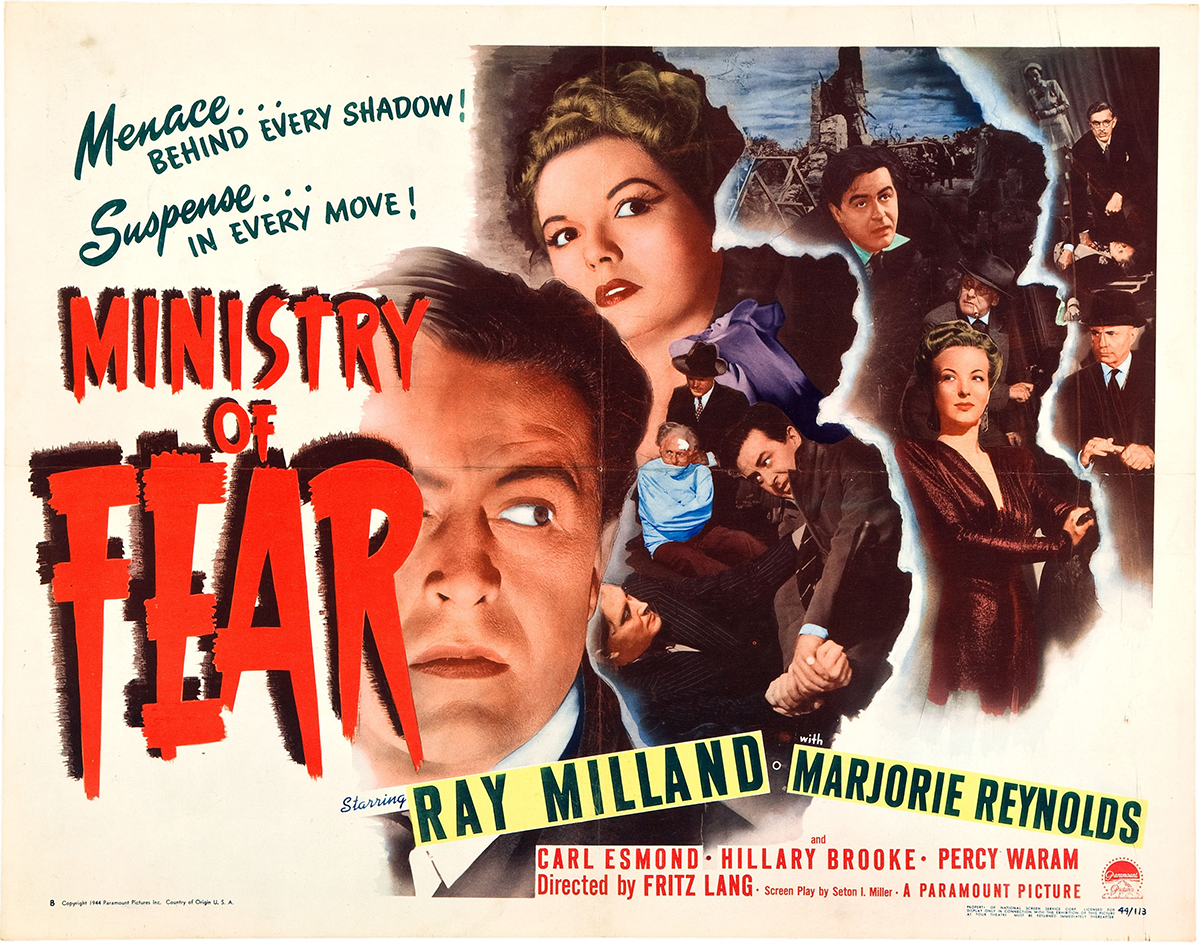
In this imitation Hitchcock film directed brv Fritz Lang, a man recently released from an asylum for mercy killing, soon gets involved with Nazis in America. 1 HR 26 MINS 1944 Paramount
FILM NOIR/DARK CINEMA
written by Gary Svehla
5/25/20268 min read
Story
After Stephen Neale is released from Lembridge Asylum, he goes to the train station to buy a ticket to London. While waiting, he notices a nearby fair and decides to check it out. He stops at a table where people pay to guess the weight of a cake, and he buys a ticket. Then he wanders into a dark tent where a woman reads his fortune. The fortune teller tells him the weight of the cake, and he buys another ticket and wins. After walking off with the cake, everyone stares at him. A well-dressed man, Cash (Dan Duryea), is dropped off, and he quickly approaches the fortune-teller. Soon, the women rush over to Stephen, saying they made a mistake—that the cake actually weighed less—but Stephen insists his first ticket still beats Cash’s guessed weight. Stephen takes the cake to his train, and Cash appears clearly disappointed.
The conductor guides Stephen to an empty car, but he is soon joined by a blind man (Eustace Wyat), whom he welcomes aboard. Stephen offers him a piece of cake, and the blind man’s eyes suddenly shift and focus on his surroundings. As Stephen eats his piece, he watches the blind man crush his slice, as if searching for something inside. The blind man hears a Nazi plane fly overhead moments before Stephen notices anything. The bombing destroys a munitions plant, and the blind man quietly flashes a smile. While Stephen concentrates on the chaos outside, the blind man wields his cane and strikes Neale over the head, stealing the cake and rushing outside since the train has now stopped. Stephen soon wakes up, following the man and his cake through the marshes. The blind man takes cover at a dilapidated shed and begins firing a pistol at him until the shed is bombed out, killing him.
Neale searches for George Rennit (Erskine Sanford), a private investigator hesitant to take on a new case. Stephen reports that his hotel room was ransacked, he was robbed on a train, and he was shot at. They first visit the Mothers of Free Nations charity office to find the address of the cake woman. Directed to an inner office, he meets Willi Hilfe (Carl Esmond) and his sister Carla (Marjorie Reynolds). Stephen asks if any members might be using the organization as a cover for criminal activities. Stephen explains his entire story, and Willi wants to investigate. Willi then takes them to Mrs. Bellane’s house, the palm reader. Instead of a matronly woman, Mrs. Bellane (Hilary Brooke) turns out to be a tall, younger blonde. She has a group waiting for a séance. She admits she was at the fair, telling fortunes, but she wasn’t the same woman Neale met. Still, she invites them to join the séance. They sit in a circle and hold hands. Mr. Cost, the man from the fair, is the last to arrive. The lights dim, and Mrs. Bellane softly speaks as if communicating with someone from beyond. Neale panics and asks aloud, "Who is that?" and suddenly a gun fires in the dark. When the lights come back on, Cost is dead with a bullet in his temple. Everyone blames Neale, accusing him of breaking the circle first. Willi tells Neale to punch him and get away.
Neale eludes the authorities, finds his office ransacked, and calls Willi, but reaches Carla instead, who plans to join Neale. In London, air raid sirens sound as people flee to bomb shelters when Stephen meets up with Carla. In the shelter, Stephen tells Carla that two years ago, here in London, he was sentenced for murder. He was guilty of a mercy killing, for killing his wife who was wasting away with a horrific disease. She couldn’t stand the pain, and doctors couldn’t help her.
The next morning, Carla takes Stephen to Mr. Newland’s First Editions Bookstore. Displayed up front is The Psychoanalysis of Nazidom by Dr. J.M. Forrester (Alan Napier), a man prominent at the séance last evening. Mr. Newland offers the duo a place to hide out for a few days. Mrs. Bellane catches up to Stephen at the bookstore and asks what he had against Mr. Cost. He strikes back that he didn’t kill Cost and that she knows it.
Later at the office, Willi and Carla talk. Carla is pulling names from the file catalog, people sponsored by Dr. Forrester. Wanda says they have been sponsoring a spy ring for three years, and Forrester works for the Ministry of Home Security. Willi wonders how the cards got into the file, and Mrs. Merrick, Hilfe’s secretary, said that Carla sent them to her. She doesn’t remember. Carla is very upset that the Nazi’s are now setting up shop in London, just like in Germany and Austria. Carla tells her brother that she is falling in love with Stephen.
The phone rings at the bookshop, and Newland answers to find Forrester calling about a book Newland uncovered for him. Forrester plans to come right on over. Newland sends Stephen and Carla to an outside apartment to stay. When Stephen goes to open the large suitcase, a bomb ignites, but the couple remains safe due to Stephen’s quick thinking. He awakens in a bed at Scotland Yard. Stephen proclaims he was alone, even when asked about the woman with him. Inspector Prentice (Percy Waram) at Scotland Yard is more interested in the people Neale murdered than the Nazi threat. The Inspector tells Stephen that George Rennit has disappeared.
The Inspector takes Stephen to the shed where the blind man shot at him. They find a piece of the gun recovered and the cake box. As they give up searching for the cake and depart, Stephen sees birds pecking at something high up on the shed’s remains. Climbing up, he finds the remains of the cake. And sifting through it, Neale finds microfilm which the Inspector plans to take to the proper authorities. The film shows England’s mine fields and other protective devices. The Inspector suggests that Forrester might be involved in photographing the maps. They follow the trail to Travers, a tailor that Forrester recommended, and discovered he was here yesterday. The apartment where Neale was bombed was leased by a Mr. Travers.
The authorities make an appointment with the tailors for that early evening, and Neale offers up names from the charity to arrest. But he refuses to involve Carla. Neale reports to the tailors requesting to see Mr. Travers. Mr. Cost, very much alive, walks out to Neale’s surprise. Stephen Neale alerts the police to Mr. Travers, who makes a run for it and soon kills himself. Remembering the phone number that Cost just dialed, Stephen redials, and Carla answers. But Stephen, in shock, does not say a word. Stephen goes to Willi Hilfe’s apartment, who is shocked to see him alive. Carla is called in from another room, in total shock. Carla erupts that Willi gives the orders, not Dr. Forrester, that he bombed their apartment. Willi demands that Carla and Stephen leave. Carla throws a candlestick at her brother, and Stephen makes his move. Struggling on the floor, Stephen tries to make Willi drop his pistol. The espionage film is sewn into the new suit jacket, and Stephen collects it. As Willi once again gets the drop on Stephen and escapes by the door, Carlo shoots, and the bullet reaches its mark. Neale grabs the jacket and leaves with Carla.
Someone is coming up the elevator, so the couple takes the stairs downward. The bad guys are below him, so he and Carla go back up the steps. Forrester comes upon Willi’s body, and the other Nazis direct him upstairs. Stephen and Carla escape outside the rooftop door. The others soon join him on the rooftop, guns blazing. Soon, the police catch up to the Nazis, and they drop like flies. In the final coastal scene, Carla and Stephen plan their wedding as they drive along.
Critique
Fritz Lang was one of the architects of film noir, and this Graham Greene novel was ripe for filming. Adapted by the producer, Seton I. Miller, from the best-selling novel, Fritz Lang was familiar with rewriting the screenplay to improve its quality and to make the film conform to his style. But since the screenwriter also produced, the creative hands of Lang were tied, as Seton Miller wielded too much authority. Thus, the film remained a good Alfred Hitchcock clone and generally avoided the Lang style. Because his hands were tied, Lang never considered the film to be among his better productions.
The cast, both the familiar—Ray Milland, Marjorie Reynolds, Dan Duryea, Hilary Brooke, Alan Napier—and the lesser known—Carl Esmond, Percy Waram, Helena Grant, Eustace Wyatt—who were more than competent. Lang’s direction, even though he was more reigned in, created effective scenes (the blind man aboard the train, the séance scene, the apartment scene where it was blown apart, the sequence in the London bomb shelter) that stick in the memory and are effectively conceived.
But at the same time, one wonders about the subplot where Stephen is institutionalized for two years for the mercy killing of his wife. That story does not go anywhere. It demonstrates why Stephen is not readily believed, but, beyond the fact that his release leads to his attending the charity fair, it adds no significance to the screenplay. It would make a good alternative movie.
Lang uses the paranoia of British bombing raids to create suspense and the sense that life could end at any moment. Scenes such as the bombing of the shed where the blind man hides and shoots create suspense for the entire audience. The underground bomb shelter creates an air of ordinary life that can occur at any time, but it also shows that daily life is fought against danger. It seems the charity offices are peaceful and safe havens, and ordinary London is a dangerous place to reside.
The symbol of innocence, the charity cake, becomes the McGuffin, the small relic that starts the movie on the trail of nazi infiltration. The cake disguises the Nazi microfilm and the war strategy it hides. Inside a festive cake hides the horrors of war.
During and after the Second World War, films made during this era features cancerous cells of Nazis trying to create a stranglehold of their political beliefs here in America. Ministry of Fear is one of the better ones that prove the Nazi threat did not just occur in Europe but also in our own homeland, in the safety of institutions that we dearly trust and love. Nowhere was safe. The intricacies of having a Homeland Security officer being a Nazi officer were insidious. The fact that a tailor sewed microfilm inside the shoulder of a suit jacket was more than clever and just as deadly. It was as though the cancer cells disguised themselves as American-made.
Frita Lang did not wield all his creative powers to make his film, but the film produced was an effective one of paranoia, suspense, and insidious villainy, closer than usually suspected. The monsters were not just across the sea, but in our own backyard, right on the home front. Ministry of Fear was a classic espionage film, meant to frighten us into realizing the enemy can be so close. It is a film well concocted to chill the blood, convincing us that the enemy is hidden right beside us.
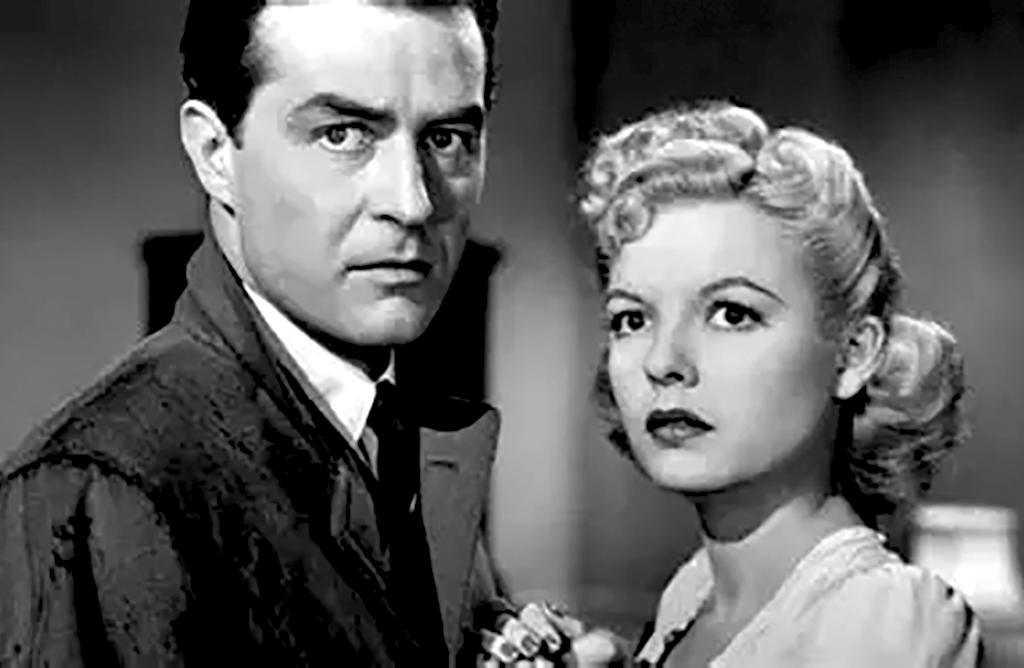
STEPHEN NEALE (RAY MILLAND) AND CARLA HILDE (MARJORIE REYNOLDS)
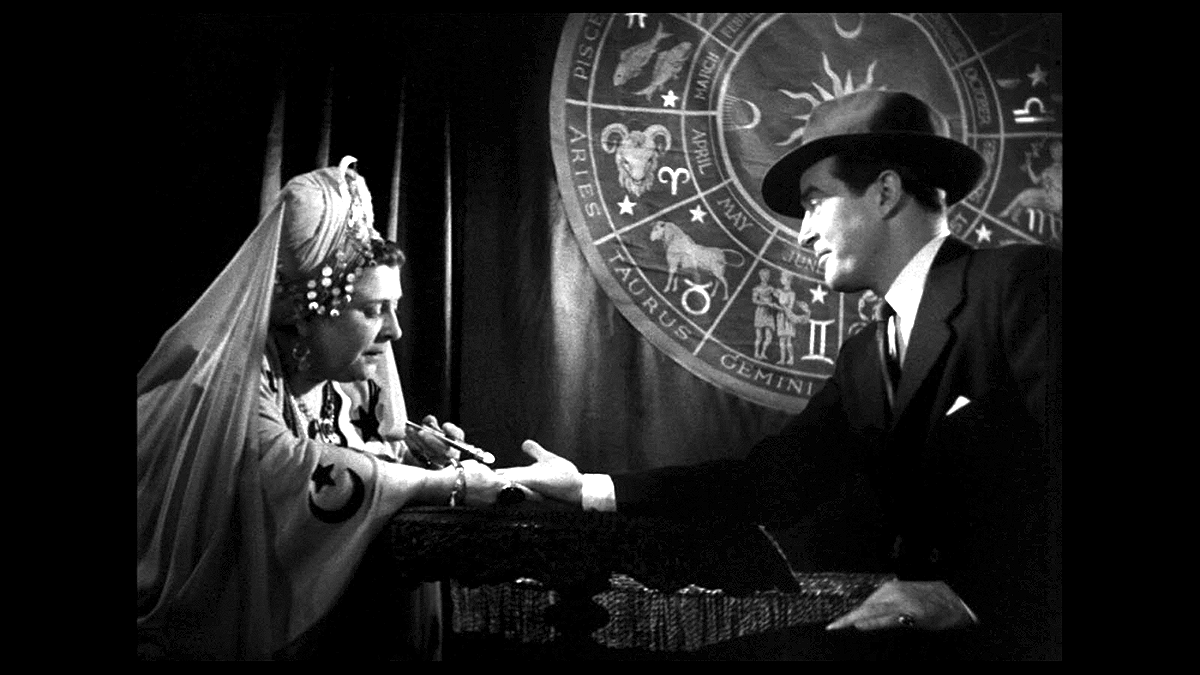
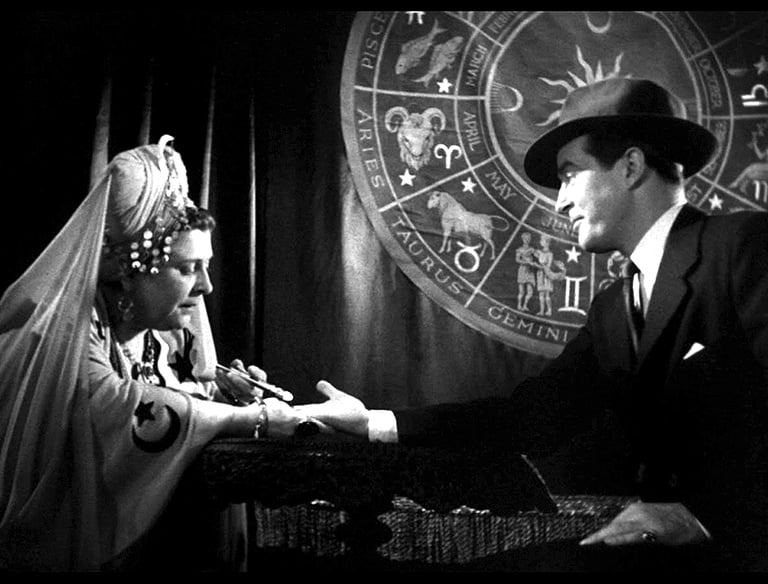
THE CHARITY FAIR PALM READER MRS. BELLANE (AMINTA DYNE) READS THE FORTUNE OF STEPHEN NEALE.
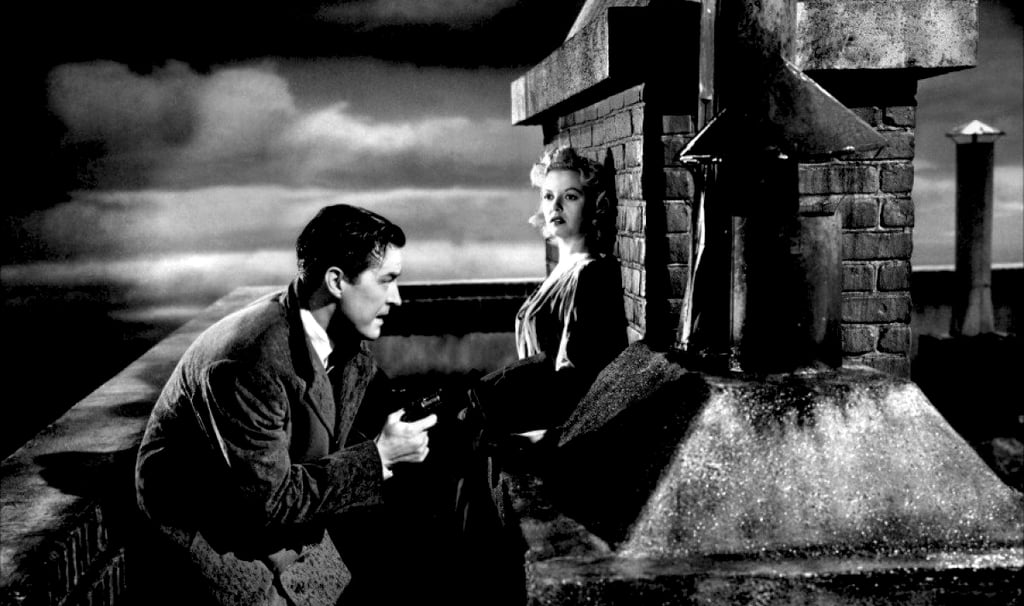
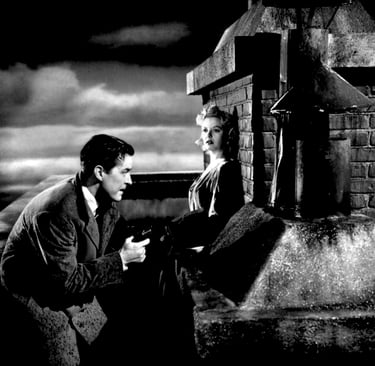
IN A PUBLICITY SHOT, STEPHEN NEALE AND CARLA HILFE POSE AT THE BOMBED OUT SHED.
garysvehla509@gmail.com