
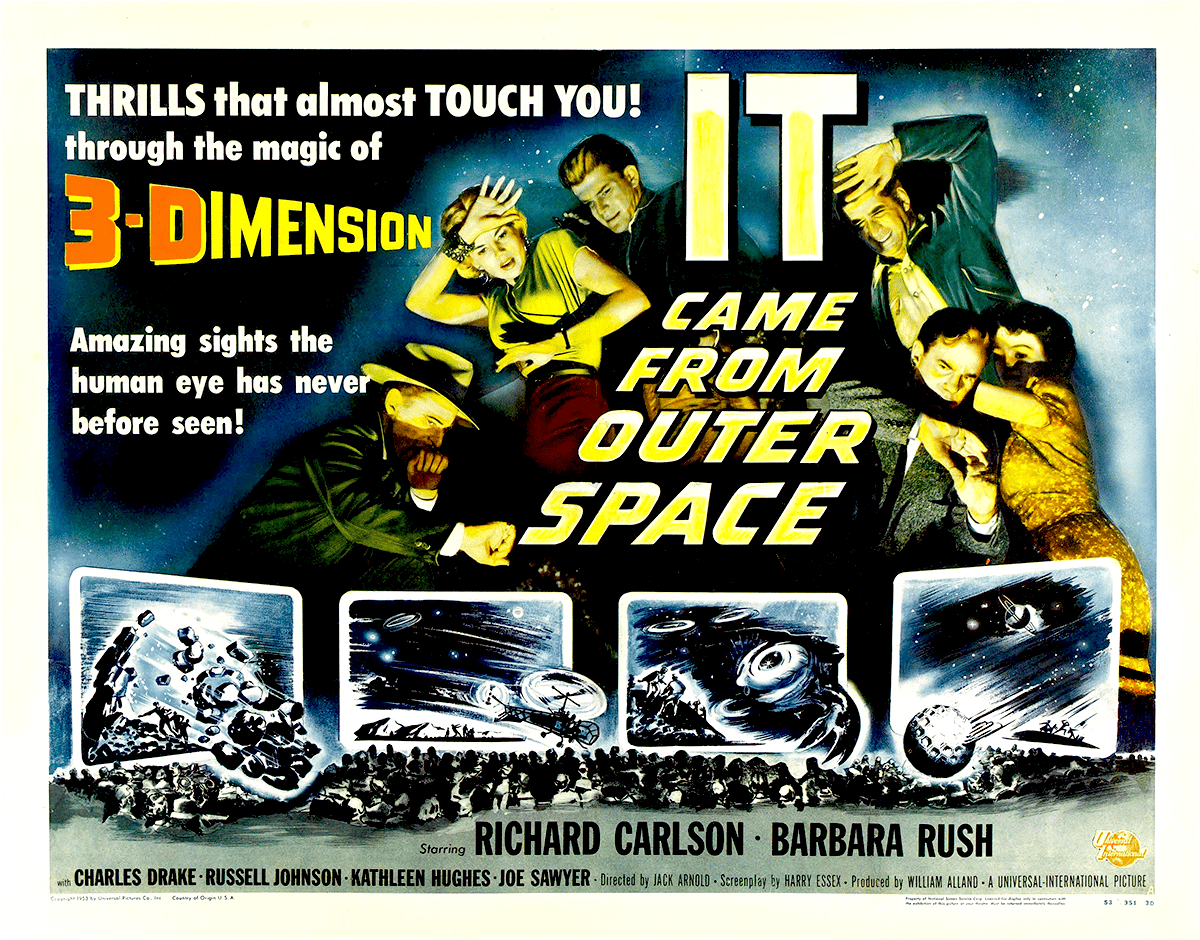
It Came from Outer Space
One of the early alien visitation films, It Came from Outer Space is a precursor to Invasion of the Body Snatchers and introduces director Jack Arnold's fixation with the desert. 1 HR 21 MINS 1953 Universal International
HORROR/SCIENCE FICTION
by Gary Svehla
12/29/202510 min read
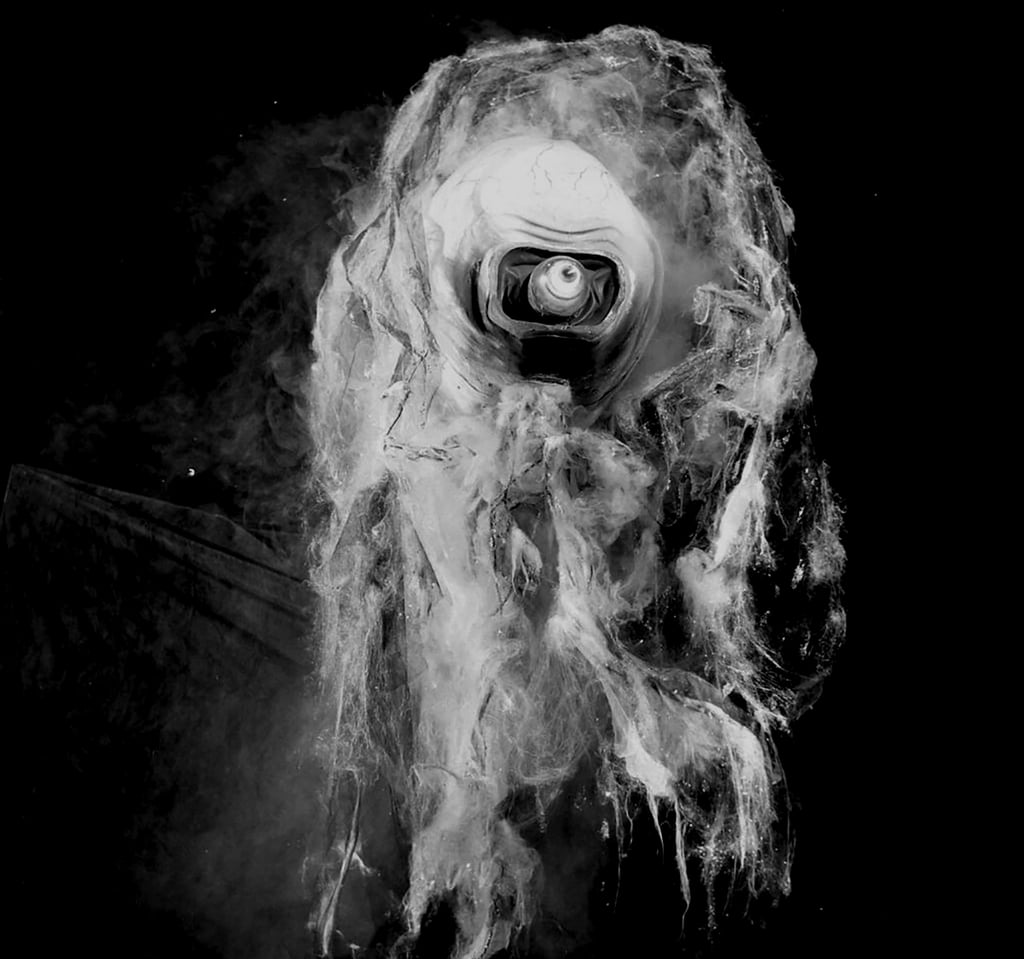
THE ONE-EYED ALIEN THAT CAME FROM OUTER SPACE.
THE STORY
A narrator tells us this is Sand Rock, Arizona, in the late evening of early spring. John Putnum (Richard Carlson) and his fiancée, Ellen Fields (Barbara Rush), live in a small home in the Arizona desert. He is an astronomer, and Ellen assists him in his work. John is so happy that he moved from the city to the desert because he no longer has to deal with closed-minded people. Suddenly, a loud noise is heard, and a slow-moving fireball crosses the desert, descending to Earth and exploding. Ellen holds John close, and John declares it was one of the largest meteorites he has ever seen. He looks at the smoking crash site near the ruins of an old mine through his telescope.
For our own information, the camera approaches the fiery inferno, cuts through the smoke, and focuses on a round vessel wedged between the rocks. The camera zooms in on the ship as a side panel opens amid smoke, with music swelling. Inside, advanced scientific equipment dazzles as the screen slowly darkens. The camera pans left in the darkness as space music flourishes. There, a giant eye emerges from the darkness, then the rest of its monstrous body, moving through the mist toward us. A transparent oval, a watery lens, materializes, allowing us to observe what the creature sees from its perspective. The beast exits the ship into the desert, depositing shiny crystals wherever it goes. Desert rabbits scurry, as do wolves and owls.
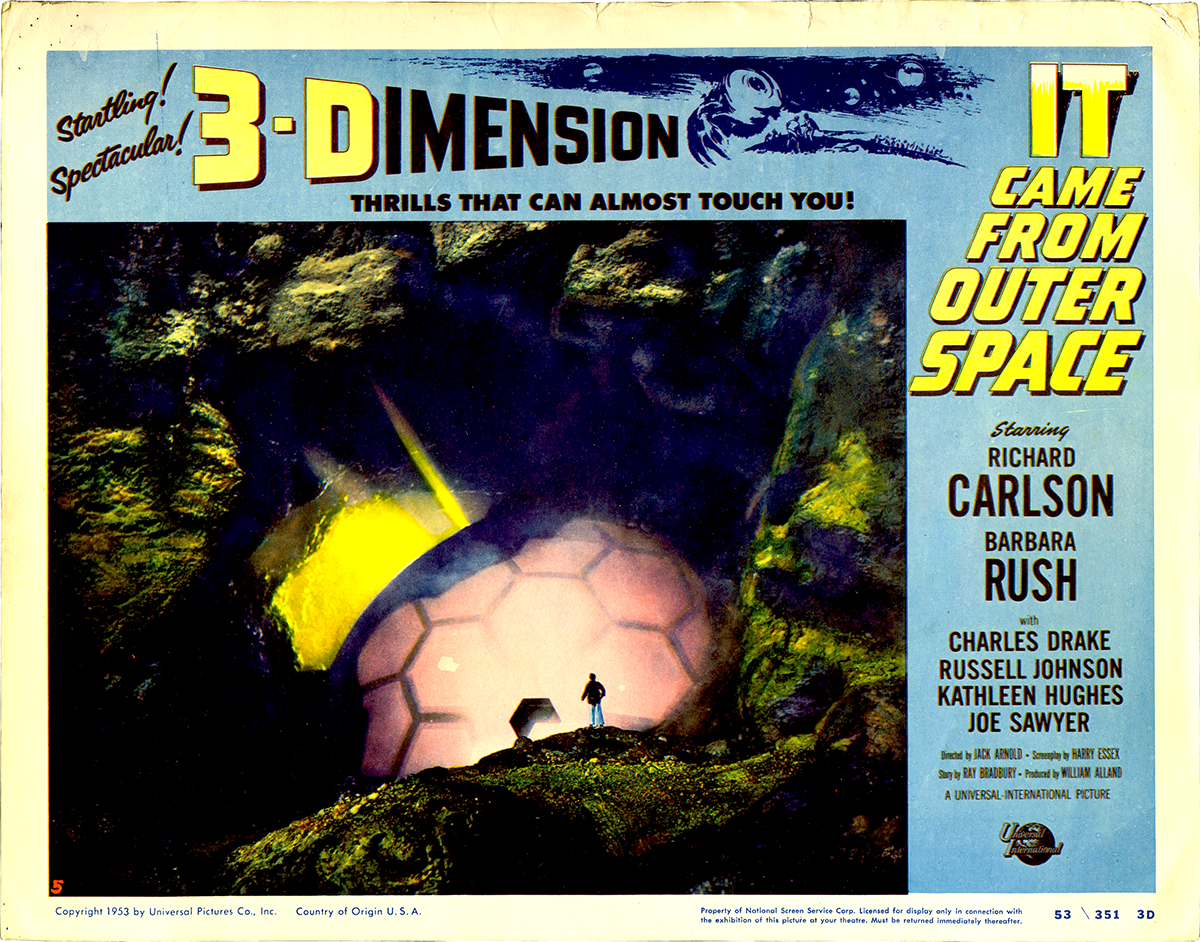
A crop-dusting helicopter carrying John and Ellen flies to the meteorite-smoking crater in the desert. After landing, all three are amazed by the crater, but John wants to get a closer look. He climbs down into the crater. Cutting through the smoke, John finds a vessel with its hatch open. He focuses on the trail of crystalline debris on the ground. His face is a mixture of fear and curiosity as the watery lens appears before him, and he looks right at it. John slowly approaches the open hatch as it closes. He backs away as rocks begin to avalanche downward. John carefully climbs back up the crater. In a daze, John says something about finding a ship down there. “I can tell from its size and appearance that this thing came from outer space. I even have reason to believe there’s some form of life in it.”
Later, as John tries to reach the crater site, he is besieged by reporters. Dr. Snell (George Eldredge) and his assistant are recording normal radioactivity levels, so the scientists, good friends, meet. Snell doubts John’s theory, believing this is a meteorite crashing to Earth. John is disappointed that Snell lacks an open mind.
George and Frank, two linemen, drive down the dusty highway, watching the telephone pole wires. Spooky outer-space music plays as the car approaches the one-eyed monster in the middle of the road, which was previously viewed. They exit the vehicle to examine the phenomenon as the watery lens turns its gaze upon them. With a look of horror, George backs away and is enveloped in a misty cloud closing in on him.
John stops his car and gets a premonition to go back to Frank and George. They come upon the lineman’s parked truck. John finds bloodstains on the truck and a crystalline trail in the desert. Venturing there, the watery lens follows them until they turn and confront George. He now speaks in a low, monotone voice. John briefly sees Frank’s arm lying still on the ground. George stares for a long time at the bright desert sun without protection. John and Ellen are nervous and concerned, but they soon leave, with John telling Ellen that Frank is dead. Putnum wants to get help from the town. But Frank soon awakens, seeing George’s clone and the actual George, who is also alive, the two of them. The alien Frank says, “Don’t be afraid. It is within our power to transform ourselves into anyone we want. For a time, it will be necessary. We cannot, would not take your souls or minds or bodies. Don’t be afraid! Your friend is all right.”
While talking in their car after dropping the sheriff off, John and Ellen spot George and Frank walking down the city street. John calls out to them, saying he wants to speak, but they duck down an alley. A door closes, but John forces it open. In the shadows stand the two linemen, who tell John to keep away. “We don’t want to hurt anyone!” John pulls a gun on the alien clones, and they say, “Your friends are alive; they will not be harmed if you do as we say. Give us time, or terrible things will happen. Things so terrible you have yet to dream of.”
That night, John and Ellen are summoned to the sheriff’s office. The wives of Frank and George both report that the men are not acting like themselves since they arrived home and are dead afraid for their spouses. The landlady says George skipped dinner, which is very odd for him. John pleads to Matt, “Now you’ve got to believe there’s a ship buried in the desert.”
Ellen is driving on the desert highway, with electrical wires strung along the roadside, when Frank appears in the middle of the road, raising his hands to signal her to stop. He enters her car, sits quietly, and looks stoic. Frank asks Ellen to take him to the mine. Suddenly, the watery eye lens appears, and horror erupts on Ellen’s face. She screams.
A telephone call is made to the sheriff’s office, telling John that they have Ellen. Matt and John rush to the desert to the spot John knows the aliens want to see him. Matt remains in the car. John waits at a rock; Ellen, appearing more sensuous and blank-faced, appears over the desert ridge. She says nothing but leads the way. Ellen runs ahead and disappears. Soon, a voice yells, “Here!” This leads John to a deserted mine. An otherworldly voice warns him to stay out of the mine, saying they are repairing their ship to leave Earth. “We need your help.” The voice says that now is not the time to meet in friendship, “Because you would be horrified at the sight of us.” The voice says to keep all people away, or it will destroy them. John says he cannot believe the alien leader unless he sees him as he actually appears. The voice says, "You shall see me," as the watery lens appears again. As John backs up, the one-eyed creature emerges from the mine, and, horrified, John covers his eyes.
At that moment, Matt honks his horn as John returns, disheveled and dazed. He tells Matt the aliens won’t come out to Earth’s people because they don’t trust us, believing that what they can’t understand, they destroy. Matt reluctantly agrees to help John keep people away from the mine for now. Matt sees Frank on the street and gets incensed, and John has to punch the sheriff to subdue him. But Matt approaches several deputies, ready to fight the aliens. John speeds off in the sheriff’s car. Meanwhile, a mob of people is assisting the sheriff.
Matt and the men set up an armed roadblock to stop George’s truck. When Frank is close enough, the sheriff and the mob open fire on his truck. He swerves past the roadblock, crashes into a boulder, and erupts in flames. Meanwhile, John has driven to the mine. He goes inside the dark tunnel, armed with a flashlight. Zombified Ellen soon confronts him. Ellen now speaks, “Just a few more hours!” John faces a dark underground river that could kill him if he fell. Then Ellen raises a weapon toward him and fires a laser beam. John cleverly evades the beam. A failed attempt on his life, alien Ellen jumps to her death in the river below. The sheriff’s men and volunteers approach the mine.
John finally comes upon the alien vessel and the men working tirelessly to repair it. The lead alien appears as John Putnum. He shows John a superweapon that powers spacecraft and can destroy Earth. John volunteers to hold off the mob, but the lead alien would rather it end here. John asks the aliens to release the hostages as a show of good faith, and then he releases them. The real Ellen hugs John. Putnum quickly hustles the hostages outside the mine as the lead alien transforms again into the one-eyed creature. As the sheriff’s party of men approaches, John fetches some dynamite to seal the mine entrance. Then the hostages and John encounter the sheriff and his mob. A motor sounds, and a giant fireball ascends into the desert skies. John rants, “There’ll be back!”
THE CRITIQUE
The screenplay for It Came from Outer Space was written by Harry Essex, based on Ray Bradbury's original screen treatment. Word has it that Essex’s screenplay closely copied Bradbury’s original treatment, including the dialogue. After making It Came from Outer Space, Director Jack Arnold quickly became the major director of Universal’s science fiction films during the 1950s; among his movies are The Incredible Shrinking Man, Tarantula, and Creature from the Black Lagoon. But this was Arnold’s first genre film.
Jack Arnold was chiefly known for his obsession with the Western American desert. Looking closely at a specific scene from the movie, we can see why. In the sequence, John and Ellen stop near the site of a Joshua Tree (whose shadowy illumination at night once terrified Ellen) and survey the desert. John says, “It’s alive!” Ellen responds, “And yet it looks so dead out there.” John continues, “Oh no, it’s alive and waiting for you. Ready to kill you if you go too far. The sun will get you or the cold at night. A thousand ways the desert can kill … Where are you? What do you look like? What am I supposed to be looking for? I know you’re out there. Hiding in the desert. Maybe I’m looking right at you and don’t even see you. Come on out!” As the couple leaves, they overlook the crystalline trail right beside them.
The desert is perhaps, along with oceans, the closest thing to an alien world on Earth. Once the ship from space crash-lands, the alien promptly leaves the vessel to venture into the desert, almost as if the environment reminds it of home and it feels safer out there. For director Arnold, the Arizona desert becomes the great unknown here on our planet; it’s where mysterious and deadly events occur. It’s where the unheard of becomes real, and the unreal becomes possible. As the dialogue above illustrates, the desert is always ready to kill, deadly, mysterious, and filled with false illusions.
And strangely enough, I always think of Jimmy Webb’s iconic song, Wichita Lineman, when watching this movie. George and Frank are two linemen-repair technicians in the film, and one iconic sequence captures the beauty and mystery of the sound of the electric wires carried by telephone poles. John and Ellen stop to speak with the linemen, Frank (Joe Sawyer) and his partner, George (Russell Johnson), and ask whether they saw anything strange this morning. Frank says he’s not seeing anything weird, but he’s hearing something on the wire. “Never heard anything like it on the wires before.” John climbs a ladder to listen to the distortion. “Sometimes you think the wind gets inside the wires and hums and listens and talks. Just like we’re hearing now, it comes and goes.”
To quote the beginning of the song:
I am a lineman for the county
And I drive the main roads
Searchin’ in the sun
For another overload
I hear you singin’ in the wires
I can hear you through the whine
And the Wichita lineman
Is still on the line …
These lyrics capture the loneliness of the linemen who search for outages to repair and hear strange sounds in the wires, here a human voice, but in the movie, alien sounds, strange and mysterious, hauntingly buried sounds covered by distortion and static. They sound like an aural puzzle waiting to be deciphered. Only an artist such as Ray Bradbury could create such poetry.
And It Came from Outer Space presents a simplified version of Invasion of the Body Snatchers, three years before that science-fiction classic was first filmed. In Body Snatchers, seed pods grow an exact duplicate of a human being while they sleep. The original body is destroyed, leaving the replica intact. The copy is identical to the Earth-born original, except it loses all emotion and develops a hive mentality that connects each individual to the entire pod race. In other words, it loses all aspects of its humanity and individualism.
In a simplified version illustrated in It Came from Outer Space, the alien race can create duplicates of human beings that are identical to the originals. Instead of destroying the original, the duplicate is held captive and sequestered from other humans. The duplicate again hosts the alien mentality, an emotionless persona that speaks in a slow monotone and walks side-by-side, almost holding hands, signifying a hive mentality. What is very unusual here is that the duplicate can confront the human original and actually speak to it.
It Came from Outer Space borrows several key concepts from the 1951 classic The Day the Earth Stood Still. In the earlier production, Klaatu, an alien, arrives in Washington, D.C., with his enforcer, Gort the Robot. Because humanity is venturing farther into space, its warlike culture must cease if it is to be allowed to exist and to meet intelligences on other worlds. Witnessing Gort’s incredible power, Klaatu’s message is that the planet faces annihilation unless it joins the society of interplanetary peace. There is no middle ground.
In It Came from Outer Space, the message is that not all monsters are evil. The aliens insist that now is not the time to meet as friends, since the sight of these one-eyed creatures will frighten humanity into believing their intentions are manipulative and evil, because they look evil to us. This alien race believes humans will destroy anything they do not understand. As seen by the mob at the picture’s end and by human reactions throughout the movie, they might just be right. We need to mature a bit before our two races meet again.
It Came from Outer Space is an early science fiction film released in 1953. Producer William Alland, director Jack Arnold, and the rest of the Universal crew had much more to say, but this picture marked the start of a satisfying decade. It borrowed from other films, but it also sparked innovation. The movie presented well-thought-out theories about what our civilization is and can be. It shows our citizens as not being mature enough to encounter other worlds with intelligent civilizations. But with independent thinkers such as John Putnum and Ellen Fields, we are maturing faster and faster, coming one step closer to meeting our interplanetary neighbors.
Too bad the innovative and poetic mind of Ray Bradbury was never used again by Universal in this inspiring decade.
JOHN PUTNUM (RICHARD CARLSON) VENTURES DOWN THE CRATER TO FIND THE OUTER SPACE SHIP WEDGED IN THE ROCKS.
garysvehla509@gmail.com