
Horror of Dracula/Dracula
Perhaps Hammer Film Productions' most remarkable film, a true classic that showcases Peter Cushing and Christopher Lee as the modern masters of horror. 1 HR 82 MINS 1958 Universal.
HORROR/SCIENCE FICTION
written by Gary Svehla
12/16/20257 min read
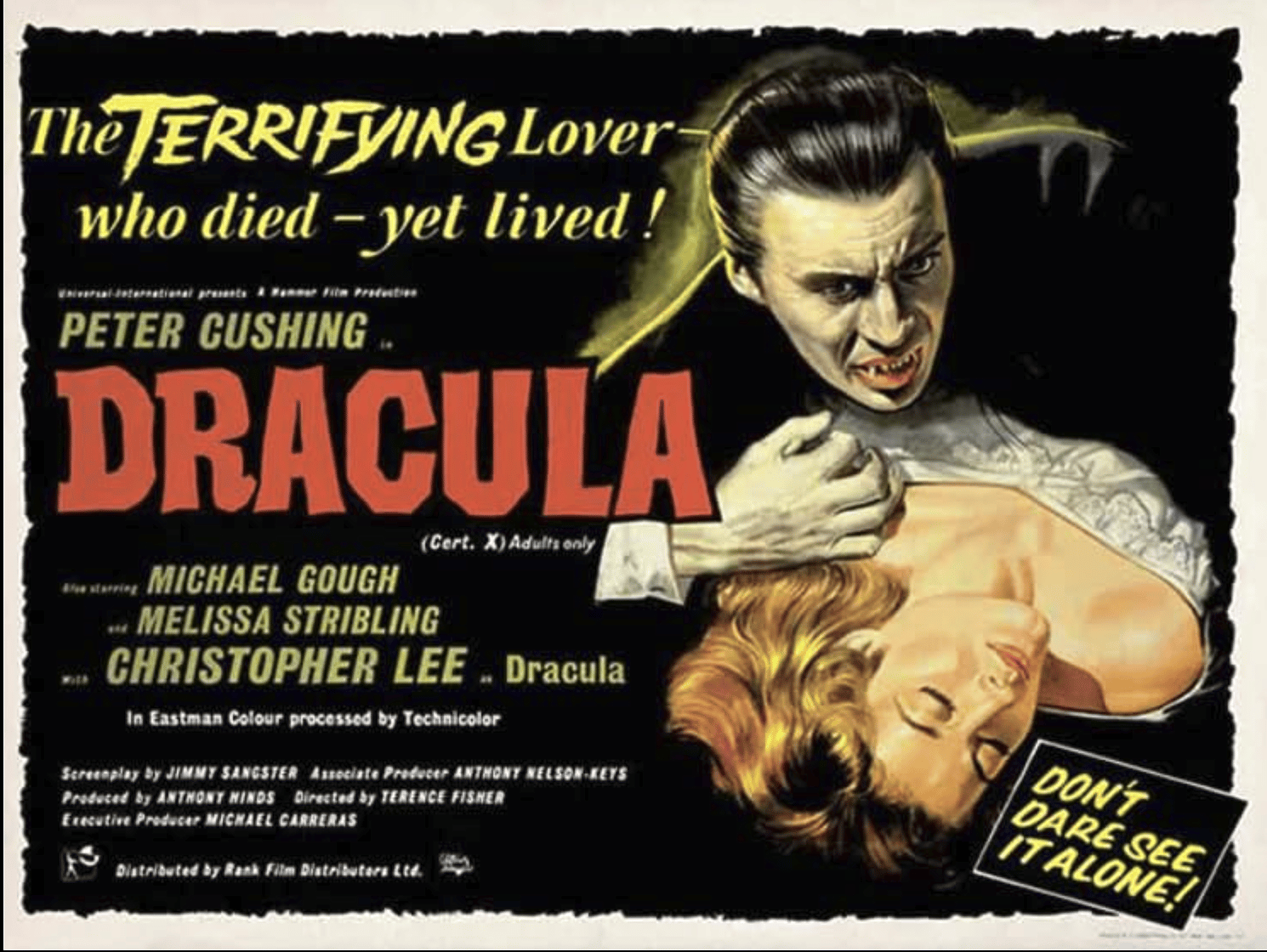
One month after April 1958, when United Artists’ Return of Dracula premiered with its modern take on the feared Undead by Francis Lederer set in a small-town American setting, the British horror film Horror of Dracula (released in its native England as simply Dracula) arrived in America in May with a heavily promoted publicity campaign. Hammer became the modern equivalent of Universal Pictures, known for its original science fiction films like X: The Unknown and the Quatermass series, creative reinterpretations of classic Universal horror movies, and original horror films such as Plague of the Zombies and The Gorgon.
Horror of Dracula was the second Hammer Gothic Horror in color, arriving one year after Curse of Frankenstein. Its success encouraged the Hammer team to continue making mainly Victorian costume dramas on a budget. Unlike Return of Dracula, which featured Dracula in a black-and-white Western American setting for “B” audiences, Horror of Dracula showcased its Count in vibrant color against an ancient British backdrop. It was a “B” picture dressed up to look like an “A.” However, in the States, it was still released as a double feature with The Thing That Couldn’t Die, a Universal programmer.
The significance of Horror of Dracula's being shown in color was notable. This wasn’t like Blood of the Vampire or Flesh and the Fiends’ style of color; the screen's artist-cinematographer literally painted Horror of Dracula, his work presented in long-gone three-strip Technicolor. Horror was vividly brought to life by legendary cinematographer Jack Asher. The only criticism of his work is that he took too long to shoot movies that were carefully crafted to perfection. But true art requires time.
Take the scene in Dracula’s dark crypt where Jonathan Harker traps the vampire woman who seduced him into a life of vampirism. Harker could easily kill Count Dracula first, as the sunlight is still shining. But the woman is Harker's primary target, mainly because she introduced him into the world of the Undead. He unravels the wooden stake and drives it into her chest, blood spilling out in bright, vivid colors—a Hammer trademark.
The crypt is pitch black, but Dracula’s eyes cut through the darkness, darting around as if feeling constrained. His threatening facial expressions stand out sharply against the darkness. When Harker is finally ready to destroy Dracula, the sun has sadly set, freeing Dracula from his stone sarcophagus and releasing him from his daylight confinement. As eerie music plays, there is a pause from looking up at the crypt door to seeing Dracula’s tall, statue-like form appear, knowing he has Harker trapped—a masterfully captured scene by a skilled director. The hunter becomes the hunted.
Another example of Jack Asher’s excellent camerawork is at the beginning of the film, when we first enter Count Dracula’s castle. We see streaks of sunlight illuminating dark, colorful shadows. Some rooms are bathed in dense blue, while others are shaded in morbid grays. The way Asher shoots the castle in dark shades is textured, rich, and moody. Only in IB Technicolor, with its lush texture and deep, intense shades, can this remarkable cinematography truly be appreciated.
James Bernard’s exquisite musical score has become iconic. His Dracula motif highlights the Count’s name in slow rhythms. During the intense climax, Dracula tries to bury Mina in the ground to complete his vampirization of her, while Dr. Van Helsing and Arthur Holmwood are close behind. This sparks a frantic chase through the castle's staircases and dark hallways. Bernard’s score evokes excitement and suspense, perfectly complementing the on-screen action.
James Bernard’s music is incredibly memorable. For example, his ending score for the movie, after Van Helsing jumps and tears down the curtains, letting in intense sunlight to destroy Dracula, slows to a whisper, creating a calming effect and a sense of resolution, ending the film on a sad note of triumph, and bringing the Dracula motif back one last time, resonating in its presentation.
But what about Jimmy Sangster’s screenplay? In today’s efforts to replicate the novel as accurately as possible, for example, look at Guillermo del Toro’s recent version of Frankenstein. During the movie's publicity, del Toro claimed that his film was the closest adaptation of Mary Shelley’s novel and that it was more faithful because it better reflected the novel's intentions. Consider the story of Horror of Dracula, credited to Bram Stoker and Sangster. Bram Stoker’s credit seems to be a way to honor the creator of the original work, and it likely helped boost publicity.
Jimmy Sangster’s screenplay differs significantly from the Stoker novel, even though his story incorporates many elements of the book within his budget-conscious script. Hammer was making “B” movies that appeared much more stylish, featuring good costume design, detailed sets and production design, and some interesting decorative pieces. Hammer Film Productions always aimed for the highest quality, when they could only afford the minimum. Although money, or the lack of it, was always a challenge, Hammer understood that creativity and imagination were essential. Peter Cushing and Christopher Lee knew that these lower-budget fairy tale films mattered to movie fans, and Peter Cushing, whether manipulating small props or pretending to be Errol Flynn, always delivered his fantastical characters with serious dedication and energy. Many have observed that Cushing played each role as if he were performing in a Shakespeare play rather than a horror movie.
Christopher Lee, on the other hand, portrayed the monsters (Frankenstein’s Creature, Dracula, and the Mummy) with eerie sensitivity and a human touch. Whether it was communication through a single eye, an unbalanced newborn body with a damaged brain, or contrasting Count Dracula as a regal nobleman versus a feral beast — an animal with blood covering his mouth and lips, hissing while baring his fangs — Lee always found one or two elements to emphasize in his portrayals that made them stand out.
In Sangster’s condensed script, where is Renfield? Where are the Gypsies? Where is the sense of a long journey across Europe? In other words, where is the scope of the original novel? Sangster wrote a screenplay within Hammer’s budget. He limited action to the Holmwood house, the nearby grounds, Dracula’s castle, a mortuary, and some coach-riding scenes. Surprisingly, the script works, and Sangster effectively emphasizes horror and suspense. There’s a feeling that it doesn’t matter that the novel has been reshaped, reimagined, and heavily simplified. Most people did not care that the Bram Stoker novel was not closely followed. The remaining elements, as well as those added, are excellent.
Sometimes what works well in a novel doesn’t translate effectively to the screen. Often, a novel adapted for the screen will be too long or include elements better suited to the page than to visuals. Del Toro deserves praise for trying to create a faithful adaptation of the Frankenstein novel, but that doesn't necessarily make it a great movie. Look at Universal’s Frankenstein or Bride of Frankenstein — films that took significant creative liberties with the source material. Still, these 1930s Frankenstein films have never been surpassed, and they hardly follow the novel. A novel is meant to be open to interpretation and serve as a starting point. It exists to be reimagined by creative, vivid minds. Often, the best movies differ significantly from the original novel. Tied to the Hammer budget and vision, Horror of Dracula featured an inventive screenplay inspired by the novel rather than a literal translation.
Teamed together for only the second time, Peter Cushing and Christopher Lee became the modern-day titans of terror, as if Karloff and Lugosi had passed the baton. The keyword for Peter Cushing would have to be intense. With his use of props and complete sincerity, he would comfort the terrified and teach the uninformed. He never strayed from being assertive when the situation required it. You could clearly see his mind at work in films like Horror of Dracula. He never hesitated when a vampire, perhaps a former friend, had to be freed from the cult of the Undead with a sharp wooden stake through the heart. He was firm and confident, almost arrogant. But he was definitely on the side of good in movies like Horror of Dracula.
In one of his better scenes from the movie, Arthur Holmwood waits outside his sister’s tomb, she a victim of Dracula. Lucy, his undead sister, runs up to him, wanting to hug him. As she gets closer, a close-up of an arm holding a metal crucifix enters the scene from the right. Lucy’s rapid breathing fills the soundtrack as the crucifix touches her forehead with a sizzling sound, leaving an impression burned into her skin. Terrified, Lucy runs into her crypt. Scenes like this show you don't need much money to create an innovative and frightening sequence. Hammer proved that creativity rules.
Director Terence Fisher demonstrated that simple battles between good and evil are enough to carry a film. Christopher Lee was convincing whether lying trapped in his tomb, snarling like a wild animal in the library, or gracefully descending a staircase in his castle to greet Harker. His varied personality traits created a complex character that may be the best onscreen Dracula of all, even beating Lugosi. Although modern film techniques—vampirism as subtle sexuality, rich color schemes, more graphic violence, period-accurate costumes, and powerful musical scores—this Hammer classic achieved so much with so little that Horror of Dracula remains one of the most impressive horror films ever made.
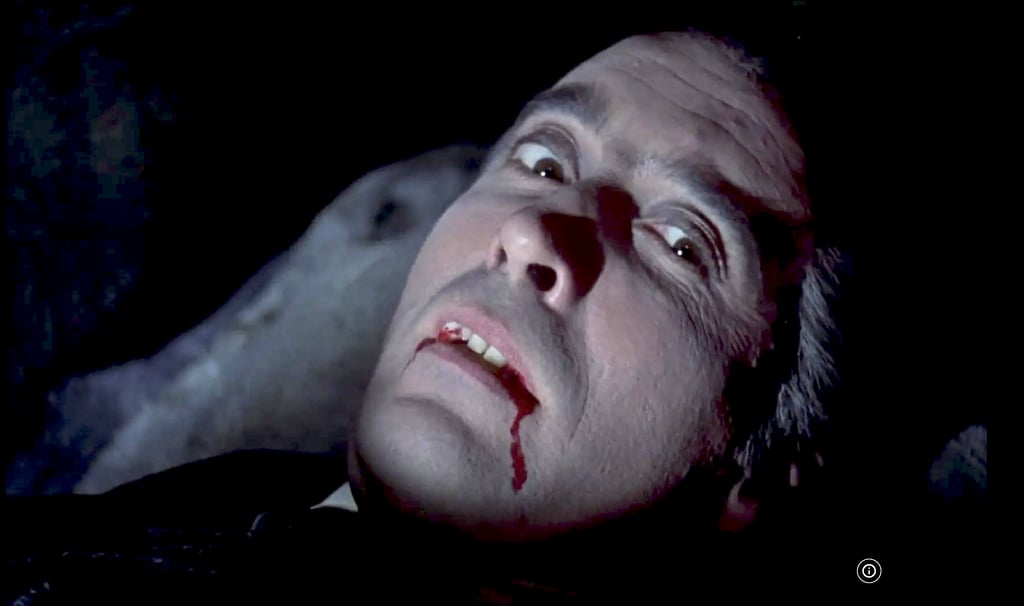
COUNT DRACULA (CHRISTOPHER LEE) LIES TRAPPED IN HIS SARCOPHAGUS MOMENTS BEFORE THE SUN SETS.
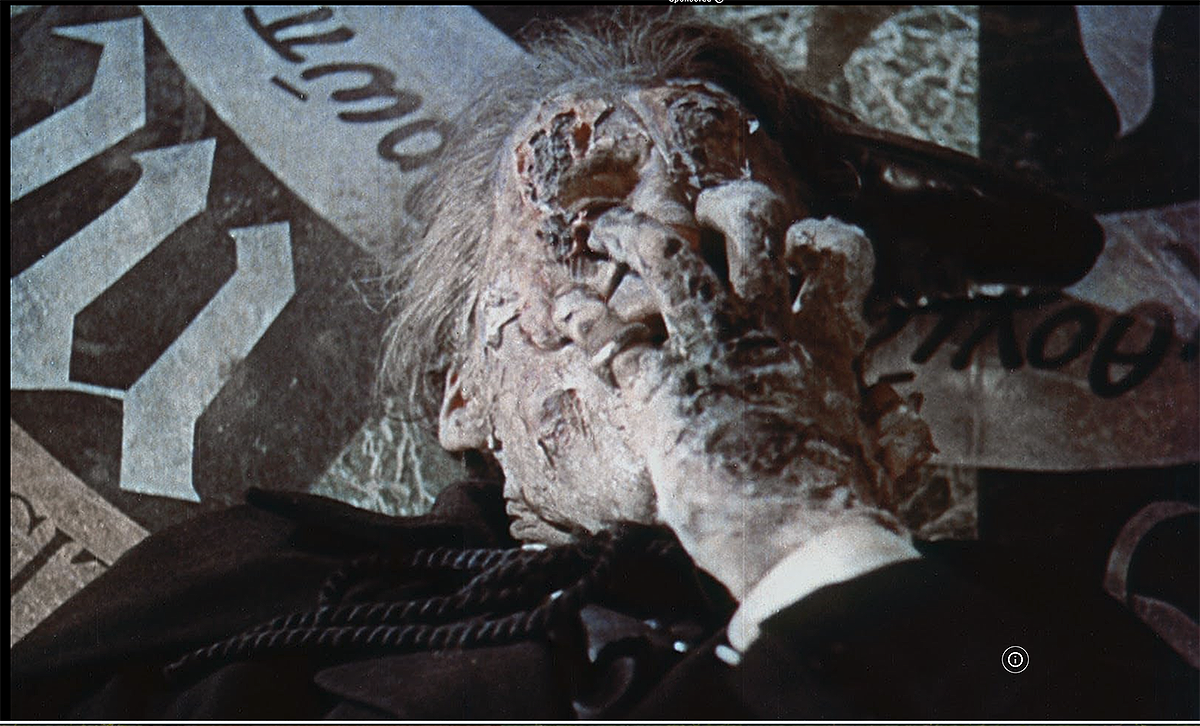
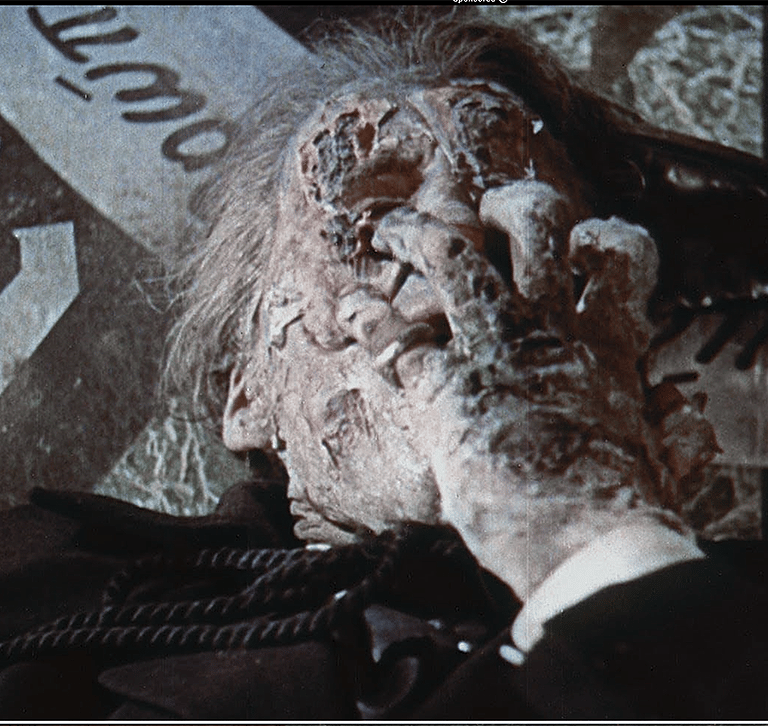
COUNT DRACULA, TRAPPED BY THE RAYS OF THE SUN, DISINTEGRATES AND TURNS TO DUST.
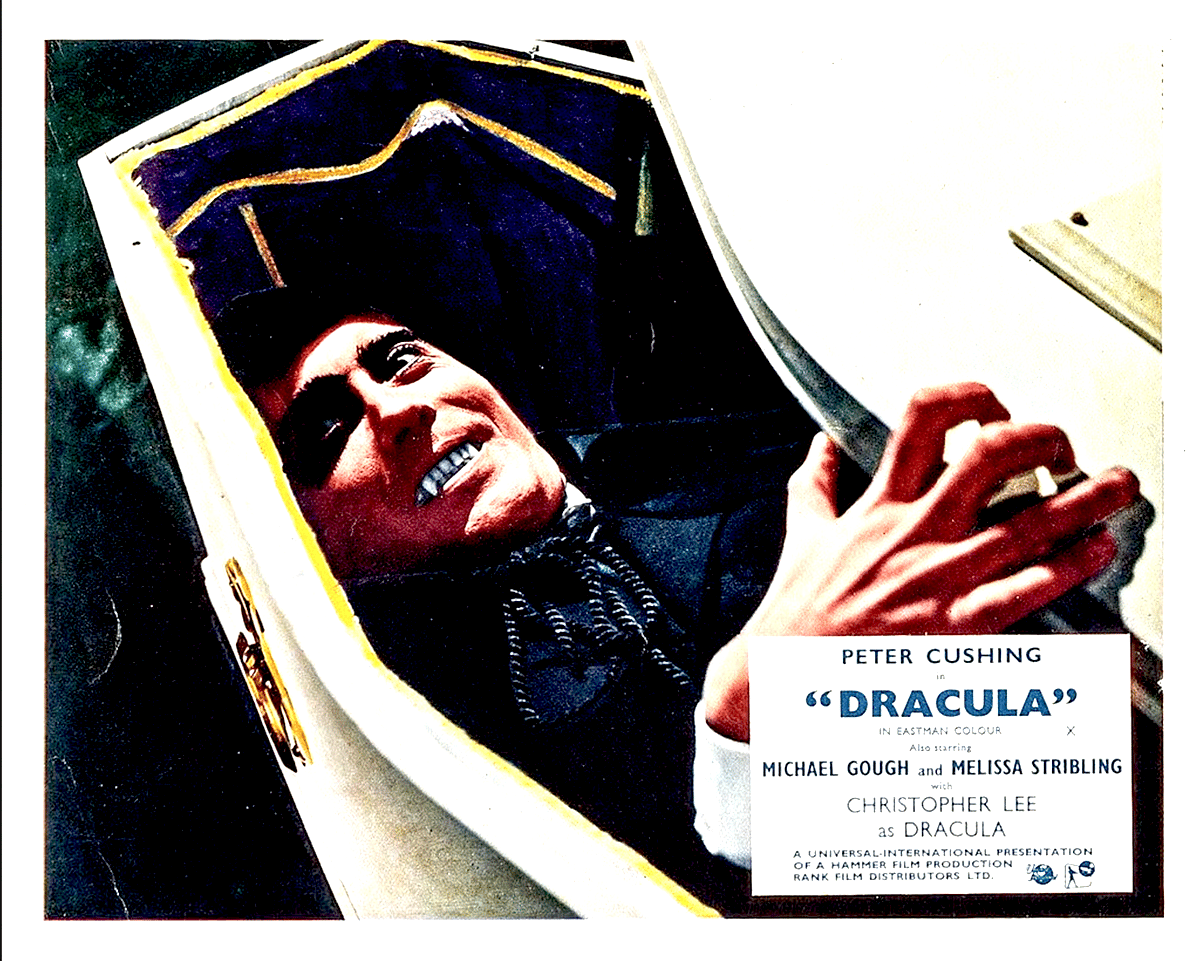
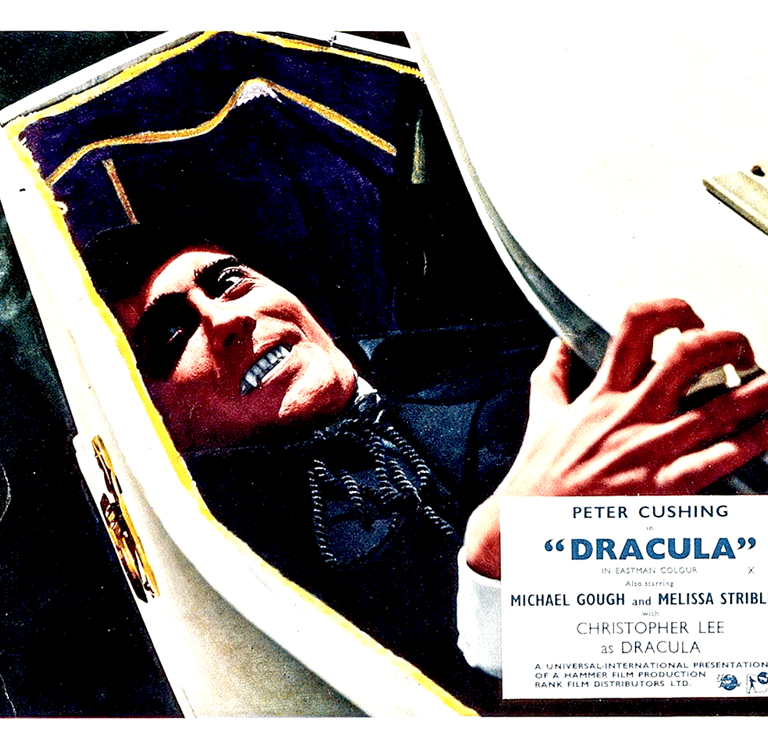
HIDING HIS WHITE CASKET IN A MORTUARY, COUNT DRACULA EMERGES.
garysvehla509@gmail.com