
Fear in the Night
A man dreams that he commits a murder in a mirrored room, and the tortured man tries to convince others that he is innocent. 1 HR 11 MINS 1946 Paramount
FILM NOIR/DARK CINEMA
by Gary Svehla
1/27/202610 min read
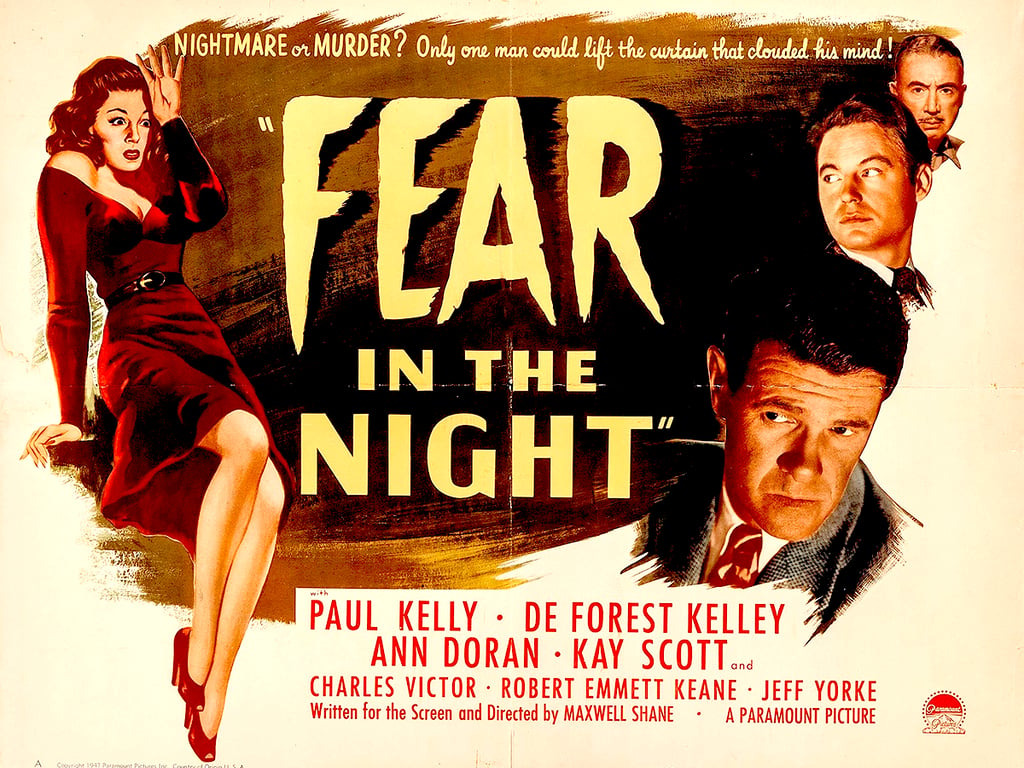
Story
Vince Grayson (DeForest Kelly) is in a mirrored room, encountering another man and woman. Grayson struggles with the man; they fight for a long time. Suddenly, the woman hands a metal spike to Vince, and he stabs the man. All this is captured with surreal photography. The woman flees from the room, leaving Grayson and a dead man inside. Vince stuffs the body in a closet, locks the door, and takes the key. But Vince runs outside the room and seems to fall, as if in a dream.
Vince awakens. Vince believes all that happened was a dream. But when entering the bathroom and looking into the mirror, Vince sees marks on his neck as though he were being strangled, which he was in the dream. He goes to turn on the spicket and sees blood on his hand. He reaches into his pants pocket and produces a key. Thinking to himself, he never had the key in his possession last night. Vince thinks the key, the blood on his hand, and the strangulation marks on his neck mean he wasn’t having a dream, that the murder in the mirrored room must be real.
Vince sits on his bed, calling the bank to take the day off. Girlfriend Betty Winters (Kay Scott) takes over his window. Later in the day, Betty calls to check on Vince, but he does not answer, which the boss finds suspicious since he’s supposedly sick.
Vince gets out of his room to clear his head, going to see Cliff Herlihy (Paul Kelly), his brother-in-law, a cop, to try to find an explanation for what happened. Vince confesses to Cliff that he perhaps killed a man last night; he doesn’t know who or where it was supposed to be. “I stabbed him …” Then Vince recounts the rest of the hallucination. Cliff seems to doubt the story, telling Vince that he’s working too hard.
When the men go in to dinner, Betty is there with Cliff’s sister Lil (Ann Doran). Betty admits to being worried about Vince, but Vince is annoyed that he cannot take a day off without causing a commotion. Vince looks at his bloody hand, which is odd since he washed the blood off.
Vince states that at some time after midnight, something awakened him: Cliff! Cliff wants to hear the truth about what’s really happening, not this dream business. Vince asks Cliff to investigate further to learn more about his dream, such as where the mirrored room is located. Cliff advises him to forget the entire thing and reveals that Lil is pregnant, and he doesn’t want her worrying
Cliff forces Vince to accompany Lil and Betty on an outing, and Vince suggests a canyon out of the blue. He doesn’t know why. Cliff stops the car so the group can have a picnic. Lightning strikes briefly but powerfully, and shortly afterward, the rain descends, ruining their picnic. As Cliff drives away, they pass a bridge Vince recognizes. He then describes the road, a turnoff, and a big house up ahead. Vince thinks, “I didn’t know myself how I knew that, but the closer we came, the harder my heart pounded, and the more frightened I became.” The car approaches the big house, and they dash for it. Nobody appears to be home, but Vince instinctively retrieves a key from a flower pot. Even though Vince thinks he has never been here before, he seems to remember the house’s interior.
Vince, instead of joining the others, wanders alone upstairs. In a case of déjà vu, he finds the mirrored-paneled room and goes inside. Looking around carefully, he utters that this is the place of his dream. Vince hands Cliff the key he possesses, and he unlocks the closet door. Vince points out the tiny room where he propped up the dead body. Inside, there is dried blood, but no body. Vince still wears that dazed look.
The men go into the kitchen area. Cliff begins acting like a cop as he accuses Vince of lying, claiming to know everything from a dream. Cliff thinks Vince drove out to the canyon, to this house, and killed a man last night. Cliff, angry, thinks Vince was making a fool of him. Cliff begins grilling his brother-in-law while Vince swears his dream was real. Cliff slaps him hard and asks for the name of the man he killed.
Suddenly, a man in a black raincoat enters, Deputy Torrence (Jeff York), armed with a pistol. The man asks for the men to identify themselves immediately. Torrence eases up when he sees Cliff’s police ID. Torrence reveals there was a murder committed here last week. The murderer ran over a woman in a car, the owner of the house, while her husband was away in Mexico. Vince does not know how to drive a car, and Cliff knows that. The police also found a body stuffed in a closet in the mirrored room upstairs. He was stabbed to death.
The two men and Torrence go to the police station. Captain Warner (Charles Victor) reads the police report, which describes a man who looks like Vince as the identified killer. The morgue photos are of the same man and woman Vince saw in his dream. Vince thinks to himself that he is a murderer as he passes out and falls to the floor. Cliff revives him with a drink of water, and they leave.
Back at the hotel, Cliff plans to report everything he knows about Vince and the crime to his precinct boss and then turn in his badge. Vince says he’s scared stiff … what is he going to do? But Cliff offers no comfort. When Cliff leaves, Vince momentarily considers slitting his wrists and jumping from his hotel window. Cliff sees Vince on the ledge from the street and rushes back to his room. Betty follows him. But Cliff gets to Vince’s room first, struggles, and pulls him inside. Cliff tells the just-arriving Betty to take Lil home, that he’s spending the night with Vince. Cliff mutters that someone who is willing to die must have some truth in his story.
Vince utters, “I’m licked!” Cliff wants him to retell the story of his neighbor, Harry Byrd (Robert Emmett Keane), and a burned-out light bulb in his hotel room. As Vince tells it, he was just going to bed when someone knocked on his door. Byrd enters the dark hotel room with a lit candle, stating that the light in his room went out. He is just checking if the entire circuit went off or just his room. It turns out Vince’s lights are working just fine. Byrd slowly backs out of the hotel room. Cliff repeats the commentary, “He was standing there with a candle in his hand, and he kept saying that you were tired. Eyes thick and glassy, as though you were mentally unbalanced.” Cliff is deep in thought, mulling over a new theory, and quickly leaves the hotel room. Cliff returns with a picture of a man, who, when he draws glasses and a mustache on the photo, resembles Byrd. The man is Dorothy Belknap’s husband. You did not kill Mrs. Belknap because you can’t drive. Mr. Belknap was waiting outside in his car and deliberately drove over his wife. But you did kill a man and stuffed his body in a closet. We got to prove you didn’t know what you were doing and why you didn’t know it.
Cliff and Vince head back to the mirrored room. After the funeral, Mr. Belknap returns home, with Vince hiding upstairs. Belknap places his wife’s ashes in a closet in the mirrored room while Vince watches and soon confronts him. Belknap is shocked that Vince remembered this house, but Vince says he has the dazed look of someone … hypnotized. In another room, Cliff and an assistant record the entire conversation. Vince says, “I killed that man in self-defense. But I’ll never be able to clear myself in the eyes of the law!” Belknap offers Vince money and a way out of the country. Vince rejects the offer, so Belknap pulls out his shiny pocket watch and attempts to hypnotize him once again. While Vince is under a trance, the surreal cinematography returns, and Vince falls under his power. “I didn’t want to go, but my brain was handcuffed.”
Belknap walks Vince out to his car and drives away. The good guys jump into a car and follow. Belknap forces Vince to write a confession note admitting his guilt, which also serves as a suicide note. Even with elusive driving tactics, Belknap’s car is spotted. Belknap stops the car, and both men exit. Vince is asked to take off his coat, which is holding the note. Belknap asks Vince to climb into the dark waters, telling him, “This is where you will find peace.” The hypnotist drives off as he sees the other car approach. Cliff manages to pull Vince out of the water just in time as the other two keep driving and reach Belknap’s car, guns blazing. Torrence shoots out one tire, forcing Belknap to plunge off a cliff and crash. Meanwhile, Vince revives and says, “I feel all right.” Later, Vince is at the courthouse to plead self-defense, and all seems fine, and Betty is joining him as they walk into the building hand-in-hand.
Critique
So much damn plot for an hour and 11-minute movie!
Maxwell Shane was known as a producer and screenwriter, but he also directed a few films. In 1946, he wrote a screenplay based on a novel by Cornell Woolrich, one of the iconic noir writers, titled Nightmare, written under his pen name, William Irish. The screenplay had its share of twists and turns and became a highly rated film noir. But he was not finished with Woolrich’s story. Again in 1956, he remade his own movie, this time titled Nightmare, starring Edward G. Robinson and Kevin McCarthy. It was quite similar to the first version, but had a bigger budget the second time around and the star power of the two leads. But the Woolrich story was so creative that it was worth a remake.
Film noir in the 1940s gave rise to a subgenre, psychological film noir, which gained commercial traction and produced many memorable movies. At the heart of psychological film noir is usually an outsider, a man tortured by his crime, his nightmares, his delusions, or his inner struggle between good and evil. Here is the debut of DeForest Kelley, primarily a “B” actor who appeared in detective shows, dramas, and Westerns. Later in life, he created the character of Dr. McCoy in the Star Trek television series and feature films. In 1946, he played the tortured role quite well. While he appears to experience nightmares, he believes his dark dreams are real, even to the point of thinking he is a murderer.
His dramatic foil, brother-in-law Cliff Herlihy (Paul Kelly), is a practical cop who believes in logical explanations. He wants Vince to remain quiet about his obsessions, believing that at the least Vince is overworking, but at the worst, he is having mental problems. Since Cliff’s wife is pregnant, he does not wish to burden her further by bringing her brother’s problems into the picture. Even though the two men are related through marriage, Cliff shifts into pure cop mode, accusing his brother-in-law of murder, lying, and playing him for a fool. When Vince is ready to jump out of a hotel window, Cliff quickly turns tail and now believes Vince because he was willing to die for his obsession. The turnabout seems such a sudden change.
The outrageous cinematography by Jack Greenhalgh, at various points in the movie, recalls similar visuals in Stranger on the Third Floor. The very first image is a round light bobbing and weaving against a black background. Then we see a woman’s head floating toward us against a black background. We first see the mirrored room, with shimmering waves of light creating a dreamlike effect. We see Vince fall downward in slow motion, the shimmering light reinforcing the hallucinatory effect as he twirls around. Later, we have a zoom-in on Vince’s face, and his eyes reflect the struggle in the mirrored room. We see the man who invades Vince’s room holding a candle, backing out of the room. Later, we see the bright reflection of the pocket watch as Belknap hypnotizes Vince once again, walking him out of the house as the weird shimmering light returns. And these are just some of the sequences with hallucinatory photography. Programmers obviously tend to avoid such eccentric (and expensive) cinematography.
The use of déjà vu is pivotal to a psychological film noir. Vince constantly feels he’s been somewhere before but doesn't remember being there. He remembers the interior of the Belknap home as if he had been there before. The same is true of the road ahead, with the turnoff and the big house. He was there, but he just doesn’t remember. This knowledge torments him. He fails to connect the dots.
The trope of hypnotism in this movie is similar to the idea that it's all a dream. The first time the trope is used, it's a great gimmick, but by the 10th or 20th time, it becomes, as stated, an overused gimmick. Each audience member must decide for themselves whether the use of hypnotism is a gimmick or a clever trope. Anyway, hypnosis is cleverly and mysteriously used in Fear in the Night, adding mystery and suspense to a movie where few realize just what is going on. And that is the movie’s strength, the utter failure of its audience to figure out the crime and motives until near the end.
Some will say that the use of inner narration to reveal Vince’s thoughts, frustration, and reality (distorted though it be) is an overused trope in film noir, but others will claim that, in this case, it is essential to know the internal thoughts and emotions of the tortured main character, Vince. If the overused trope were ever justified, it is essential and well used in this movie.
The central focus of the mirrored room is innovative. For instance, the mirrors distort reality through reflection within reflection within reflection, yet they still reveal the truth (even though the lens is distorted). Vince is indeed in the room, and he stabs a person to death. Vince’s brain is also confused and distorted, but he never realizes the truth that he was hypnotized to do somebody else’s bidding, not his own. The mirror room shows what happened, not why or how. The distorted brain attempts to show not just what happened (Vince knows he killed a man in that room) but also why and how it happened. That’s what frustrates Vince; he can’t figure out all the facts or motives.
The sequence with Belknap and Vince driving off at the movie’s end seems slightly anticlimactic, with Vince once again in a trance, confessing to crimes via writing a note that is blatantly false. And the scene where he climbs into the water to die is played for suspense, but it still seems a bit much.
An incredible amount of plot structure unfolds in this very brief movie, but it is a fun puzzle to solve, even if it relies on gimmicks and coincidence. The movie constantly keeps audiences guessing and holds them in a web of suspense right up to the end. And for this very ambitious “B” movie, that is more than enough.
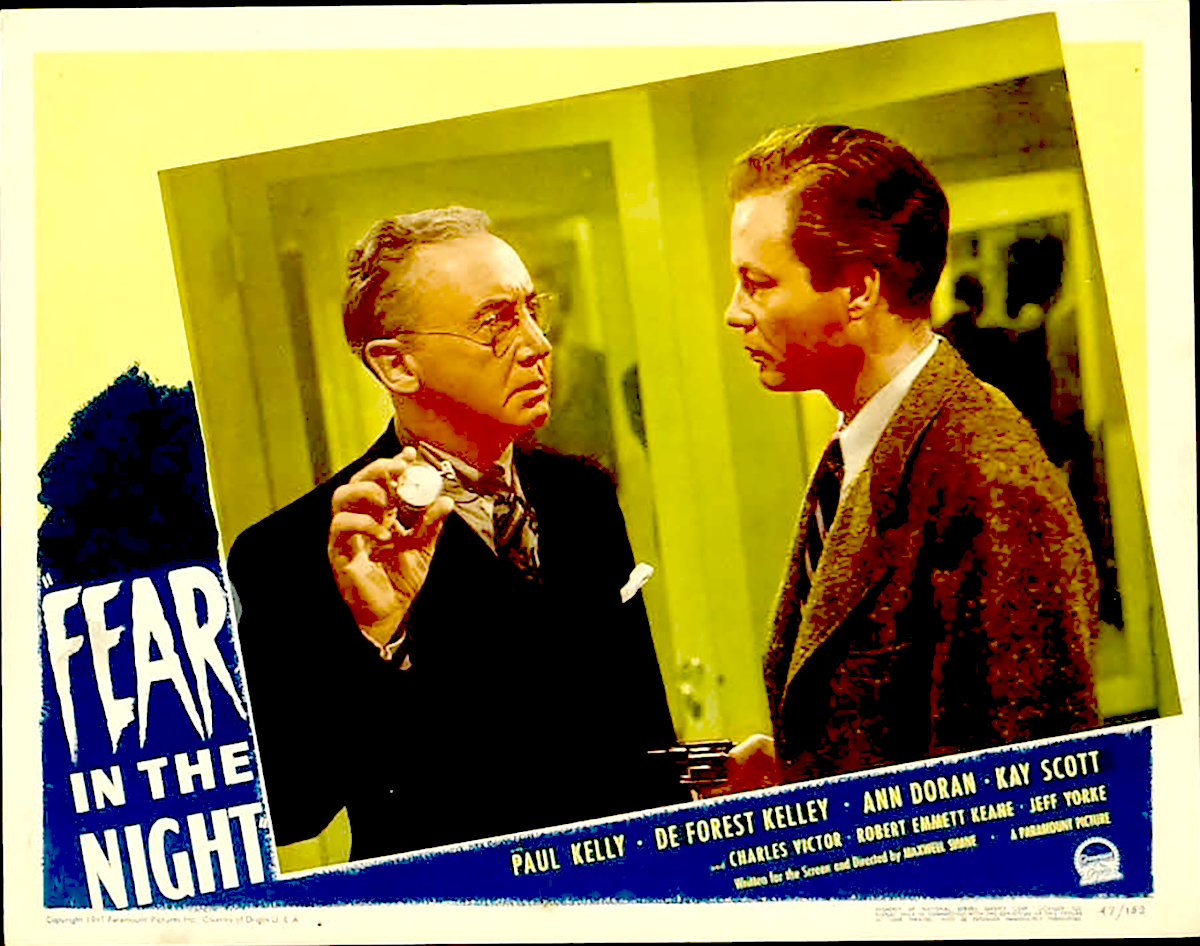
LEWIS BELKNAP (ROBERT EMMETT KEANE) HYNOTIZES VINCE GRAYSON (DEFOREST KELLY)
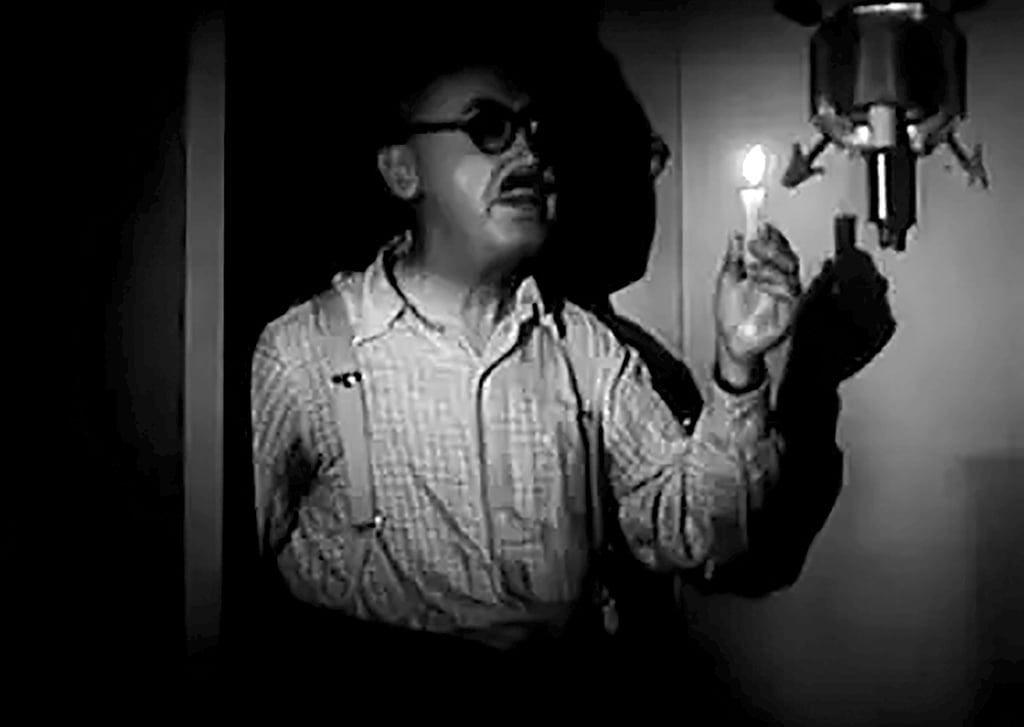
HARRY BYRD (ROBERT EMMETT KEANE) SLOWLY BACKS OUT OF THE APARTMENT WITH A MESMERIZING CANDLE.
garysvehla509@gmail.com