
Deadline Before Dawn
An innocent sailor must clear his name by dawn for a murder he did not commit. But it's never that simple. 1 HR. 23 MINS. 1946 RKO
FILM NOIR/DARK CINEMA
by Gary Svehla
1/20/202610 min read
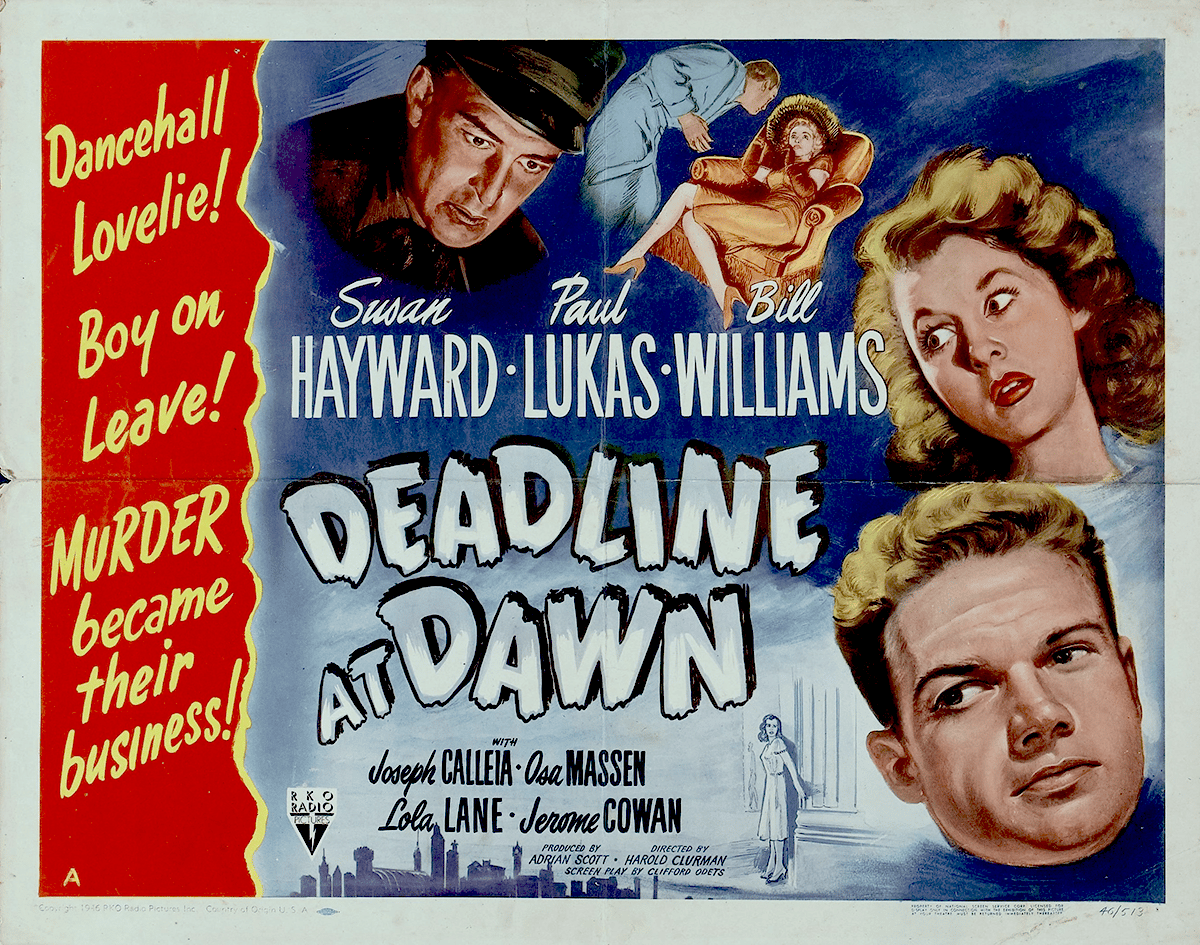
Story
A knock on an apartment door. A woman, a fly crosses her face, lies asleep. The woman, Edna Bartelli (Lola Lane), dons her robe and opens the door to Sleepy Parsons (Marvin Miller), her blind ex-husband. He asks her for the $ 1,400 she owes him. As she checks her purse, her money is gone, and she says a sailor took it.
We finally meet the sailor Alex Winkler (Bill Williams), who awaits his bus in a few hours to return to the naval base in Virginia, now sweltering in New York City’s August heat. Leaving a newsstand, he drops a roll of money that he has forgotten. A street barker lures Alex into a dance hall club, where sailors are half-priced to enter. The women charge for a dance. And June Goffe (Susan Hayward) is trying to be rid of a customer who won’t leave her alone. Alex says a few words as June passes by, and he asks her to dance, flashing a handful of tickets.
The sailor tries to talk to June, but she is tired and doesn’t have the energy to connect. But ultimately, she returns home (her feet are killing her) with deli meats to make supper for Alex, an innocent distraction before his bus arrives. When he announces his return to the naval station in Norfork, June beams that she was born there and that her mother lives there. Perhaps he can deliver a message to her that she has a good role in a play, that she will be home soon, and that she’s doing well. But her actual situation isn’t that rosy. She is a dance hall girl. He offers her his wad of money to return to Norfolk and surprise her mother. He tells her a woman asked him to fix her radio after she got him into a crooked card game where he lost all his money. She got drunk and fell asleep, so he pocketed her money and left. He asks for her help.
Alex and June take a cab to the city and to the apartment where he stole the money, with June standing guard outside for him. With a shocked expression, Alex returns and tells June the woman is dead. June immediately accuses him of committing the murder, but he claims his innocence. Alex thinks he’s not bright and asks June for help again, but she insists it’s not her problem. Alex figures out that Edna scheduled a man to come to her apartment to pick up the money Alex stole, unaware that it was gone. June, having insisted this was not her problem, now admits it may be, but she is not sure how to help him. June bellows it’s 2 a.m., but they will have to catch the murderer before Alex catches his bus at 6 a.m.
June and Alex discover that a lame blonde woman took a cab about one hour ago near the apartment, so they ask a cabbie if he picked her up or remembered her. Luckily, the driver remembers the street where he left her in The Village. June decides to split up. She is going to the Village, and he is looking for a nervous man who may be the murderer. Suddenly, a man in some distress grabs a cab, and Alex gets another to follow it, driven by Gus Hoffman (Paul Lukas). The desperate man is trying to get help for his cat, Sophie, who swallowed a chicken bone, but it is too late. “My dearest friend in the whole world!” The man walks away sadly. Another person cleared!
At the same time, June arrives at the Village and asks the cabbie to wait. The disgruntled Super of the apartment remembers the woman's apartment that June is seeking. The woman’s name is Helen (Osa Massen), and she is arguing with her husband. June tells her Edna Bartelli is dead and to sit on the outside step if she wishes to know more. Helen says she went to a party with another man and doesn’t want her husband to know. Obviously not a killer, June tells her to get up and go to bed. Returning to her apartment, Gus soon follows. The cabbie says this young fellow appeared to be in trouble, and he tried to help. Alex tells Gus the entire story. Gus says Edna had these letters for blackmail, even her own brother.
June asks Gus what they should do, and he suggests they escape by bus back to Norfork, but Alex says the women need to escape. Blacking out for an hour, Alex believes he killed Edna. Suddenly, a knock sounds, and a woman, Mrs. Raymond (Constance Worth), enters the dark apartment calling out for Edna while the others hide. The others reveal themselves and accuse the woman of stealing Edna’s letters. Besides the letters, Mrs. Raymond has the $1400, and Gus wants everything returned, but the woman produces a gun and quickly exits.
Alex telephones Lester Brady (Jerome Cowan), and he invites the sailor to his hotel room, telling him to bring a check. Mrs. Raymond appears at Lester’s apartment and says she saw Edna lying dead. She immediately accuses Lester of killing her. June, Alex, and Gus find themselves being followed by Edward Honig (Steven Geray), the leech from the dancehall who had been pestering June. June shares that Honig actually proposed earlier on the dance floor. June soon breaks into tears, worrying over the outcome of Alex, whom she considers too innocent for this world. Gus, who delivers all the psychological lines, comforts June.
Val Bartelli (Joseph Calleia) meets with Lester. He reminds Val they are partners in a $42,000 investment. Lester reminds Val that he owns a 20 % stake in his show, but if it doesn’t open on Tuesday, “You own a piece of dirt.” He introduces Val to Mrs. Raymond, whose husband is investing the extra money to open the show, “But if he finds out his wife and I are friends, we are ruined!” Val asks how the husband would find out? “Because your sister has some letters she wrote to me last spring. She says she will show those letters to Mr. Raymond unless she gets a piece of the show herself.” And he reveals his sister Edna is lying dead. Val tells Lester to shut up. The telephone rings, and Val tells Alex to come right up
When the sailor arrives, Lester asks for the check for the money he originally stole, and Lester says people have been locked up for a trick like that. To which Alex replies, “ Some states put you behind bars for passing bad checks.” Lester takes a swing at the sailor, but he counters and punches Lester, knocking him flat. From another room, Val Bartelli and Mrs. Raymond appear. Val accuses the kid of killing his sister and hits him over the head, knocking him out, taking him to her apartment, and seeing his sister dead. In rage, he prepares to shoot Alex, but Lester intervenes, knocking the shot astray. But outside, Gus and June hear the gunshot, and they sneak into the apartment, getting the drop on Val. Gus tells Val he carefully hid the letters away, but to get them returned, they must help to clear the sailor by 6 a.m. It is now 4 a.m. Gus says their only clue is a white carnation sitting on a table in the apartment.
Sleepy Parsons, who wears a white carnation, plays piano in a lounge trio,as Alex and June and the ensemble take their seats in the club. June, who spilled some of Edna’s perfume on herself, plans to walk up to Sleepy’s piano and see how the blind man reacts. Sleepy plays a slow tune alone as June approaches. She stands near Sleepy, saying nothing as his face registers recognition and concern. “Who is that?” Sleepy asks. June accuses Sleepy of killing Edna. Sleepy is in the bathroom when Val walks in, and Sleepy recognizes him. He acts all shocked and dazed that Edna is dead. But Val grabs him, while Sleepy gets overly excited, has a heart attack, and dies.
Alex is being grilled at the police station, and during a break, he tells June he doesn’t know how he existed before knowing her. After being leaned on heavily, Alex confesses he might have murdered Edna while he was blacking out, and that’s enough to book him on. But across town, another man confesses to Edna’s murder, saying he shot her, while she was strangled. Gus, the cabbie, breaks into the office confessing he was Edna’s murderer, that his daughter’s husband was fooling around with Edna, and he killed her in the heat of the moment. As Gus kisses his daughter and is locked up, June and Alex catch a cab to Norfolk, affectionately kissing each other on the way.
Critique
This film is filled with surprises, including the one where the director, Harold Clurman, who only directed two films, is co- credited with uncredited director William Cameron Menzies, a veteran of cinema, a sometimes director who was acclaimed for his surreal art direction for films such as Invaders from Mars, The 5,000 Fingers of Dr. T, and The Narrow Margin, among others. The screenplay, written by Clifford Odets, was based on a novel by Cornell Woolrich, who wrote this novel under the pen name William Irish. We remember from other reviews that Woolrich was one of the primary authors of film noir, whose novels served as the basis for many noir movies.
But a “B” movie film noir written by Clifford Odets is incredibly surprising. Odets emerged from the Group Theater, founded by Harold Clurman, Lee Strasberg, and Cheryl Crawford, known for “Method” acting. Beginning with the play Waiting for Lefty, written in 1935, Odets became the most famous young playwright in America. And massive success followed his career. So, what is his reason for writing a low-budget programmer in 1946?
One only has to listen to the dialogue. In the role of Gus Hoffman is a philosopher cabbie. Characters speak in a street-weary dialect in a 1940s film noir, but Gus speaks in pure Odets fashion. Gus advises Alex, “Remember, speech was given to man to hide his thoughts.”
Later, as June is questioning the logic of an innocent young boy being accused of murder, Gus has his long Odets speech: “The storm clouds have passed us now … Statistics tell us we’ll see the stars again. June, the logic you’re looking for … the logic is that there is no logic. The horror and terror you feel, my dear, come from being alive. Die, and there is no trouble; live, and there’s trouble. At your age, I think it’s beautiful to settle for the human possibilities. Not to say I hate the sun because it don’t light my cigarette. You’re so young, June, you’re a baby. Love is waiting outside any door you open. Some people say love is a superstition. Dismiss those people from your mind; they put poison-bottle labels on the sweetest facts of life. You’re 23, June. Believe in love and its possibilities the way I do at 53.”
Finally, June and Gus are driving in his cab. “How can you love a boy you just met?” “How can a casual passing stranger change your whole life?” Gus smiles and comments. “You’d be amazed. I met and fell in love with my wife in a minute. The dentist’s office. I loved her to this day. All those 16 years she’s been gone … the man my wife ran off with. You won’t believe it, but for six years I shaved every night before bed. I thought she might come back.”
When was the last time you met a cabbie who talked like that?
The movie explores the dichotomy between a life-weary 23-year-old woman and a young sailor who views life with curiosity and vigor but is too naïve to take care of himself. Alex’s problems are not June’s problems … until they are. Besides finding love in this young, innocent Alex, he awakens within her the zest for life that had been slowly drained away.
In his youthful innocence, she discovers not everyone has to be wary of life and become despondent, and he gives him the faith to believe in someone, someone she comes to help.
In this one night, June and Alex face murder, theft, callousness, brutality, confusion, and deceit. But come morning, and the evil world is renewed once again as the possibility of love heals the forsaken. Everything wrong with society has an equally important flip side: potential and hope. People have the choice to forge into the light or wallow in the darkness. Life is equal parts good and bad. At the movie’s end, one man is headed to jail for murder, while another couple giggles and kisses on a bus headed to Virginia.
Gus Hoffman is played by Paul Lukas, an actor almost selected over Bela Lugosi for the starring role of Count Dracula in Universal’s iconic 1931 classic. His performance is perhaps over-the-top for a 1940s film noir, but his wisdom and philosophy, while perhaps unrealistic, still impress. Susan Hayward, while awaiting full stardom, still shows her vivid talents. In a drab life, her June is looking for a cause to elevate her life. And youthful Bill Williams as Alex gets through life as a sailor, punching criminals, who he doesn’t realize can have him killed, stealing money in a taxicab that belongs to some rough people he doesn’t want to get involved with. He lucks out in transversing the dark side, and his innocence allows him to escape pure evil. He plays by a sweet moral code, while the others play to win at any cost, no matter how evil. He’s in over his head but doesn’t realize it.
As stated before, odd things occur throughout the movie. For instance, June repeats the phrase “I hear the whistle blowing” several times throughout the movie. I half-way expected her to break out Johnny Cash, except for the simple fact that the song wasn’t written yet. The expression, made at the time, figuratively means that someone is about to expose wrongdoing, report illegal/unethical acts, or reveal secret information.
The short vignette about a man rushing to get help for his dying cat, who swallowed a chicken bone, is both sad and insightful. The man calls the cat his best friend in the world, which suggests living in a dark world where humans cannot be trusted, but pets can. He walks off-screen heartbroken, having lost one of the main reasons for living. The cat becomes his shaft of light in a dark world.
In another brief episode, June and Alex follow a woman expecting her to be a murderer when she is only guilty of running around on her husband, going to a party with a man, not her husband. Another example of people existing within a rotting life of deception, trying to find happiness in any way they can.
Both of these stories fail to make major connections to the main plot, but they cleverly exist by showing that the world out there is bankrupt and corrupted, and that individuals try to make life meaningful in any way they can. We all suffer in the darkness,
Basically, Deadline by Dawn is a movie about finding a little light in the darkness, about finding a little goodness in an otherwise corrupt world. In one night of gloom and sadness, young people Alex and June find a connection, bringing each other together to find meaning and happiness in a cold, dark world. And perhaps that’s all we get in life.
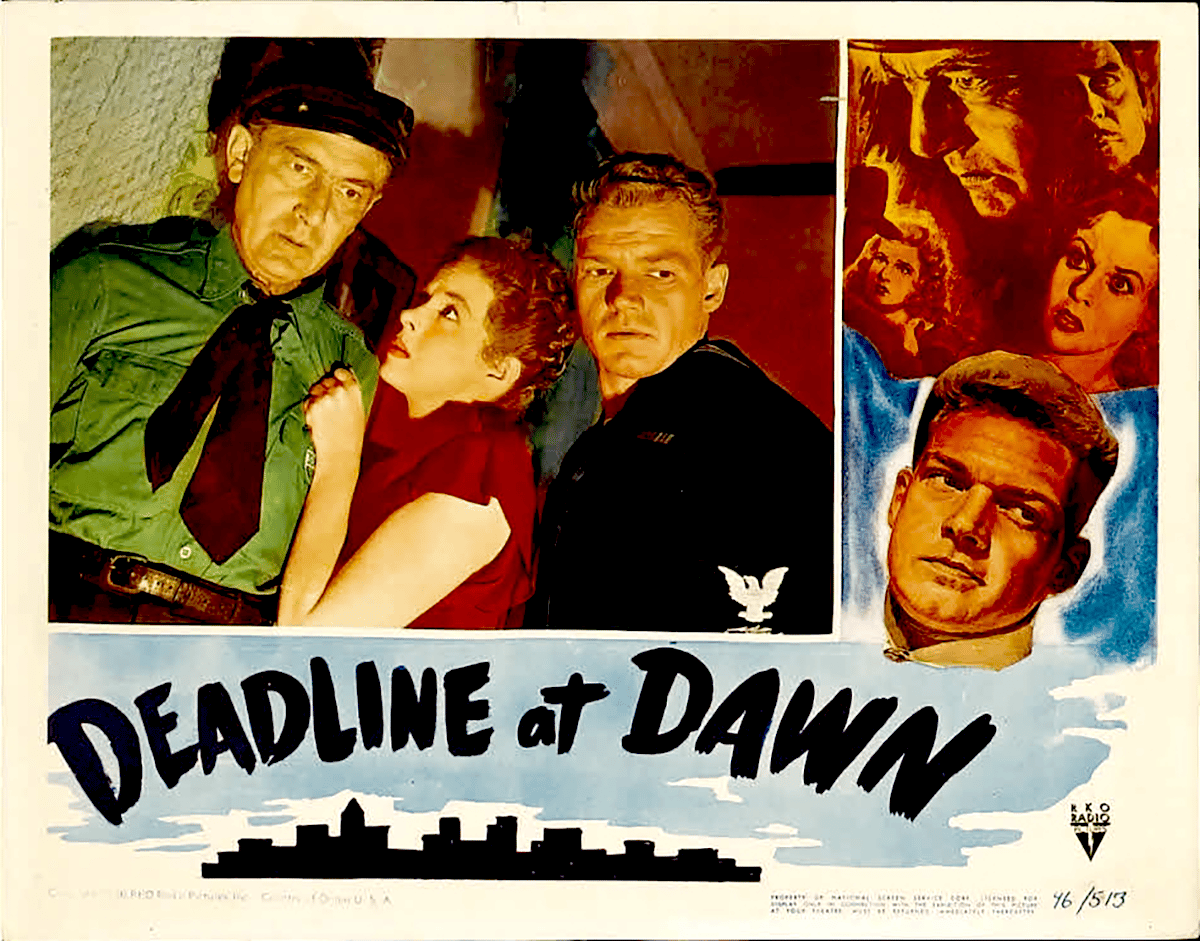
CABBIE GUS HOFFMAN (PAUL LUKAS), JUNE GOFFE, JUNE GOFFE (SUSAN HAYWARD), AND ALEX WINKLER (BILL WILLIAMS)
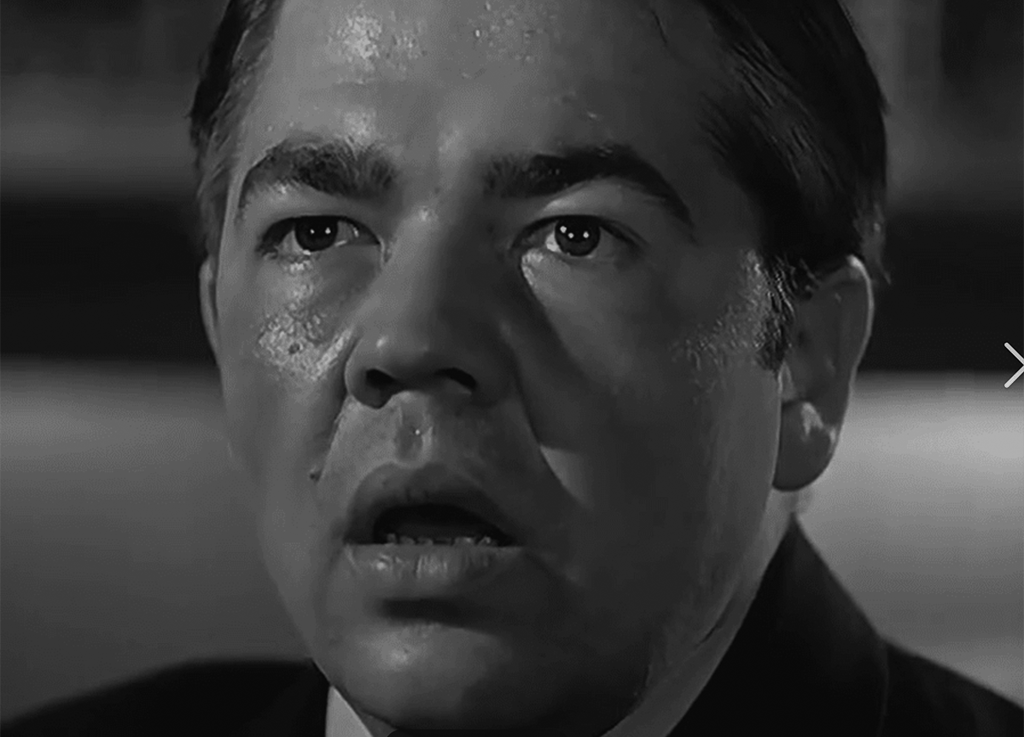
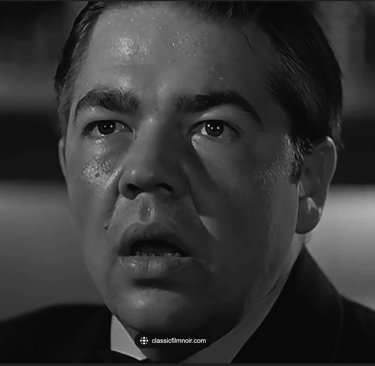
SLEEPY PARSONS (MARVIN MILLER) IS THROWN OFF-KILTER WHEN HE SMELLS EDNA'S PERFUME.
garysvehla509@gmail.com