
Bloody Horror: November
Ralph Kirchoff continues to examine modern horror, which should interest both today's and older genre fans.
HORROR/SCIENCE FICTION
written by Ralph Kirchoff
11/4/20257 min read
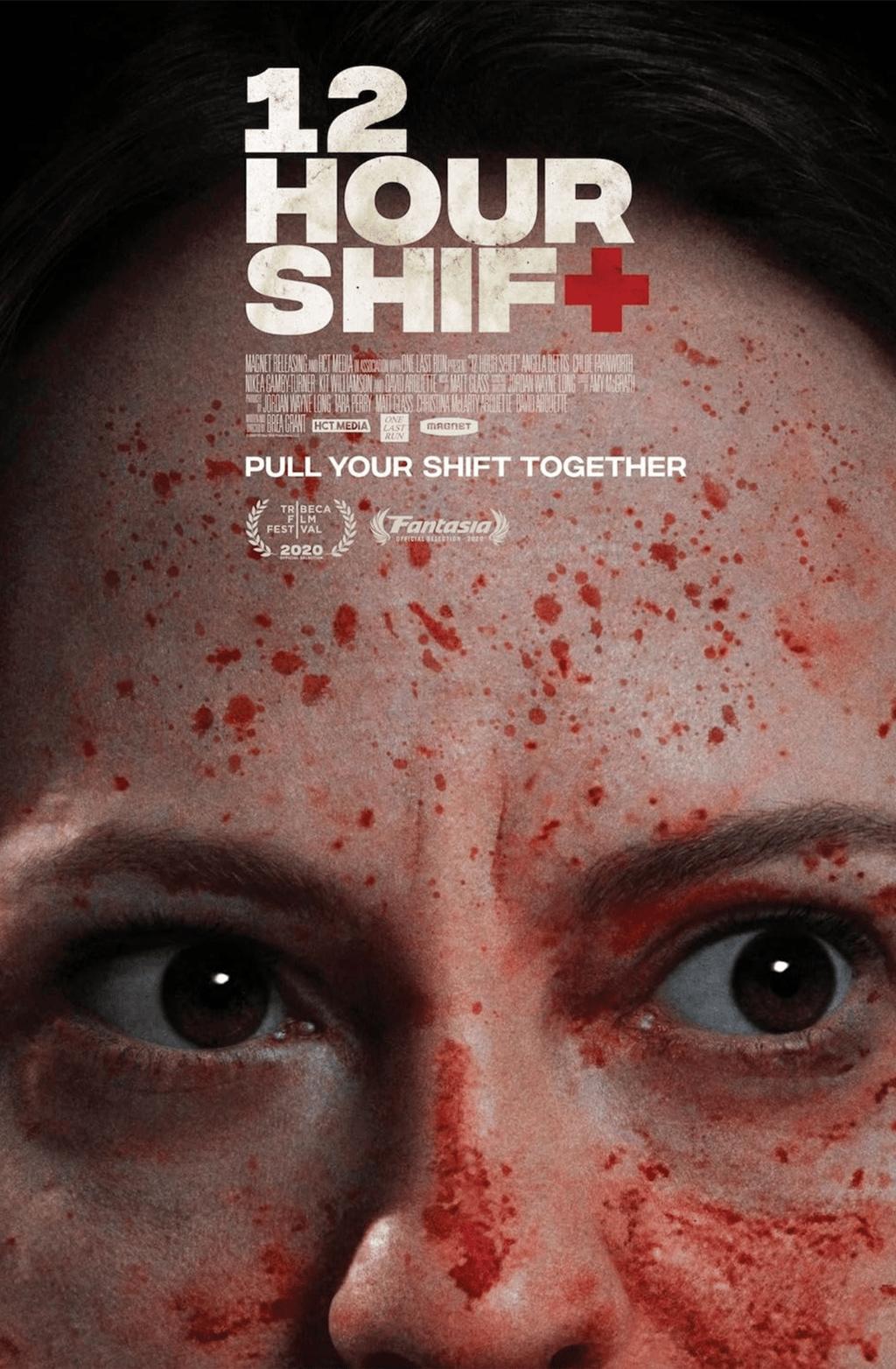
12 Hour Shift
Blood-soaked, female-led, hospital-based, organ-harvesting black comedy, 3.5 stars. 1HR 26MIN, HCT Media, 2020
As a TV and film actress, Brea Grant wanted more creative control in filmmaking. She “wanted to be involved earlier [in the process]” … “wanted to help shape those stories.” She wrote a number of comic book series and film scripts.
Her brother is a nurse, and while visiting her elderly father in the hospital, she observed the stress that nurses undergo. 1990s urban legends influenced her imagination. Raised in Texas, she remembered an urban legend about a kidney theft and a real-life story about a murderous nurse.
Let’s sum it up. Writer/director Grant’s 12 Hour Shift (2020), a female-centric black comedy about an organ-harvesting nurse, is a wild, blood-soaked, and fun ride.
Arkansas, 1999, and two nurses briefly chat, one about the long shift she just worked, the other, grizzled and cynical Mandy (Angela Bettis), will begin her long 12-hour hospital shift. The typeface title appears.
She walks toward the nurses’ station to start her shift and is immediately confronted by stereotypical characters, the gay hypochondriac, the pseudo bible-spouting black head nurse. This is ultimately a comedy after all. The head nurse directs Mandy to “get a Soda”; it’s code for picking up a freshly packaged pancreas and delivering it to its next link in the harvesting operation. Mandy’s own little drug sniffing problem explains her motivation. Ah, the joys of the age-old Burke and Hare service. But sometimes you might have to ‘prepare’ a donor.
We will meet Mandy’s dizzy, bumbling blonde cousin, Regina (Chloe Farnworth), who is the catalyst for all the ensuing mayhem. We also have patients and their family members pleading for information from dismissive nurses, distracted and easily misled cops, bossy hospital staff, and bullying criminals. At some point, the characters become sharp and aware of the devilish goings-on under the wire. Will they be effective in curtailing it?
It’s nice to see Angela Bettis. I haven’t seen her much since her stellar work in Lucky McKee’s May (2002). Speaking of McKee, fans can catch his director’s turn on the Poker Face season 2 episode, “The Taste of Human Blood.” It’s got John Sayles in a supporting role in a story about an out-of-control alligator. Given Sayles’ famous involvement in Lewis Teague’s fan favorite Alligator (1980), he had to be laughing all the way.
Okay, diversion over. Grant draws her two-dimensional characters talking with exaggerated East Texas accents. The actors do a good ‘not real’ job inhabiting this schtick. Bettis shines as she plans, manages, participates in, and reacts to the carnage. There are multiple sides to Mandy’s personality, and we can see the wheels turn as she navigates them.
Like most horror hospitals, the walls, hallways, and rooms are a pale, unhealthy-looking yellow. The film doesn’t have much drama, but low cellos play when there is a suggestion of one character’s wish for death. The blood and gore are reminiscent of the harvesting effects in the ‘Live Organ Transplants’ segment of Monty Python’s The Meaning of Life, … “Can we have your liver?”
As filmed, Grant’s script is complex, with many characters interacting. But she keeps it all coherent. I had the thought, “If the Marx brothers had made a horror movie …”
As yet, we haven’t screened it at our biweekly Bloody Horror Friday Club. I give it 3.5 out of 5 stars.
Caveat
Well-crafted low-key mystery thriller, Irish setting, 3.5 stars. 1HR 28MIN HyneSight Films, 2020
Damian McCarthy was influenced by classic chillers such as The Wicker Man (1973) and Rod Serling’s The Twilight Zone. Raised in Southwest Ireland, he aspired to build ideas that unnerved him into a film. Lensed in County Cork using claustrophobic sets and with classic horror tropes, writer/director McCarthy’s suspenseful thriller Caveat realizes this aim.
The film opens with a young woman, Olga (Leila Sykes), walking into a rustic wood-floored room. She holds out an old, dirty, fuzzy toy rabbit. The wind murmurs. She turns and walks in another direction, holding the toy out again. This time, the rabbit rattles on its toy drum. She walks further, now down the basement stairs. As she descends, the toy rabbit drums more steadily. Is it guiding her like some sort of supernatural Geiger counter?
She settles next to a wall, picks up a small knife, cuts a round hole, and peers through to the other side. We see nothing but black. McCarthy’s camera angle shows her from the other side, all blackness but a round circle of light with the young woman in the center. Terrific editing as the circle of light transitions to a glass portal on a front door. Isaac (Jonathan French) is knocking to come in.
Isaac enters and greets Moe Barrett (Ben Caplan), an old acquaintance who wants to hire Isaac to watch his niece, Olga, for a few days. There had been tragedy in their family—Olga’s father’s suicide and her mother’s disappearance—and Barrett just wants Isaac to “babysit” Olga, keep her company; that’s all. He will pay handsomely, and there shouldn’t be any difficulty. Isaac says, “There’s got to be more to it than that.” And with the timpani shot, the title appears in oddly angled letters … Caveat, and we get it. It’s fair to say that Isaac is being set up; of course, we don’t know what his peril will be.
We will experience people and animals chained, strange electronic signals and knocking, flashbacks and dreaming, and objects relocating on their own. Is it communication? A persistent, quiet rumbling creates an enveloping sense of suspense. Isaac is slowly encountering artifacts of a deathly mystery. Will he determine a solution, or succumb to its madness?
McCarthy’s photography is stunning, with lovely shots of the isolated island setting. The set of conflict is the house’s dark, dilapidated interior. Viewers can sense the mustiness, and McCarthy’s moving camera supports the claustrophobia.
Low, melancholy orchestra tones follow the characters. Foreshadowing danger, the tones become louder, more menacing. The characters are deeply drawn. The acting is totally believable. You will go along with every change.
Caveat is slow-moving, but the seams in the narrative and the qualities of the contributors make it worth watching. As yet, we haven’t screened it at our biweekly Bloody Horror Friday Club. I give it a solid 3.5 out of 5 stars.
Mandy
Dynamic revenge film, visually immersive, psychedelic soundtrack, 4 stars. 2HR 1Min SpectreVision, 2018
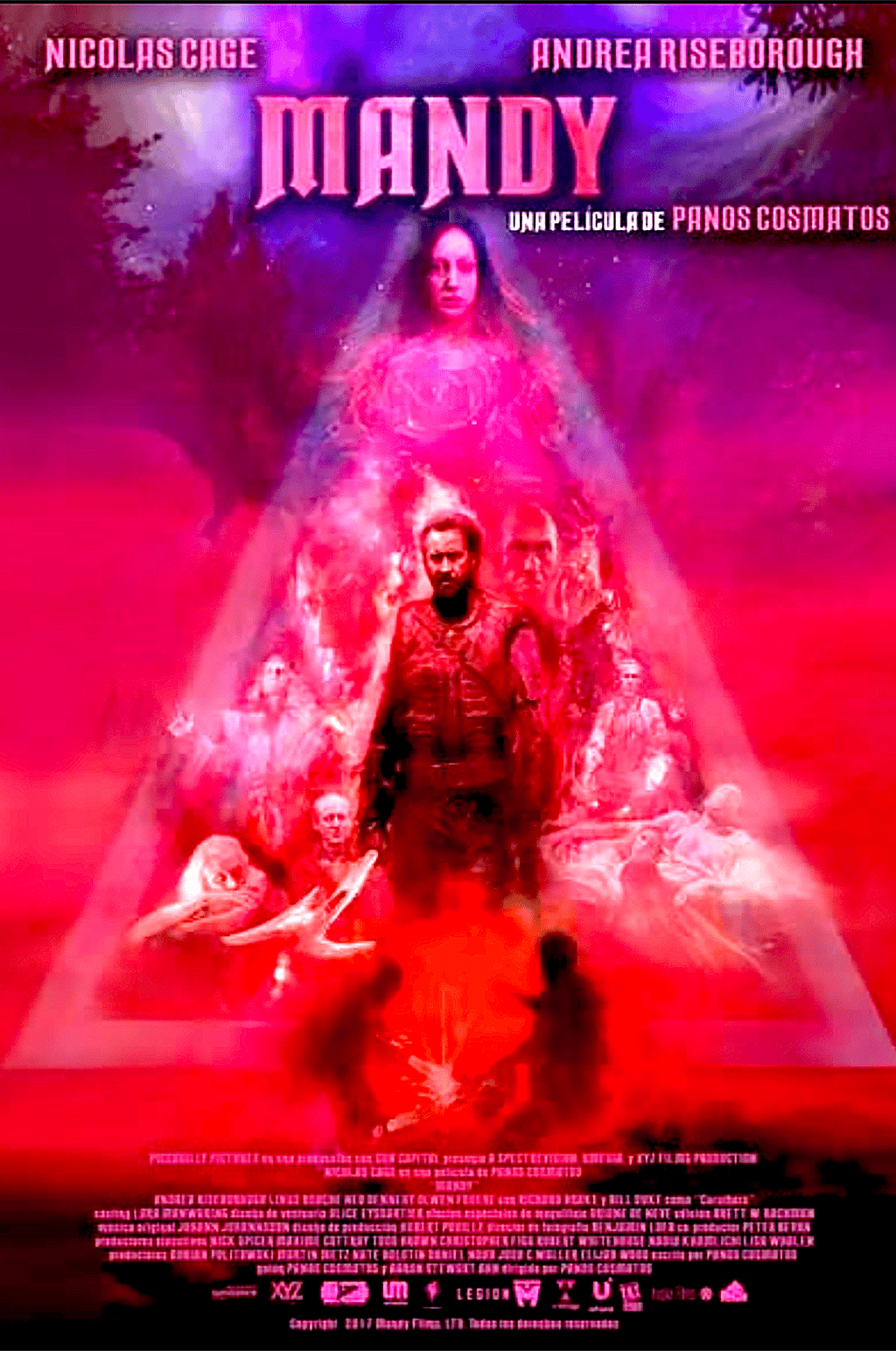
Nineteen Eighties fantasy and Barbarian movies were the films of Panos Cosmatos’ youth. He was influenced by the rudderless feeling of Lucio Fulci’s Conquest (1983) (… weren’t we all). In his grief from the loss of his father, he began writing the story for Mandy, and as a metalhead, he played his enormous heavy metal collection while writing. Incorporating pseudo-religious fanaticism and phantasmagorical visuals, Cosmatos’ Mandy (2018) is an extraordinary, good-versus-evil feast of color and sonics for the viewer.
The production and cast credits appear to contain distorted synth sounds. A wish to be rock and rolled after death poem scrolls, and the sound of a wild guitar array merges into the emblematic King Crimson track, “To Scenes of Red” (Nicolas Cage), a logger in a flannel shirt wearing a lumberjack crew. Work week over, he shakes his head ‘no’ when offered a pull on a whiskey flask. His wife, Mandy (Andrea Riseborough), is his whole world. He’s going home to her.
The music shifts to Eno-esque tones while paintings of coiled lovers slide across the screen. The paintings are Mandy’s works. It’s 1983, and as Red pulls up to his woodland home in the Shadow Mountains, we hear President Reagan’s discourse on the car radio about pornography and a spiritual awakening in America. Home now, Red jokes with Mandy, and she tells him about the intricacies of ancient peoples and planets, the subjects of her paintings. He is enrapt. The two are deeply in love, lying together, gazing into each other’s eyes. The starry night sky is filled with swirling, thick, red, smoky mist.
The next day, they fish in a small canoe on an icy blue lake. The red and yellow fire looms high as they camp that night. Their stares and the close-up camera work convey understanding and desire for each other.
Mandy is a sensitive creature. She walks the misty woods and cries as distant mellotrons play. There is considerably more of this New-Agey kind of exposition with plenty of lights and red colors in the skies and surroundings. Is carnage coming?
We next see wide-eyed Mandy walking a wooded path and wearing a Black Sabbath T-shirt. She is spotted by a passenger vehicle full of members of an evil pseudo-religious drug cult, Children of the New Dawn. Cosmatos uses blazing intertitles to identify dates, locations, and characters.
The cult's leader, Jeremiah (Linus Roache), instantly wants her. He speaks of ascension to his followers. And in subsequent scenes, he berates and bullies them into kidnapping her. Jeremiah needs Mandy for pleasure and to be another of his brides. Cosmatos uses red-gel-covered camera lenses in many scenes of villainy, sometimes against blue skies or backgrounds.
The kidnapping plan is enacted. The enigmatic movements of supporting characters and trancelike music create an almost Lynchian mood, but describing the lights, colors, and oddities doesn’t do justice. There are scenes of hallucinogenic drug-induced indoctrination of Mandy into the cult. I’m just going to say the attempts don’t go well.
The main thrust of the film is Red’s slow-burning, gritty revenge trip, featuring immersive visuals, camera movement, blood-soaked fury, and sound. The music in this film is terrific, and the acting is astonishing. Yes, it’s over-the-top, but these aren’t your average villains. In that Cage unreservedly inhabits his roles, it’s very much to his films’ benefit. Linus Roache’s perf warrants special mention, and it’s good to see Bill Duke in one of his final film roles.
Excellent flick, simple story, and everything about it is dynamic. As yet, we haven’t screened it at our biweekly Bloody Horror Friday Club.
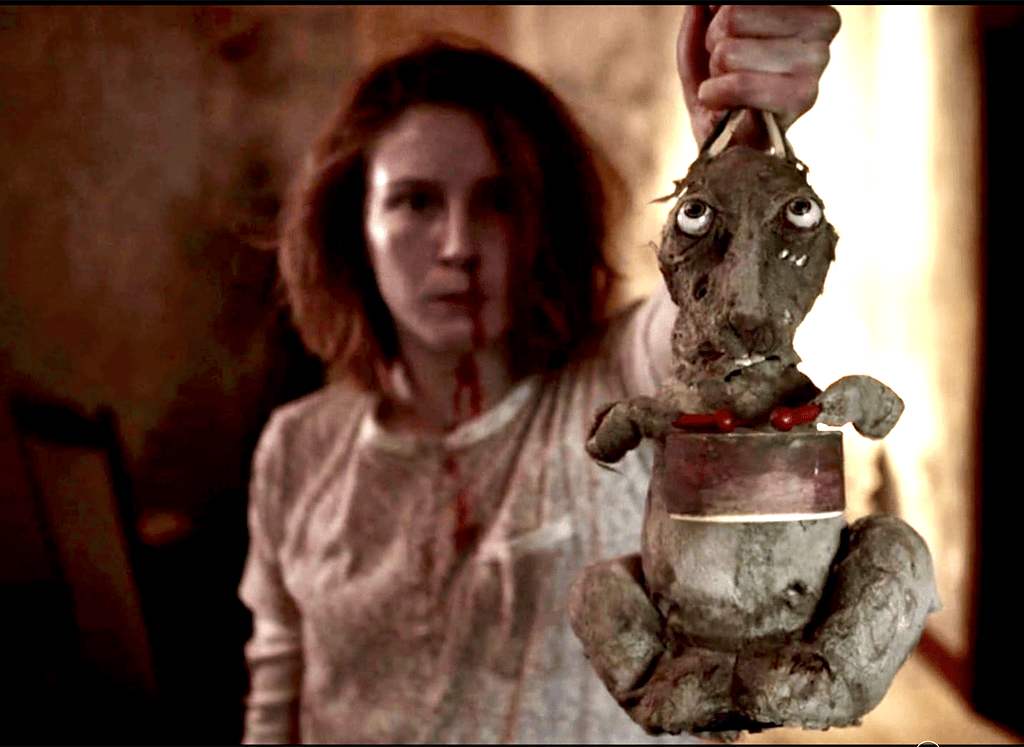
CAVEAT
MANDY
garysvehla509@gmail.com