Bloody Horror May
Critic Ralph Kirchoff continues to explore the complexities of the modern horror film.
HORROR/SCIENCE FICTION
written by Ralph Kirchoff
5/4/20267 min read
Ash
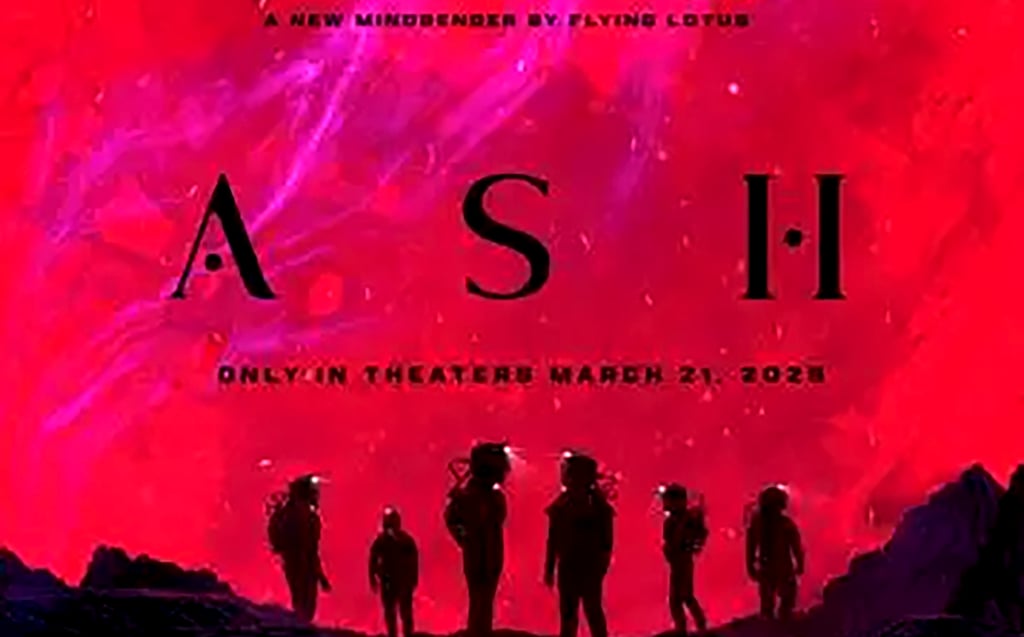
Very satisfying Sci-Fi, Bava's Planet of the Vampires–like concept, Ridley Scott look, excellent art direction and effects, 4.0 stars. 1HR 35MIN XYZ Films, 2025
Media maker and director Flying Lotus (Steven Ellison) was inspired by sci-fi films like Event Horizon and Ridley Scott’s Alien, by body-horror movies like David Cronenberg's, and by Japanese manga. He studied “How it was done” YouTube videos and learned to create CGI effects. His work as a record producer and his love for John Carpenter’s electronic scores contributed to his development of electronic and avant-garde jazz film music soundtracks. Wow, quite the exposure to now-classic sci-fi experiences, which FlyLo tapped into to craft his fantastic sci-fi film, Ash. This is a movie that sci-fi and horror fans should enjoy with enthusiasm (not pickled relish, just excitement). I’ll describe some of its qualities and setting details.
At the start of the film, we hear rising industrial music and see lights, plasma, and what looks like cosmic birth. FlyLo’s camera zooms out, revealing this chaos in the eyes of our protagonist, Riya (Eiza González). A viewer might think of the opening of Ridley Scott’s Blade Runner (1982), but this is a cosmic setting. We aren’t on Earth.
Riya’s face reflects terror, confusion, “What’s happening? Who am I?” and we see cascading images of gruesome, melting faces and broken bodies … Riya’s colleagues in space? It’s all in Riya’s mind as we hear an electronic voice, “abnormal activity detected.” We’re in tight quarters amid richly colored, but unfocused images of spaceship apparatus. Riya is waking after some kind of brutal event. There is detail in large proportion and a slowly revealed motive, but the entire plot of the film delves into the whys and wherefores of this one event … what is Riya waking from?
We see fleeting shots of blood on spaceship walls, disheveled equipment, and bloody bodies–the aftermath of battle. And we hear the female AI voice of the spaceship, “security system breach,” as Riya walks and tries to remember. In the set designs, apparatus, and spacesuits, viewers will readily see the influence of Ridley Scott’s Alien and his subsequent prequels. And later scenes, awash in color on the murky planet’s surface, are reminiscent of Mario Bava’s Planet of the Vampires (1965). But the accompanying industrial noise is all FlyLo, which creates a deeply mysterious atmosphere. Indeed, “What is happening?”
The film highlights Eiza González. After supporting roles in recent blockbuster sci-fi movies, the focus shifts to her character, Riya, who dominates every scene. González is an especially attractive actress, and she delivers a nuanced performance as her character’s emotional depth drives the story. Later in the film, we meet Brion, played by Aaron Paul, whose presence greatly enhances the story. He interacts perfectly, complementing González’s character as she reaches key plot points. I believe the rest of the cast is underused. Their characters appear and disappear, some in flashbacks, and they mostly serve as props to move the story forward. This is particularly disappointing, given that Iko Uwais shines in many other projects, but here he is reduced to wooden acting.
But the film’s main strength is its presentation. It’s about the sets, the colors, the lighting, stunning visuals, and the soundtrack (… and don’t worry, there is a beast. All great Sci-Fi films need at least one). I believe you will be impressed, enjoy FlyLo’s film, and come back for more. We gave it 4 out of 5 stars at our biweekly Bloody Horror Friday screenings.
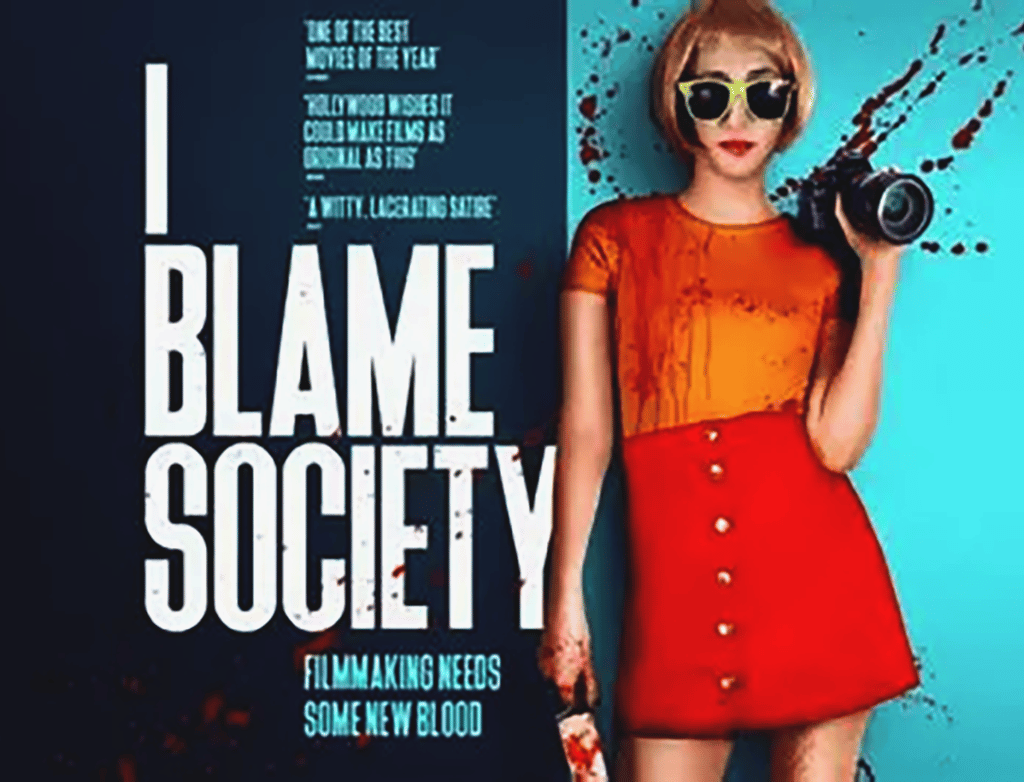
I Blame Society
Fun and really clever murder “mockumentary,” limited effects, indie feel, 3.5 stars. 1HR 24MIN Cranked Up Films, 2020
Several internet interviews reveal that after working on programming for film festivals, producing a documentary about Sam Fuller, and making films whenever she could, writer/director Gillian Horvat started making a short documentary called I, Murderer. Supportive friends joked that she would make a good murderer. The short remained unfinished because she faced the “hurdles of the [financial] powers that be” that challenged a female filmmaker’s vision. Her persistence led to a “narrative fiction feature” that earned Horvat her first directing credit. This tongue-in-cheek horror mockumentary, I Blame Society, reflects Horvat’s own experiences and is a highly entertaining romp. I will describe the setup and evaluate the film. Horvat plays the character “Gillian” (her real name) in the film. I will use “Gillian” to refer to the character and “Horvat” when discussing the filmmaker.
Two unseen people have a conversation about production credits; it’s Gillian and Chase. Gillian tells Chase that she’s filming the conversation and making a documentary because friends said she would make a good murderer. She describes how she would film a murder. Chase listens and finds it amusing until Gillian says that in her film, she would choose the murder victim to be his girlfriend. Gillian lists her girlfriend’s negative traits as reasons she would be a victim. Somebody has to be the victim, right? Chase stops being amused. The scene develops, and I leave it to the viewer to enjoy.
Gillian seems oddly off balance, somewhat emotionally needy, and assertive. In an independent film style, the dialogue throughout the movie appears improvised within a structured outline. This sense of spontaneity works well.
The story moves forward three years, and Gillian’s script for a different documentary is rejected by her manager during a humorous but cold video call. Gillian then returns to her I, Murderer project, filming interviews with several friends, relatives, and a TV writer. She begins to film herself narrating the details of her murder plots. As many actors do, Gillian starts to fully inhabit her role. She wears disguises, stalks potential victims, and breaks into their homes to surveil them. Meanwhile, some of the managers, producers, and “powers that be” she feels haven’t given her “permission” to make her movie might end up on her list of potential victims.
There is some diegetic music in the film, along with effective but subtly dramatic organ rock in the climactic scenes. The genuine inclusion of friends and family, combined with the shot-on-video storytelling, makes the film engaging. Horvat’s performance is committed and feels personal. The “script within a script” is well-filmed, and Horvat’s multiple cameras move to introduce characters and scenes. As Gillian delves deeper into her role as a murderer, the film's tone becomes increasingly unsettling, bolstered by limited special effects. There is enough blood and shock without overdoing it.
As it evolved for Horvat, the idea for I Blame Society is as clever as it gets. It’s simply outstanding work, and highly recommended. We haven't screened it at our biweekly Bloody Horror Friday Club yet. I rate it 3.5 out of 5 stars.
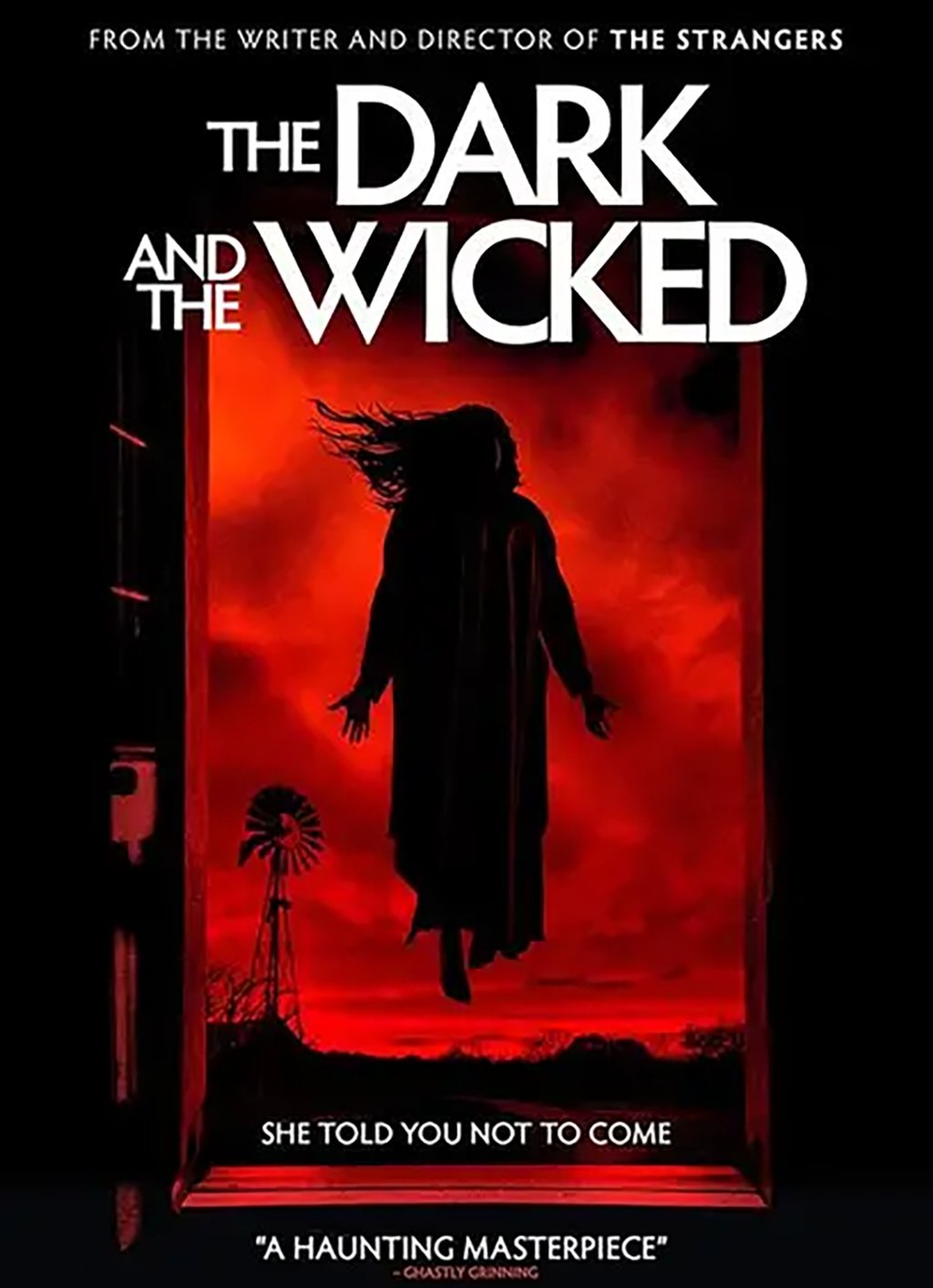
The Dark and the Wicked
Sinister mood setting not unlike When Evil Lurks, good off-kilter camera work, effective scares, 3.5 stars, 1HR 35MIN Unbroken Pictures, 2020
Writer/director Bryan Bertino aimed to convey the universal anxiety of losing a family member. He channeled the emotional pain of losing his parents into writing his horror film, The Dark and the Wicked. Shot on his family farm in Texas and incorporating supernatural elements, The Dark and the Wicked explores grief and guilt with a tense, fear-inducing tone. Progressing inevitably toward a doom-laden climax, it offers a compelling viewing experience. I will share some of the film's settings, plot, and qualities. Production credits appear over braying goats, a weather vane, and a chilly farmhouse interior. A mother (Julie Oliver-Touchstone) is alerted to the braying in the barn and moves to attend to the animals. The mood is quiet, but a low, distant murmuring pervades the stillness. As Bertino’s camera slowly closes in, a mysterious presence becomes apparent.
The mother comforts her bedridden, unresponsive husband. Suddenly, loud, disturbing noises emerge, and the animals watch anxiously. The saturated black-and-white title, The Dark and the Wicked, crashes onto the screen as a loud cello plays. An intertitle appears—Monday. Clearly, we’re about to follow a narrative spanning several days.
Twenty-something daughter Louise (Marin Ireland) arrives. Bertino’s camera lingers over hanging bells and the long-horned skeletal remains of goats. Louise and her brother Michael (Michael Abbott Jr.) are there to support their mother while their father is near death, but their mother repeatedly says to them, “I told you not to come.” A hospice nurse, Lynn Andrews, is also helping. Privately, the siblings discuss their mother's condition, and this conversation is ongoing. The remorse of not helping sooner and not doing more constantly haunts them. The mother insists that her children leave and go home. She doesn’t want them there. Is she demonstrating independence, or is she trying to protect them? Is there an evil that has befallen the farm and its people? Louise and Michael try to make sense of their mother’s wishes as demonic happenings begin to occur.
We (not the characters in the film) can see a human-like shadow in a doorway in the house. Bertino’s camera movements are at angles and often create the feeling that things are slightly off balance. The mother constantly gazes at doorways and sings little hymns to herself. Low, quiet orchestral tones fade in and out with the blowing wind. The signs of evil affliction are present.
The mother stands at a counter, delicately chopping carrots with her fingers exposed. She is affected, and we can predict some things. I don’t want to describe more, but this is a re-watchable film. So, I’ll reveal that someone will be found hanged. There are bloody deaths. We will hear the sounds and see the illusions, the personifications of evil. You will want to follow every thread.
Bertino’s camera is inviting, drawing the viewer’s attention to details in iron fences, hanging trinkets, woodland, and animal movements. He pans and angles, and I felt compelled to watch. The sound design is another highlight—subtle, somber, and eerie. I haven’t seen these actors before, but they feel so familiar, comfortable to be with—excellent ensemble work.
This is a recommended movie. We rated it 3.5 out of 5 stars during our biweekly Bloody Horror Friday screenings.
garysvehla509@gmail.com